

It’s important to take a moment to consider a detail about Kyle Busch’s early life that is often overlooked in favor of trophy counts and lap records. He was sitting in a Spring Valley, Nevada, classroom, turning in As and Bs because his mother insisted on it, before he became one of the most decorated drivers in NASCAR history.
That wasn’t a minor issue. Gaye Busch wasn’t being challenging. She was being pragmatic in her own way. Kyle needed to demonstrate that he was capable of handling more than a steering wheel if he wanted to compete. The agreement was straightforward: maintain high grades while continuing to race. The keys disappear if you drop them. That was all the inspiration he needed for a child who had been behind a go-kart since he was six years old.
It is noteworthy that he surpassed the standard rather than merely meeting it. Busch was an honors student at Durango High School in Spring Valley, where he consistently received both As and Bs. Then he accelerated instead of coasting toward a typical graduation date. In order to fully focus on his driving career, he graduated a full year ahead of schedule. At sixteen or seventeen, you don’t just happen to have that kind of clarity of purpose. It requires specific wiring.
There seems to be a tendency for people to distinguish between intellectual discipline and athletic ability, as if the two are rarely found in the same individual. Busch challenges that presumption. Just as he did on the track, he is willing to push through school more quickly than is necessary. He may have been the type of student who didn’t settle for merely passing because of the same competitive spirit that made him the leader in NASCAR’s all-time wins across the top three series.
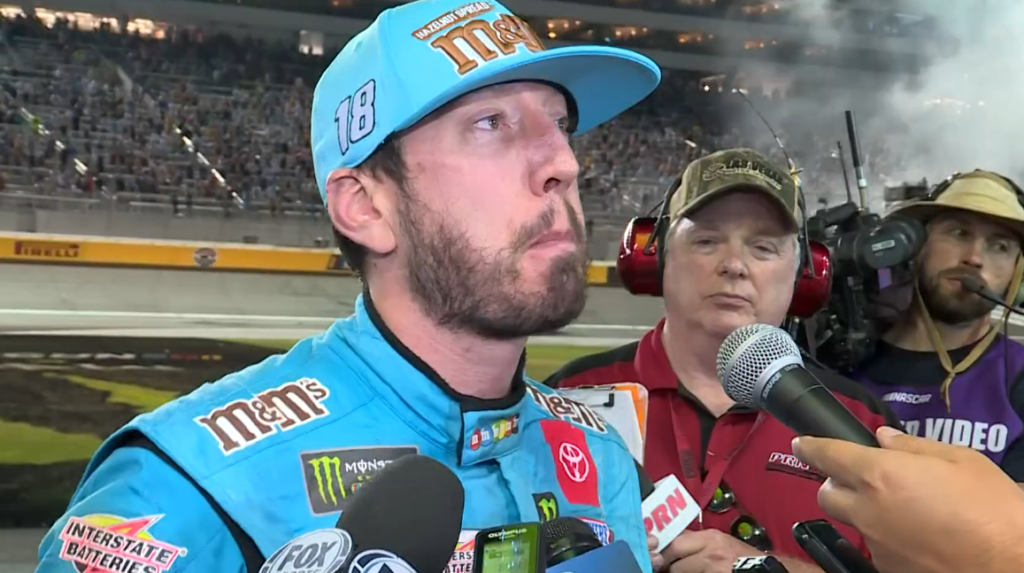
Years later, Busch appeared genuinely committed to preserving that link between ambition and education. In 2024, he returned to Durango High School as a guest rather than a student, collaborating with the international analytics company FICO to conduct workshops for students on financial literacy. The Score A Better Future Fundamentals program was created to close the knowledge gap between youth and the fundamental financial skills they would require as adults. Busch’s appearance at his former school for such an event was not a publicity gimmick, or at least it didn’t seem like one. He had earned the right to remind children that preparation is important when he stood in those hallways once more, in front of children who most likely had no idea what credit scores were.
He also directed that energy in other directions. In 2018, Busch officially opened the PALM Charter High School in South Carolina, a specialized school that combines vocational education with STEM. He had gone there to speak with students about striking a balance between a passion—motorsports in his case—and the academic foundation required to pursue it. It’s simple to write off that type of mentoring as ceremonial. However, it suggests something more intentional when a two-time Cup champion enters a school that most people are unaware of and talks to teenagers about how he got from a garage in Las Vegas to Victory Lane.
It’s difficult to ignore the fact that Busch’s relationship with education was subtly consistent for someone known as “Rowdy,” who had a career filled with fiery moments and aggressive passes. Early on, his mother drew a line. He was respectful of it. And somewhere in that discipline—the kind that allows you to win local go-kart championships and graduate from high school a year ahead of schedule—is likely what kept him competing at the top level for over 20 years.
It’s never clear if young people will take that message as intended. However, the attempt appears genuine enough when it is repeated over time and in different locations.
