

From the outside, Drake Stadium appears unremarkable on a May morning. The bleachers fill slowly, the concession stands smell like burnt coffee, and the grass outside the infield still has the distinctive green of a Midwest spring that isn’t quite ready to fade. However, something changes by the middle of the morning on the first day of the Iowa High School Track and Field Championships. Whatever was quiet about the place vanishes completely when the sound of a starter’s pistol pierces the atmosphere. This is the state. And for several hundred high school athletes from all over Iowa, this week has been the focus of everything they have done since January.
The Iowa Farm Bureau-sponsored 2026 Iowa High School Track and Field Championships will take place at Drake Stadium in Des Moines from May 21 to May 23. Participants will compete in four divisions: 1A, 2A, 3A, and 4A, as well as a Para division that merits much more attention than it usually receives. Every morning at 7:30, the gates open, and the schedule extends well into the evening. Relay preliminary competitions, field events, and hurdle heats are stacked in such a way that athletes are stretching anxiously in warm-up areas just out of sight of the main track and coaches are constantly checking their phones.
The team winners from the previous year provide some insight into Iowa’s program depth. Spirit Lake and Okoboji shared the 2A title, Lisbon held on in 1A, Ankeny won 4A, and Newton won 3A. The Wild Card division was won by Siouxland Christian. Lisbon and Riverside-Oakland are tied atop the early 1A girls scoring through the first day of this year’s meet, with Lake Mills following closely behind. This indicates the competitive balance in the smaller classifications, where a single strong relay team can swing a title. The 1A races seem to have the most condensed drama, the narrowest margins, and strangely high stakes for schools that most people couldn’t find on a map without squinting.
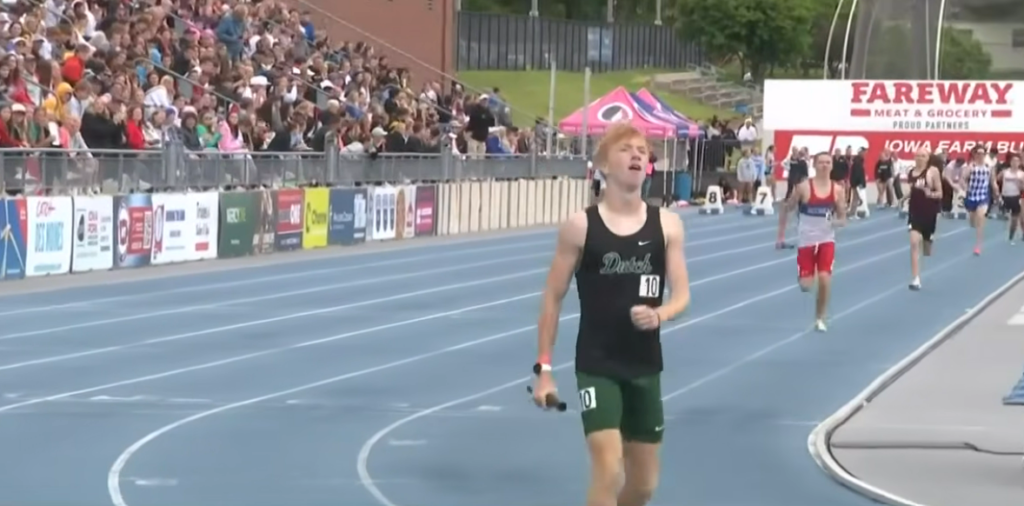
It’s difficult to pinpoint what makes the Iowa State Meet feel different from comparable gatherings in other states, but it has to do with the range. A 1A student from a town of 800 who runs because his school doesn’t have enough students to field a football team lines up on the same track as a 4A school from a Des Moines suburb that fields athletes who have been recruited and trained with collegiate ambition. They are both present. They are both in competition. Every now and then, the student from the small school runs a schedule that causes discomfort for the larger programs. At Drake, that occurs frequently enough to be a genuine expectation rather than a charming exception.
One of the more helpful things the IHSAA does for families who are unable to travel to Des Moines is a free livestream of all three days on its YouTube channel. The infrastructure is strong, with several announcers, real-time results via Wayzata Timing, and heat assignments updated throughout the day, though it’s still unclear if streaming numbers have increased significantly in recent years. The logistics are truly impressive for a meet this size, especially considering that the schedule runs events concurrently across field and track from early morning until evening.
It’s difficult to ignore how much Drake’s atmosphere is influenced by the families. The coaches move quickly. The officials move as efficiently as a clipboard. However, parents and classmates who traveled two or three hours from Decorah, Creston, or Harlan to witness someone they know run 400 meters in less than a minute are responsible for the place’s actual emotional texture and sound. The Iowa State Meet’s character is derived from that investment, which cannot be quantified by state rankings or athletic budgets. The outcomes will be made public. We’ll take note of the records. And a young man from a small town will breathe his first breath of the season somewhere in the infield.
