

The oldest area of Michigan State University’s campus feels almost purposefully slow when you stand on the north bank of the Red Cedar River on a chilly Michigan morning. Instead of being straight, the roads curve. The area feels like a forest that at some point decided to allow buildings among its roots due to the thickness of the trees. Beaumont Tower, a clock tower that marks the location of the first classroom building that no longer exists, rises above the site of the original College Hall. Despite its inability to preserve the tangible proof, the campus appears conscious of its own past.
When a Michigan governor signed the legislation establishing what was then known as the Agricultural College of the State of Michigan, Michigan State University was established in 1855. It arrived on a hillside close to Lansing before most people believed publicly funded agricultural education was a serious idea, and it was the nation’s first institution of its kind, seven years ahead of the Morrill Act. There were 63 male students and five faculty members when the first classes started in 1857. There weren’t many. Apparently, the ambition wasn’t.
What transpired over the ensuing 170 years tells the tale of an organization that continued to expand beyond its initial definition. Under President John Hannah’s aggressive expansion strategy, it transformed from an agricultural college to a state university by the middle of the 20th century, increasing enrollment from 15,000 in 1950 to 38,000 by 1965. With an endowment that has grown to about 4.6 billion dollars, MSU now enrolls over 51,000 students across 17 colleges and 400 areas of study. This amount would have been nearly unthinkable when the school was on the verge of dissolution in its early decades, and it has survived mainly because federal land-grant funding arrived just in time.
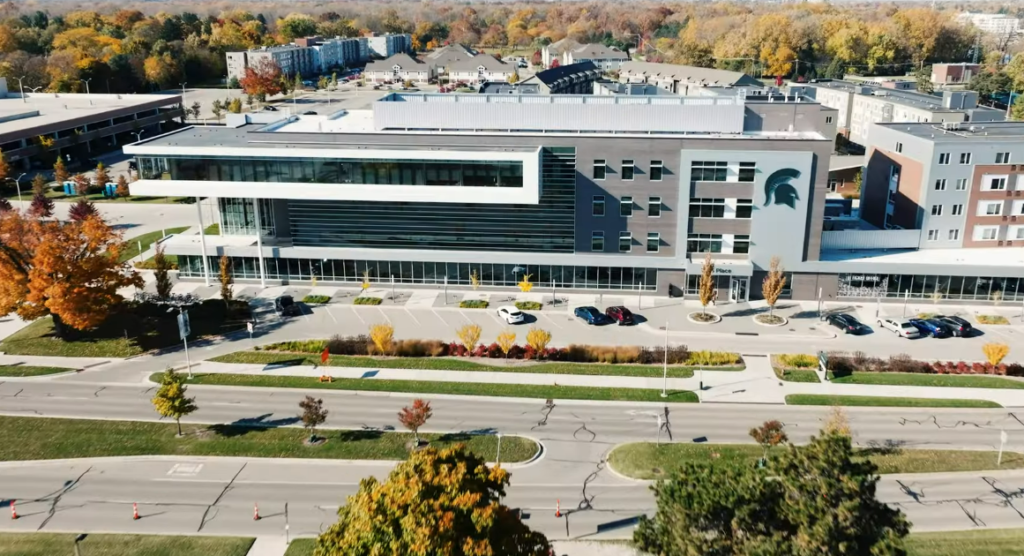
The campus itself is one of the biggest contiguous university campuses in the nation, spanning 5,200 acres in East Lansing. It has one of the biggest residence hall systems in the nation, a modern art museum created by Zaha Hadid, a botanical garden that has been in operation since the 19th century, and a particle accelerator. About 1,800 homes in Michigan could be powered by the energy produced by a solar carport array that covers 5,000 parking spaces. Over 26,000 acres of land throughout the state are owned by the university, including operational farms for sheep, cattle, horses, and poultry. In certain respects, it is still an agricultural college, but it also carries out research in nuclear physics and developed cisplatin, a cancer-fighting medication that is still in use today, in the 1960s.
The alumni list presents a different narrative. Before becoming one of the best point guards in NBA history, Magic Johnson played basketball for the Spartans while growing up in Lansing. Decades later, Draymond Green took a similar route. East Lansing was home to Kirk Gibson, Sam Raimi, and the founders of some of the most well-known businesses in the nation. Gretchen Whitmer, the governor of Michigan, graduated from this law school. It’s difficult to ignore how many of MSU’s notable alumni are from Michigan itself, as if the university serves as a kind of amplifier for the goals of the state.
That’s not to cover up the more difficult chapters. A 500 million dollar settlement and a period of difficult institutional reckoning that the university is still, by its own admission, going through were the results of the Larry Nassar scandal, in which a university doctor sexually assaulted hundreds of athletes and students over decades. Three students were killed in the 2023 campus shooting, which added another level of sorrow that a university community is rarely fully equipped to handle. Building survivor support programs, reorganizing accountability structures, and conducting climate surveys at MSU give the impression that those involved are sincerely trying, even though they are aware that once trust is broken, it takes years and not announcements to rebuild it.
As you stroll around that north campus, you get the impression that Michigan State is a place that is content to be undervalued and quietly determined to disprove those assessments. On a remote hillside, it began as a farm school. It survived near-dissolution, outlasted its detractors, and eventually constructed the Facility for Rare Isotope Beams, a particle accelerator that attracts researchers from all over the world. Spartans Will is the straightforward motto. That statement consistently proves to be true, whether it’s in research, athletics, or the arduous, slow process of institutional change.
