

You’ll notice something that doesn’t quite fit the definition of “education” when you walk into practically any good preschool classroom on a Tuesday morning. Some kids are using wooden blocks to construct unbalanced towers. Paint is all over the place, even on the elbow of a young boy who doesn’t seem to care. A plastic dinosaur is the subject of a loud negotiation between two girls in the corner. Additionally, if you can see her, the teacher is crouching next to a child and asking questions instead of responding. On the surface, it appears to be well-organized chaos. In actuality, it’s more akin to science.
For more than 200 years, those who support, discuss, and occasionally reject preschool education have misinterpreted it. It’s possible that no other learning stage is given as much importance and respect as this one. Children who participate in high-quality early childhood programs exhibit better social behavior, stronger cognitive abilities, and better results in later schooling, according to exceptionally clear research. By the third grade, these effects are still present. They make compounds. However, only about 40% of children between the ages of three and four are enrolled in any kind of early childhood education worldwide. We should be a little more ashamed of that number than we actually are.
Most people are unaware of the depth and age of this field’s philosophical foundations. Early 19th-century German educator Friedrich Froebel maintained that play was the best way to learn rather than a diversion. He created particular toys that he referred to as “gifts,” items that were intended to pique curiosity and encourage self-expression rather than provide an accurate response. At the time, his ideas seemed radical. They still do in many circles of education policy. There is an ongoing conflict between those who want to see four-year-olds tracing letters and counting to twenty and those who think preschool should lay emotional and social foundations. Data is in both camps. Neither is wholly incorrect.
Lev Vygotsky, a Russian psychologist whose theories became popular decades after his passing, had an especially interesting perspective on this. According to him, children learn best when they are just on the edge of their capabilities, where a task is just a little bit difficult but not impossible. When a teacher helps a child tie a shoe, they don’t do it for them; instead, they stand close by, provide just enough support, and then gradually move away. The concept is surprisingly straightforward. Additionally, it demands a level of care that is difficult to scale and simple to underfund. It is worthwhile to observe this strategy in action.
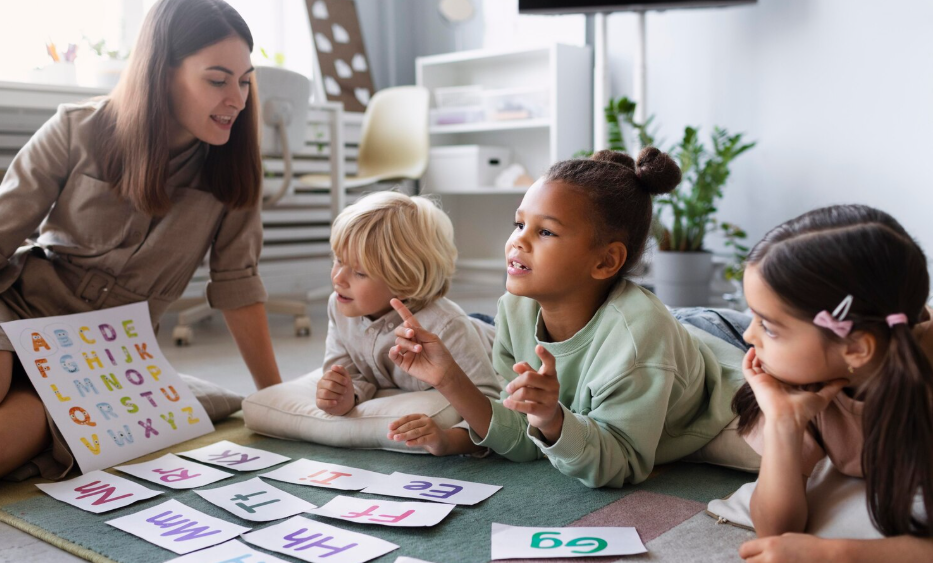
Maria Montessori approached the issue in a different way. She saw children in classrooms while working as a doctor in Rome in the early 1900s and came to the conclusion that true learning was driven by independence rather than instruction. In Montessori classrooms, ages are purposefully mixed so that younger students can learn from older students and older students can reinforce their knowledge through instruction. The surroundings are made to encourage exploration. It still sounds out of the ordinary. Nowadays, thousands of schools around the world use it, and almost every city with one has a waiting list.
The picture of policy is still extremely complex. Only roughly one in four children in sub-Saharan Africa receive any kind of early childhood education. The percentage rises to about two out of three in Latin America. Early childhood access has been identified by the UN as a goal worth pursuing. However, the question of whether preschool funding is necessary or optional is still being debated by local and federal legislators in many nations, including wealthier ones. It’s difficult to ignore the paradox: early education investments have some of the best-established economic returns in social science, but the programs themselves are still brittle, underfunded, and unevenly accessible.
According to Jean Piaget, children develop their own understanding of the world through experience and reflection rather than merely absorbing information. According to his framework, errors are data. A child learns something that a worksheet cannot impart by stacking blocks until they fall. Even if the adults in charge are unaware of Piaget’s name, this concept is fundamental to the majority of serious early education practices.
Spending any significant amount of time in this field gives one the impression that the adults discussing early childhood policy in conference rooms are frequently describing a different world than the one that is taking place on classroom floors. The evidence has been around for a while. The desire to fully and fairly address it is still developing.
