

When the purpose of old English buildings vanishes, a certain kind of silence descends upon them. It’s more like a held breath than a complete absence. Even though Stoke College is still in existence, you can still feel something of that quality when you stroll around its 34-acre campus in Stoke-by-Clare, on the Suffolk-Essex border. The walled gardens that Gertrude Jekyll once helped create, the Arts and Crafts wing with its subdued authority, and the flint walls all convey the unique gravity of a location that has held significance for a very long time.
The school will permanently close by the end of the summer of 2026. New schools will be required for about 200 students. Employees will require new roles. Additionally, a location that has been the center of academic or religious activity since 1124—when a Benedictine priory relocated from Clare Castle—will become silent for the first time in nine centuries.
That’s not exaggeration. The majority of England’s major institutions come after the priory. Under the patronage of the influential de Clare family, the medieval college established here in 1415 grew to become one of the richest monastic houses in Norman England. Before the Dissolution of the Monasteries in the 1540s, Matthew Parker served as this college’s final dean. Later, he was appointed Archbishop of Canterbury by Elizabeth I, one of the founders of the modern Church of England. No other school in England may be able to genuinely claim that particular historical thread that runs through its foundations.
After Henry VIII’s dissolution campaign cleared its buildings, the site went through several owners. Around 1660, the Elwes family bought it and built the main house and stables that still stand today, but they maintained the property in various states of disrepair. John Elwes, one of the members, was so infamously frugal that it is said that Charles Dickens modeled Ebenezer Scrooge after him. The fact that the same grounds are home to both the Archbishop of Canterbury and the inspiration for the most well-known miser in literature seems a little ridiculous, but that’s the kind of accumulated strangeness that comes with 900 years of continuous occupation.
The estate was acquired by Henry Loch, 1st Baron Loch, by 1897. In his characteristic Arts and Crafts style, he added a wing by bringing in Edwin Lutyens, the nephew of his wife. That wing still stands, and anyone who knows even a little bit about Lutyens—the architect behind many of England’s best country homes, the Cenotaph in Whitehall, and much of New Delhi—understands what it means to have his work woven into the fabric of a small Suffolk school. It’s not ornamentation. In the Suffolk countryside, its architectural history is serene and self-assured.
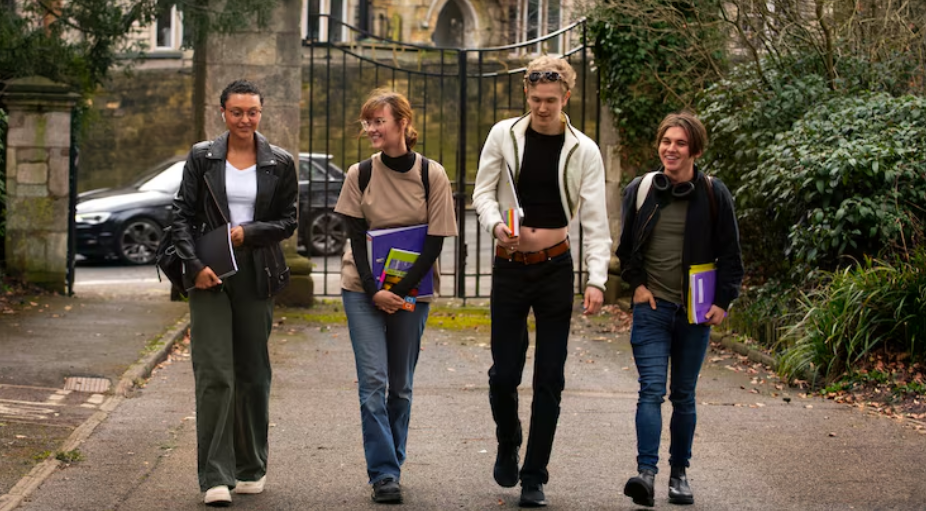
After the Loch family left the house due to postwar hardships, the school itself was established in 1954. In 1973, a small independent school moved in and changed its name to Stoke College. What came next was, by most accounts, a true success: a small coeducational day and boarding school for kids between the ages of 11 and 18 that produced results that comfortably exceeded its modest size and earned the house itself a Grade II* listed building designation in 1961. Two Year 13 students received offers from Oxbridge earlier this year: one for a highly competitive international medical position at Cambridge, and the other for mathematics at Oxford. The same cohort also received offers from Durham, King’s College London, UCL, and Veterinary Medicine. That’s an impressive academic profile for a school with 200 students.
The school is closing despite this. Although specific financial details have not been provided, the trend is common to small independent schools in England: growing expenses, demographic pressures, and a declining number of families who can afford the tuition. The announcement was “an incredibly sad day for everyone connected with Stoke College,” according to the current head, Mrs. Kim Terrar, who also noted that the decision was particularly painful because of the college’s “educational roots in the sixteenth century”. She has every right to feel that burden. This is more than just a school closing; it’s an institution with deeper roots than the majority of English universities losing its purpose.
It’s still really unclear what will happen to the site itself. A Grade II* listed home, Jekyll-inspired gardens, a Lutyens wing, and almost a millennium of multi-layered history don’t easily disappear, but they also don’t sustain themselves. It’s difficult to ignore the fact that the structures that withstood the Reformation, two world wars, and the declining fortunes of the Loch family may now be facing their most uncertain chapter because, in the 2020s, the economics of a small independent school became unfeasible. That has a darkly humorous quality, as is often the case with English history.
In Suffolk, the final day of the summer 2026 term will go by like any other. However, nine centuries of prayers, teachings, disagreements, and aspirations will silently conclude their stories somewhere in that silence.
