

You can almost picture the moment when a student in a design class just stares at the brief and hovers their pencil over it, waiting for inspiration to strike like a bus that’s a little late. The University of Cambridge started to ask, in a serious and quiet way, if that blank stare might have less to do with intelligence or effort and more to do with empathy, a skill that most schools have never taken the time to teach properly.
It’s hard to ignore what they found in their year-long study. At the end of the school year, students at an inner-London school who were taught to actively engage with the emotional and lived experiences of others scored 78% higher on creativity tests than a similar group of students who followed a standard curriculum. The standard group had been scoring 11% higher at the beginning of that same year. That’s not a small change. That is the opposite.
As part of a Cambridge project called “Designing Our Tomorrow,” the study was led by Dr. Helen Demetriou, an expert in learning through empathy, and Bill Nicholl, a senior lecturer in design and technology education. The assignment they gave students sounds easy, but it’s not: make an asthma treatment pack for kids younger than six. But the way they went about it was not like anyone else. The kids saw a video of a little kid having an asthma attack. They breathed through straws to make it feel like they were having trouble breathing. They played parents, grandparents, medical staff, and other people whose lives might have something to do with the condition. He said that by the end of the project, he could really feel bad for kids who have asthma. He told the researchers, “If I were a kid using an inhaler, I would be scared too.”
The idea that emotional education should be kept separate from academic work may have been wrong from the start, even if the people who thought of it meant well. In many schools, social and emotional learning has grown into its own walled garden, where kids can talk about their feelings before getting to the “real” work. There is evidence that Nicholl and Demetriou aren’t meant to be apart at all, which they may have found by accident or on purpose. Demetriou says that empathy is a form of creativity in and of itself. Both use your imagination. To do either one, you have to put aside your own views and build something in the space where someone else lives.
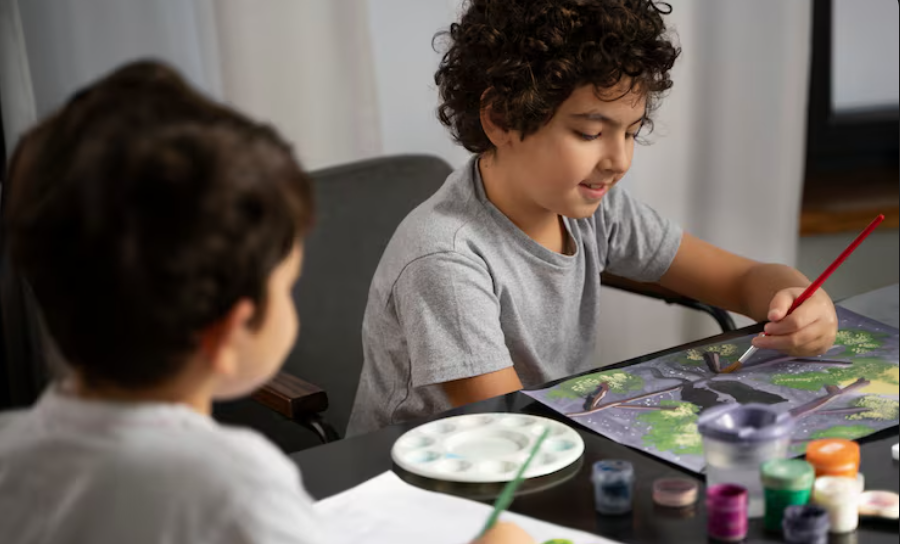
The gender results add something else to think about. Over the course of a year, the boys in the intervention group got 64% better at showing how they felt. Cognitive empathy, which means seeing things from someone else’s point of view and reasoning from their point of view, went up by 62% in girls. These aren’t small changes in the numbers. They say that structured empathy work might quietly take down some of the learning barriers that gender roles have been building up for years. Boys are often told, in subtle and not-so-subtle ways, not to show how they feel at school. That changed here. That’s hard not to think is important.
The winning student design, a pack with a monkey theme and materials that smell like bananas, is said to be being looked at by the National Health Service in the UK. Which is an amazing result in and of itself. When 13 and 14-year-olds were asked to “feel their way” into a problem, they came up with something that a national health system thought was important to look into further.
Nicholl pointed out that empathy has been a part of England’s Design and Technology national curriculum for more than 20 years, but it has been hard to find a structured, useful way to teach it. From this study, it looks like it doesn’t have to be. The Torrance Test of Creative Thinking, a well-known psychometric tool, was used to measure creativity. This gives the results methodological weight that classroom observations rarely have.
A lot is still not clear. It’s still not clear if these results would hold true for different subjects, age groups, or school settings. The study only looked at a few schools, and expanding any kind of educational intervention is notoriously hard. But it’s hard to argue with the direction of the found. Teaching kids empathy makes them more creative, and if that can be done on a large scale, it might be one of the best things schools learn how to do.
