

There are conferences where things are felt and conferences where things are said. The majority of international education events fit neatly into the first category, with well-meaning panels, meticulously gathered data, and courteous but fleeting applause. What transpired at one specific OMEP International Conference session was completely different.
It was a mid-sized room with flickering projector light and stackable chairs. Coffee cups in hand, half-distracted, researchers and policy delegates had been riding in and out all morning. Then a teacher from an Indigenous community, a woman who had taught kids whose mother tongue wasn’t the one used in their textbooks for fifteen years, started to speak. She didn’t start off with data. She began with a drawing by a young child. A tiny figure is seen looking inside a school building while standing outside with their arms by their sides.
Three previous presentations were unable to accomplish what that image did when it was displayed on a screen in a conference room. The room became quieter in a different way as a result.
The OMEP framework has long maintained that children are people now, deserving of a voice, dignity, and real involvement in their own education, not future citizens to be prepared. The origins of this philosophy can be traced to Janusz Korczak, a Polish educator and pediatrician who argued that children’s inner lives mattered and their words deserved serious attention decades before anyone thought to write it into international law. In July 2026, Poznań will host the 78th OMEP World Assembly and Conference, which will urgently revisit that legacy. However, there was no abstract discussion of his ideas during that earlier session. The room was unprepared for their arrival, and they were entering it via a true story.
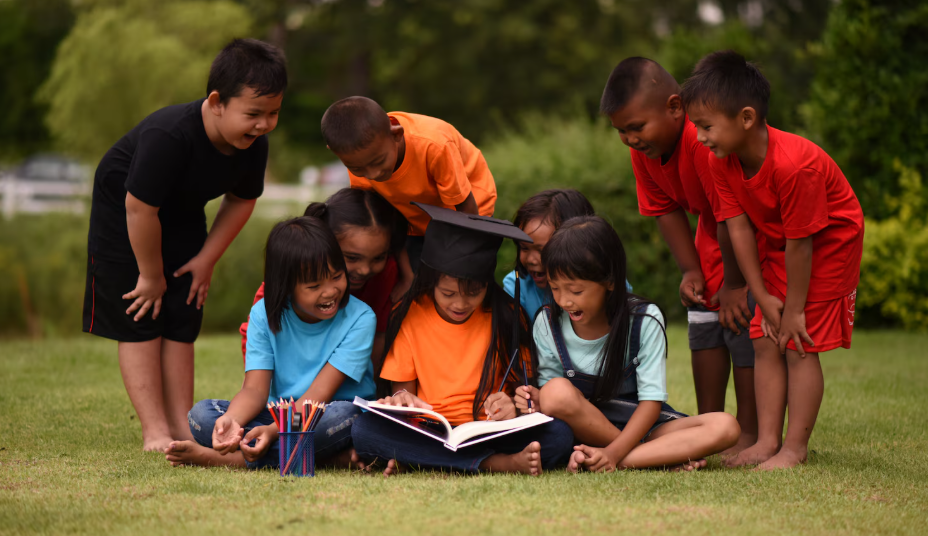
The teacher described a system that was subtly erasing something rather than one that was flawed by bureaucratic standards. Kids showing up at school and leaving copies of themselves at the door. languages that are not used. songs that are not performed. The knowledge of grandmothers is regarded as unrelated to the curriculum. She wasn’t yelling. It was nearly more difficult to listen to as a result.
The majority of people in that room were already familiar with the research on Indigenous early education, so it’s possible that the information itself wasn’t what moved them. The cumulative weight of it being stated bluntly and without apology in a setting that was meant to be caring was what moved them. Realizing that knowing something is not the same as actually taking action about it can cause a specific type of grief.
After leaving the meeting, a government education official—possibly from a nation whose Indigenous language policies had drawn criticism—returned with a colleague. What transpired in the hallway was not captured on tape. Several attendees reported that a formal review of early childhood curriculum policy was discreetly started within weeks of the conference. It’s correlation rather than causation. Maybe. However, something changed.
This kind of possibility—that interdisciplinary, cross-cultural communication between educators, researchers, families, and policymakers can yield results that academic papers alone cannot—is the foundation of the OMEP conference model. Under its thematic framework, which explicitly positions educators as human rights defenders and advocates for educational systems that address cultural, linguistic, and identity disparities from an early age, the upcoming Poznań gathering will delve deeper into these issues.
That session—the one with the drawing, the quiet voice, the suddenly attentive room—showed that sometimes the most significant discussions about children’s education start with a single picture of a child waiting outside a door to be admitted on their own terms rather than with a proposed policy.
The moment would have been recognizable to Korczak. He devoted his entire life to the argument that it is not polite to listen to children. It’s a duty. And occasionally, even governments remember that when the right person tells the right truth in the right place.
