

According to most accounts, Walton Goggins had modest expectations growing up in Lithia Springs, Georgia, a peaceful suburb located just west of Atlanta. After graduating from Lithia Springs High School, he enrolled at Georgia Southern University, where he spent precisely one year before concluding that the classroom would not help him achieve his goals. Even at nineteen, he might have sensed something about himself that formal education hadn’t quite figured out how to quantify.
He relocated to Los Angeles after leaving Georgia Southern. He had no degree, no industry contacts, and no real plan other than the attraction of something he was still unable to fully express. He was employed at LA Fitness. As a valet, he parked cars. He attended acting classes and went to auditions in between. Almost all working actors are familiar with this particular mix of quiet ambition and hard work, even though they hardly ever discuss it in interviews.
Looking back, it’s amazing how little of it resembled a conventional path. Goggins did not come from a film school with a well-known alumni list or a prestigious drama conservatory. Growing up, he received his education in a variety of unconventional settings, such as laundromats, porches where adults would converse for hours on end without anyone interrupting because the stories were always interesting, and honky-tonks where his mother would take him when she couldn’t find a babysitter. His instincts as a performer seem to have been shaped much more by those rooms and those people than by any formal education.
Raising him mostly by herself, his mother moved between different houses and neighborhoods, never settling down because she didn’t really need to. Goggins has compared his upbringing to being raised by a village, complete with aunts, his grandmother, his mother’s friends, and an uncle and aunt who performed in regional theater throughout the South. He observed them cleaning a room. He discovered what it meant to maintain focus without making demands. You don’t learn that skill in a lecture hall.
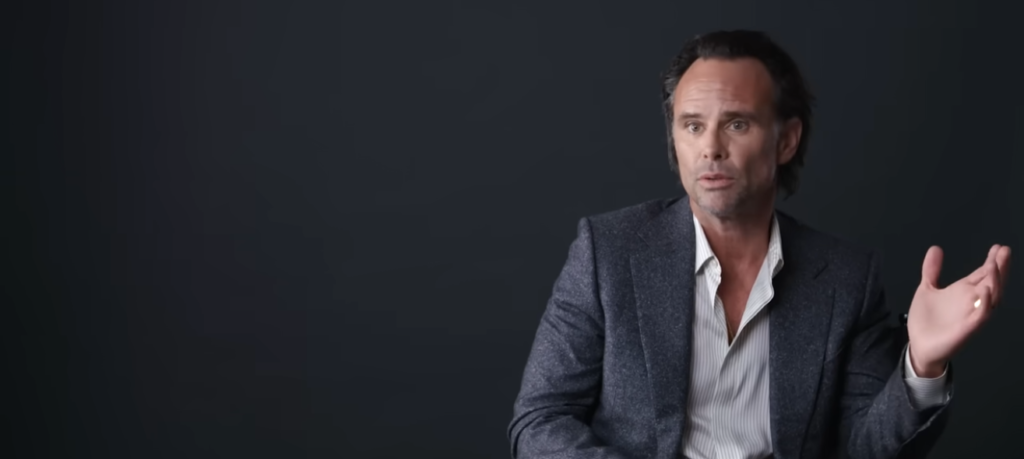
The FX crime drama The Shield, which debuted in 2002, was his big break, if you will. He portrayed the morally dubious detective Shane Vendrell, whose six-season storyline is still regarded as some of the most graphic television of the time. Although it’s still unclear if viewers realized how difficult that role was technically at the time, critics did. Eventually, critic Mike Hale of the New York Times wrote that Goggins has a tendency to be the highlight of any show he appears in. It takes more than charm to establish that kind of reputation. It is the result of years of labor, craft, and meticulous attention to detail.
Goggins had already spent more than ten years creating something by the time Justified debuted in 2010 and he turned Boyd Crowder from a character who was literally destined to die in the pilot into one of television’s most memorable antiheroes. In 2001, his production company, Ginny Mule Pictures, co-produced The Accountant, a short film that won an Academy Award. He wasn’t merely a performer who was waiting for a call. Without the support that a formal arts education might have offered, he was building his career from the ground up.
It’s difficult to ignore how his upbringing continued to influence the kinds of roles he prefers: Southern men, complex men, and men with unspoken secrets. Fallout, Django Unchained, The Hateful Eight. Every role has a lived specificity that is more akin to recognition than performance.
Walton Goggins is most likely not mentioned in any marketing materials by Georgia Southern University’s admissions office. He left quietly and without ceremony after spending a year there. However, it is evident from what followed—the Emmy nominations, the cultural moments, the Super Bowl commercial, and the sold-out seasons of The White Lotus—that his true education was always going to take place somewhere else.
