

On the University of Washington campus in Seattle, a bronze W is covered in a purple sash this week. It is situated beside Denny Hall and the older stone structures that date back before anyone alive can remember, along a path that thousands of students walk every day. It’s merely a feature of the landscape on most mornings. It feels like something else right now, a silent marker in the middle of a campus that is clearly and imperfectly attempting to hold a lot of things at once.
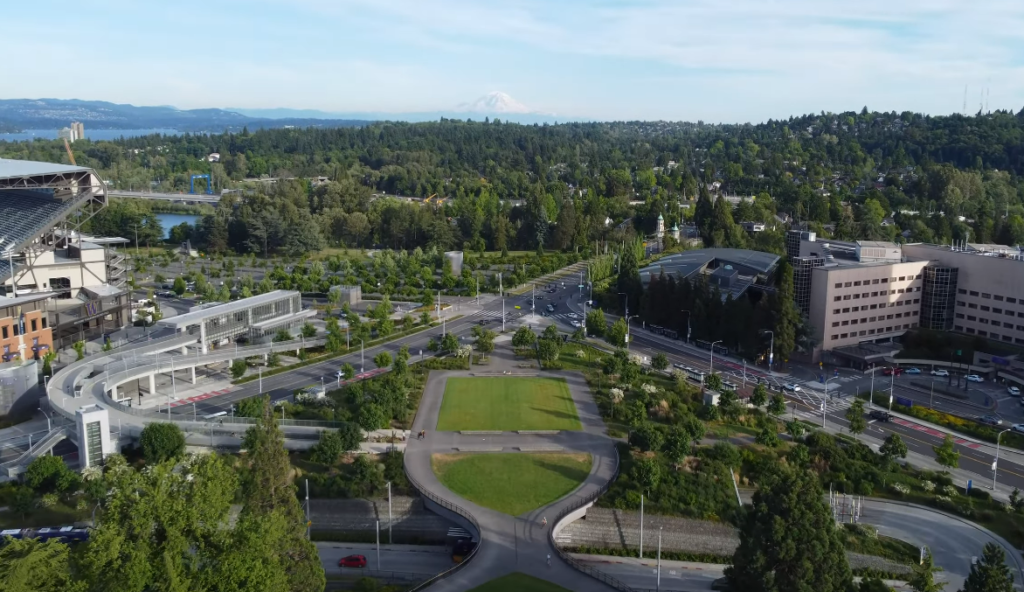
One of the oldest universities on the West Coast, the UW was founded in 1861 and is situated on 807 acres next to Lake Washington. On clear days, the skyline view still takes people by surprise. It is one of the biggest public research universities in the nation, with about 51,700 students spread across its main campus in Seattle and two satellite campuses in Bothell and Tacoma. Ranked 16th among public schools and 42nd nationally by U.S. News, it has a solid reputation in scientific research, engineering, and medicine. The endowment is currently close to $6 billion. According to reports, 70% of UW seniors graduate with no known debt, which is truly exceptional and worth considering. The brochure writes itself because of these kinds of numbers.
However, the brochure version of UW seemed especially far away this week. In the laundry room of Nordheim Court, a privately run off-campus housing complex connected to the university, a 19-year-old transgender student was discovered fatally stabbed on May 10. Within days, 31-year-old Christopher Michael Leahy, a suspect, surrendered to Bellevue police. Since then, murder charges have been brought. The memorial that appeared next to a campus sculpture was addressed to an unidentified person because the student’s name had not yet been officially disclosed as of this writing, pending family notification. Among the flowers was a handwritten note that was drenched from the rain and said, “I miss you, did we have class? Did we ever cross paths? I miss you. It’s the kind of information that sticks in your memory.
Almost immediately, the university’s response was criticized. Some students, especially trans students, felt that President Robert Jones’ descriptions of the murder as a “tragic death” and a “devastating act of violence” were purposefully ambiguous. In an interview with The Daily, the student newspaper, transgender UW senior Zahmiya James stated unequivocally that it was murder and that the messaging needed to reflect that. “A Band-Aid pat on the back,” she described it. Listening to those students gives me the impression that the administration’s tendency toward cautious, measured language went awry at a time when the community needed something more straightforward. It is difficult to determine whether that is a valid criticism or just the nature of institutional communications during an ongoing investigation. Most likely a combination of the two.
The fact that the UW is located in a city that has long seen itself as a haven for LGBTQ+ communities, especially for trans people escaping less accepting locations across the nation, makes the situation feel genuinely complicated, not just tragic. In a statement, Seattle Councilmember Alexis Mercedes Rinck stated that the city must truly operate as the safe haven it purports to be. Institutions like the UW, which bear the burden of the city’s self-image in addition to their own, are truly under pressure from this expectation.
It’s difficult to ignore the fact that there were moments of genuine hope in addition to the sadness during the same week. Nobel Prize winner Mary E. Brunkow, Class of ’83, will speak to graduates at the 151st Commencement in June at Husky Stadium, according to a UW announcement. On May 16, students from the MESH fashion club presented their fifth annual runway show. Undergraduates enrolled in an astronomy program traveled to Hawaii to study astrophysics and Native star navigation. Children wearing t-shirts that read “In my future, I will be _” were brought to campus for a day by a UW alumnus named Luis Carmona. Many of the children had never been to Seattle or a college campus before.
A university is always all of these things at once. The rankings, the fashion shows, the scientific discoveries, the laundry room where a horrible incident occurred, and the wet notes that have no idea to whom they are addressed. For 165 years, the UW has been managing that conflict. It is currently navigating it under pressure and in public, and the outcome is still unknown.
