

You see the same things when you enter practically any low-income pre-primary classroom, whether it’s in rural Mississippi, Karachi, or Nairobi. rooms that are packed. One weary teacher overseeing fifteen pupils. There are no books on the shelves. A cracked chalkboard, perhaps. And kids, who have no idea about any of this, are merely attempting to make sense of their surroundings. It’s difficult to avoid the impression that societies’ priorities in recent years have been fundamentally flawed.
Right now, there isn’t much debate about the science. The human brain develops at a rate that will never be matched again during the first eight years of life, especially the first three. Neural connections develop quickly, patterns emerge, and the emotional architecture that will influence an individual’s entire adult life starts to subtly and silently take shape. When provided carefully and with true quality, early childhood care and education can anchor a child’s development in ways that carry over into adolescence, the workforce, and even physical health decades later.
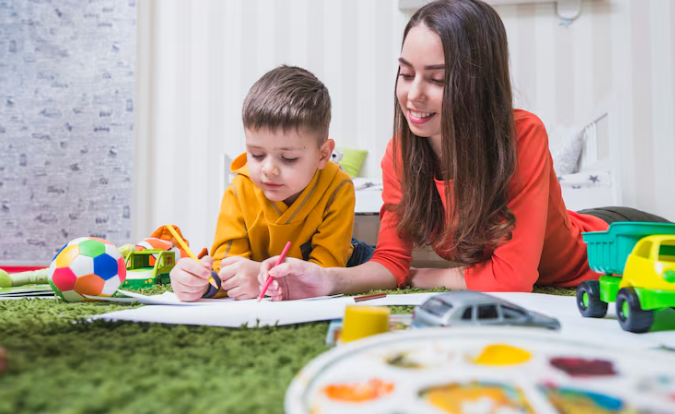
Children who had attended full-time, high-quality early childhood programs were followed up until the age of thirty in one randomized controlled trial. When compared to peers who had not attended, they then displayed lower rates of heart disease risk factors, such as improved blood pressure and fewer risky behaviors. It is not a marginal result. That’s a sign that, thirty years later, what takes place in a kindergarten classroom can reverberate in a hospital waiting room. To be honest, it’s still unclear if policymakers fully understand that connection.
The state of the world demonstrates a specific type of neglect disguised as courteous inaction. Globally, about 30% of children are not developing normally. Just 55% of children from the poorest households are developmentally on track, compared to 78% of children from wealthier homes. Many of these kids have never held a picture book or had a thought-provoking toy. According to UNESCO, it would take about $354 billion by 2030 to close the pre-primary education gap in low- and middle-income countries alone. The current global median spending rate is 0.4% of GDP. It’s uncomfortable math.
Observing this from the outside gives the impression that early childhood education and care are given a low priority, something that governments publicly acknowledge in speeches but covertly overlook in budgets. This is partly due to the extended return horizon. Election cycles, not thirty-year cognitive outcome studies, are how politicians react. It partially reflects the ingrained cultural belief that early childcare is a family issue rather than a state one. For children born into families that are least able to make up for it, that assumption has proven to be extremely costly.
Young children are not waiting to become learners, according to the pedagogical frameworks that have guided serious early childhood work, such as Montessori’s emphasis on independence, Froebel’s conviction that play is authentic intellectual work, and Reggio Emilia’s insistence that children are capable and curious rather than empty vessels. They are already. The sad thing is that contemporary educational systems frequently act as though learning starts as soon as a child sits at a desk in elementary school, as though the preceding five years were only a warm-up.
It turns out that quality is crucial. Research on large-scale early childhood rollouts with inconsistent quality has yielded conflicting or unclear findings. If you take away any one of these factors—trained caregivers, low teacher-to-child ratios, family involvement, and child-centered instruction—the results become less significant. Ten children per staff member is the ratio in some regions of Europe and Central Asia. That number makes it difficult for anyone to give a three-year-old who is struggling with something genuine attention or responsiveness.
The world has known for decades what works and roughly how much it costs, but it has chosen not to fully commit. This may be the most honest statement one can make about early childhood care and education. The kids in those overcrowded, underfunded classrooms aren’t waiting for a policy dispute to end on its own. Right now, their brains are growing.
