

When people first hear a line in Ben Stokes’ story, they usually stop in their tracks. At sixteen, England’s most renowned Test captain—the man who led his nation through unfeasible chases and revolutionized the highest level of the game—left school with precisely one GCSE, in physical education. Not at all difficult. It’s not a small collection. One.
The purpose of the educational system is to categorize people, so it’s worth taking a moment to consider that. to indicate who is and is not capable. A single qualification at sixteen is a silent sign that a door has closed by all traditional standards. Ben Stokes discovered that the door he truly required was not in any Cumbrian school hallway.
Stokes, the son of renowned rugby league player and coach Gerard Stokes, was born in Christchurch, New Zealand, in 1991. When his father became the manager of Workington Town Rugby League Football Club in 2003, the family moved to England. They made their home in Cockermouth, a tiny town in West Cumbrian that is rarely mentioned in national discourse unless it is discussing flooding or, more recently, the cricket player who grew up playing on its grounds. Ben attended the state comprehensive Cockermouth School, and by the time he was fifteen, he was already helping the local cricket team win the Premier Division of the North Lancashire and Cumbria Cricket League. It appears that his focus was never entirely in the classroom.
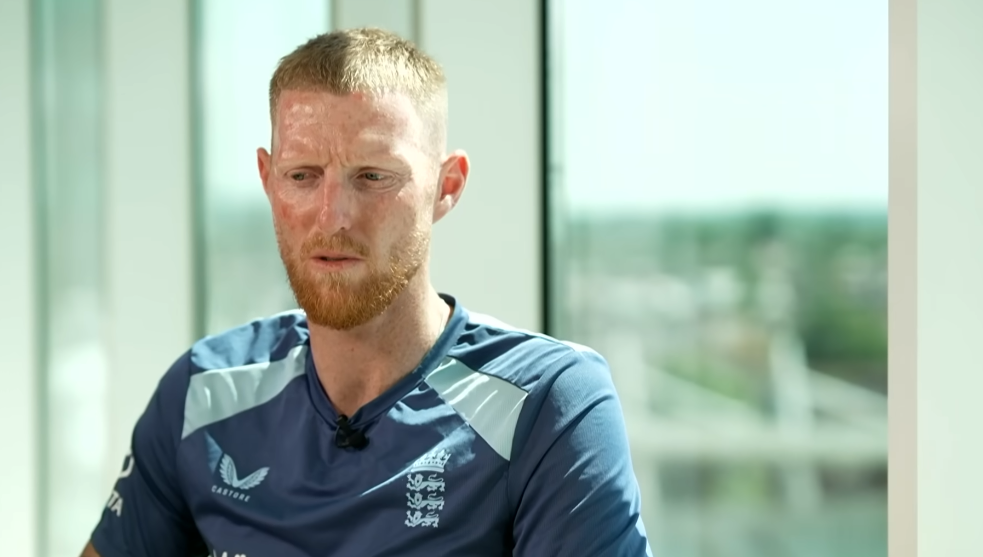
There’s a feeling that Stokes’ educational background is sometimes used as a comforting anecdote, demonstrating that credentials aren’t everything. Although that is technically accurate, it most likely downplays the more difficult reality. It wasn’t a romantic act of rebellion to drop out of school in 2007 with just one GCSE. There was very little room for error on the narrow path. There would have been few options if cricket hadn’t been successful. It’s still unclear if Stokes realized that at the time or if his batting style, which was characterized by a singular focus, simply drowned out the noise.
Instead of A-levels, he received something more akin to an apprenticeship under pressure from Cockermouth and Durham County Cricket Club. In 2009, he made his List A debut for Durham, dismissing the seasoned Mark Ramprakash with just his third professional cricket delivery. That is not a minor issue. It takes a certain level of poise that no exam room truly tests to enter professional sports as a teenager and compete against seasoned players who have spent years in that setting.
Stokes was a member of Durham’s team that won the County Championship in 2013. He was vice captain of England in 2017. There were controversies, injuries, a highly publicized legal case, and a mental health break in 2021 that he discussed with unusual candor for a cricket player of his generation. However, the arc persisted. The Cockermouth school dropout with one GCSE became the most powerful person in English cricket when he was named England Test captain in April 2022.
It’s difficult to ignore the fact that Stokes’ greatest strength—the capacity to remain composed under pressure, think clearly when things are getting bad, and make choices that defy expectations—is exactly the kind of intelligence that doesn’t appear on a results sheet. With 7,228 Test runs, 14 hundreds, a world record 258 against South Africa, and a career sixes total that even exceeded Brendon McCullum, his batting record speaks for itself. After playing 121 Test matches, he announced his retirement from international cricket on June 29, 2026.
His tale most likely does not demonstrate that education is unimportant. For the majority of people, it most likely does most of the time. It does imply that Ben Stokes found the kind of education that was important outside the building, in high-stakes dressing rooms, on challenging fields, and under floodlights in places like Cape Town and Headingley. His true credentials came from that source. And those proved to be more than sufficient.
