

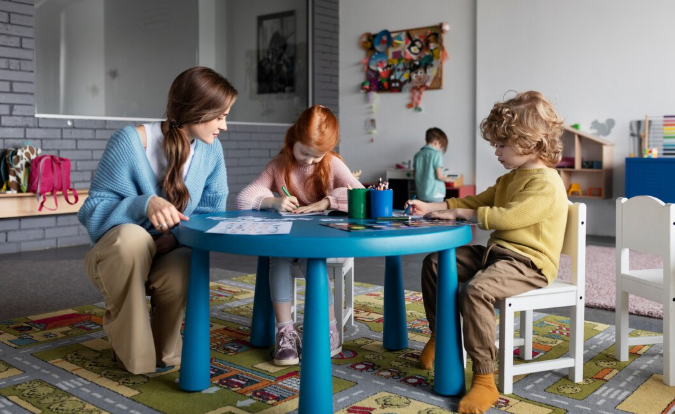
In Louisville, Kentucky, there is a structure at 8800 Westport Road that receives little attention from the general public. No athletic teams. There are no commencement ceremonies. No courses to prepare for college. What it does have is something perhaps more significant: a room full of three-year-olds discovering, perhaps for the first time, what it means to show up somewhere and fit in.
Children in pre-kindergarten, usually between the ages of two and five, are served by Westport Early Childhood Center, a public preschool run by Jefferson County Public Schools. The school is small by almost all standards, with about 186 students enrolled and a student-to-teacher ratio of 12 to 1. However, if you just look at the numbers, it’s easy to underestimate the seriousness that’s taking place inside.
With some conviction, the staff will tell you that everything that occurs during these formative years is shaped by what happens later. That’s not a novel concept. The same thing has been stated in a variety of ways by decades of research on early childhood development. However, having a theoretical understanding of something is not the same as actually constructing a school around it. Rather than merely giving it lip service, Westport appears to be genuinely organized around that belief.
The student body is a true reflection of Louisville. White students make up about 42% of the student body, Black or African American students make up about 25%, and Asian and Hispanic or Latino students make up just under 13%. 54 percent, or more than half, are considered to be economically disadvantaged. It’s not a footnote. It influences the entire context of what the school is attempting to accomplish, which is likely why family involvement is such an intentional component of the program rather than an afterthought.
Beyond the sporadic parent-teacher conference, Westport actively promotes family involvement. It appears that the school recognizes that a child’s growth doesn’t stop at drop-off and start up again at pickup. Here, strong family engagement isn’t just a nice ideology; it’s ingrained in the way the programs work. It may not seem important, but that distinction is crucial.
Not every preschool program can claim that all 16 of its full-time teachers are certified. Additionally, there is a full-time school counselor on staff, which is unusual for a school this size and provides information about what the administration feels the students need. Mental health support is frequently underfunded in early childhood settings. A different computation is suggested by Westport’s structure.
Observing the state of early education in America, it’s difficult not to question why more programs don’t resemble this. It is frequently depressing to see the discrepancy between what research suggests for early childhood education and what is actually funded and constructed. Although no school is flawless, Westport is a sincere effort to bridge that gap in one area of Louisville.
The school’s mission statement refers to “nurturing and supportive environments” and “school readiness,” which may seem generic until you consider what those terms actually mean. They refer to a child entering kindergarten with the ability to ask for assistance, sit in a group, and attempt difficult tasks. These things are not insignificant. Teachers in later grades either build upon them or spend years attempting to fix them; they are the invisible foundation.
Jefferson County Public Schools is a sizable district with all the associated challenges. Westport functions within it with a clear and concentrated goal. It is genuinely unclear if that focus will endure as priorities and budgets change over time. However, for the time being, children on Westport Road are experiencing school for the first time, and those in their immediate vicinity appear to take that seriously.
