

The majority of people have a particular perception of Robert Lewandowski. Crowd roaring, arms raised, clinical finish. That perception is genuine and well-deserved. However, there is another version of him that seldom makes the news: the one who, the day after Poland qualified for the World Cup, was sitting in front of a university panel in Warsaw, responding to questions regarding coaching theory.
October of 2017 was the month. Lewandowski had just led Poland to their first World Cup appearance since 2006 with his 16th goal of the qualifying campaign. Then, almost instantly, he turned around and encountered another type of pressure. The Warsaw Academy of Sport Education. a group of academics. In jeopardy is a bachelor’s degree. According to reports, Professor Marek Rybinski, one of the examiners, called his responses “excellent.” Not good. Outstanding.
You remember that particular detail. This degree was not awarded in a ceremonial manner due to celebrity. Lewandowski had actually written a thesis on management and coaching. It followed his own career from playing football as a kid in Leszno to competing for championships in Europe’s largest stadiums. He wrote about rivalry, ambition, and how his wife and parents shaped his identity. The majority of football players never think about creating this kind of document. Yes, he did.
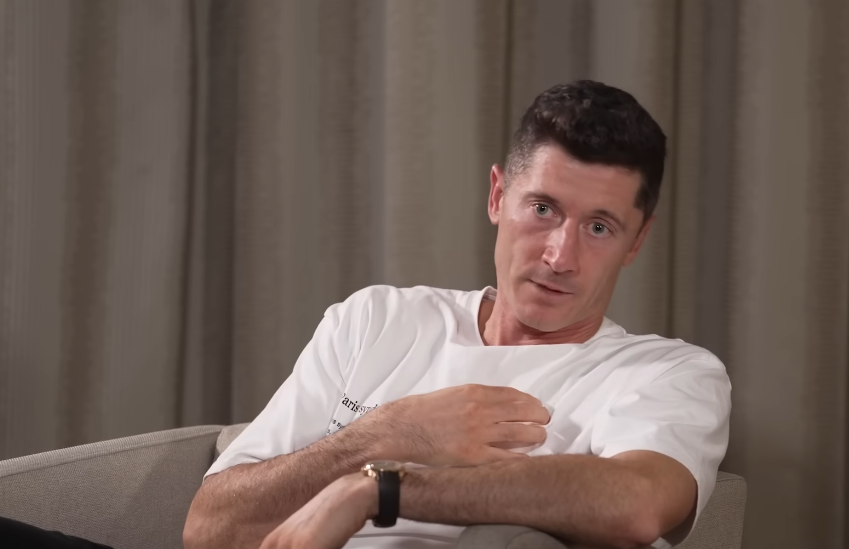
That bachelor’s degree was neither the start nor the finish of Robert Lewandowski’s education. According to reports, he went on to earn a master’s degree in sports education, which added another level of complexity to what has subtly evolved into one of the more intellectually demanding professions in contemporary football. We should take a moment to consider that. This man, who scored 41 goals in a single Bundesliga season and won the Best FIFA Men’s Player Award in 2020 and 2021, was arguably the world’s greatest striker at his best. At the same time, he was defending academic work and taking exams. At any level of the sport, that combination is uncommon.
It has an almost stubborn quality. The idea of players deviating from the pitch-and-recovery routine isn’t always rewarded in football culture, especially in Europe. The travel is unrelenting and the schedule is rigorous. Finding the time to read, study, and write a thesis requires a certain level of discipline. Or perhaps it simply requires a sincere desire to comprehend the game on a deeper level than most. Lewandowski’s plays have always had a cerebral quality. His decision-making in confined spaces, his positioning, and his movement off the ball are all deliberate. They recommend someone who considers his actions carefully.
He did most of his academic work behind closed doors. It seems like he liked it that way. This was not a public relations ploy. He didn’t announce his degree completion at a press conference. Almost by accident, the story surfaced following Poland’s World Cup qualification. Sitting in the shadow of a loud accomplishment is a quiet one.
Beyond the decisions made by a single player, it also matters for what it says. Lewandowski has won thirteen Polish Footballer of the Year awards. His national team is captained by him. He is still one of La Liga’s most reliable scorers at Barcelona, where he is currently in his thirties. Young football players keep a close eye on him. Knowing that he treated the classroom with almost the same seriousness as the training ground and that he valued education alongside excellence is the kind of detail that subtly influences how the next generation views their own futures.
Football careers come to an end. The majority of them end sooner than anyone anticipates. It appears that Lewandowski recognized this early enough to take action.
