

The horns, strangers hugging on corners, and the sense that everyone in the city has finally let go after holding their breath for years are all unique aspects of New York City celebrations. That should have been the result of the Knicks winning the NBA championship for the first time since 1973. And it did for a large portion of Saturday night. “Let’s go Knicks” was blasted over loudspeakers by emergency personnel. It was compared to New Year’s Eve multiplied by twenty. Tens of thousands had already descended upon Midtown Manhattan while Jalen Brunson and his teammates were still conducting interviews in San Antonio.
Then, at two in the morning, everything changed.
In the vicinity of Times Square, five yellow school buses—the kind you’d typically see outside an elementary school at eight in the morning—were either set on fire or severed with bats. An ambulance was unable to reach the block due to the dense crowd surrounding the 17-year-old who was shot at Broadway and 43rd Street, so police had to drive him to the hospital. There were four stabbings. Ten NYPD officers were hurt; one was struck in the face by a punch, and another was struck by a glass bottle. 63 people had been taken into custody on charges ranging from possession of a firearm to criminal mischief by the time the NYPD released statistics.
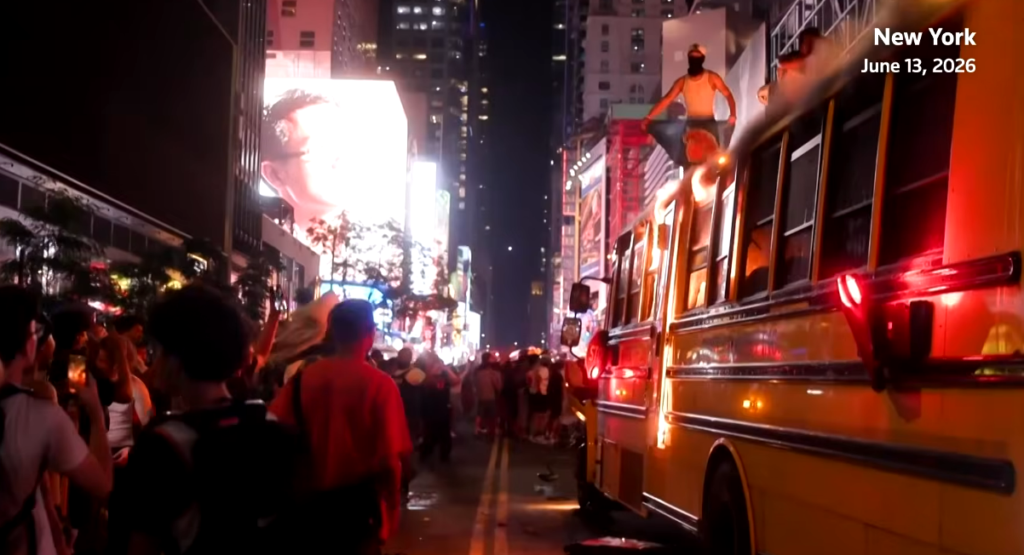
As it turned out, the buses weren’t just regular school buses that ended up in the wrong location. In order to provide fans with inexpensive transportation between Manhattan and MetLife Stadium in New Jersey, where Brazil and Morocco had played earlier that evening, yellow school buses were leased on non-school days as part of a $6 million shuttle program run by the New York-New Jersey World Cup host committee. Buses full of soccer supporters returning to a city at the same time as they erupted over a basketball championship caused an unfortunate collision. The drivers abandoned the cars after evacuating the passengers. By morning, people had jumped on roofs and swung bats at windows, leaving some burned husks and others dented.
The pictures, which show hundreds of people standing on top of a bus with their phones raised and posing for videos while someone below starts a fire, are difficult to look at without feeling a bit of silent disbelief. A reporter was informed by a bystander observing a burning bus that people were “expressing their happiness, a little bit violently,” and that this is “what happens everywhere around the world.” The interpretation is generous. The one aspect of the evening that doesn’t require qualification is the host committee’s confirmation that no passengers were on board at the time of the destruction.
In fact, James Dolan, the owner of the Knicks, intervened during Josh Hart’s press conference in San Antonio to urge fans to celebrate safely and to maintain composure immediately following the game. When 53 years of defeat finally come to an end, it’s the kind of request that, looking back, seems almost charming: one man asking a city not to do what cities sometimes do. It’s reasonable to wonder if the violence was actually related to the Knicks’ victory or if it was just chaos looking for an excuse. Out of tens of thousands, sixty-three arrests represent a small percentage, not a pattern. However, the buses caught fire. The adolescent was shot. Those events took place.
The World Cup host committee swiftly announced that shuttle operations would proceed as scheduled. On Thursday, there will be a championship parade. With blue and orange confetti, a ticker tape route, and a city hall ceremony, the Knicks will have their moment exactly as it should. That portion of the narrative is still to come.
The picture of those yellow buses, some of them burning and others collapsing at the roof, parked on a Manhattan street in the middle of the night, sticks in my mind. People were meant to be carried home by them. Rather, they turned into something quite different, an odd afterthought to a night that most New Yorkers would otherwise consider to be among the greatest in a long time.
