

Stephen Eustáquio’s journey has never been a straight line, from a small Catholic elementary school in Leamington, Ontario, to the boisterous stands of Los Angeles Stadium. However, that is sort of the point. The midfielder, who scored Canada’s game-winning goal in stoppage time against South Africa on June 28, 2026, to advance his nation to the World Cup round of 16 for the first time ever, was influenced by both his early schooling and his subsequent on-field exploits.
In Leamington, Ontario, a tiny town nestled in the southwest corner of the province, Eustáquio attended St. Louis Catholic Elementary School. Before his family left and went back to Portugal, he was only there until Grade 2, which is hardly long enough for most children to learn cursive. Until you sit with it, the detail seems almost insignificant. He started over somewhere completely different at the age of seven, leaving behind a nation, a school, and a language of everyday existence.
The family made their home in Nazaré, a Portuguese coastal town more famous for its enormous waves and fishing culture than for its football academies. Eustáquio started his official football development there when he joined GD Os Nazarenos. Throughout his early years, he continued his education in Portugal, and there’s a good chance that this time—learning to fit in with new teammates, adjusting to a different style of play, and navigating a second culture—built something in him that goes beyond strategy. Perhaps adaptability. Or perhaps it’s just a quiet solace from being uncomfortable.
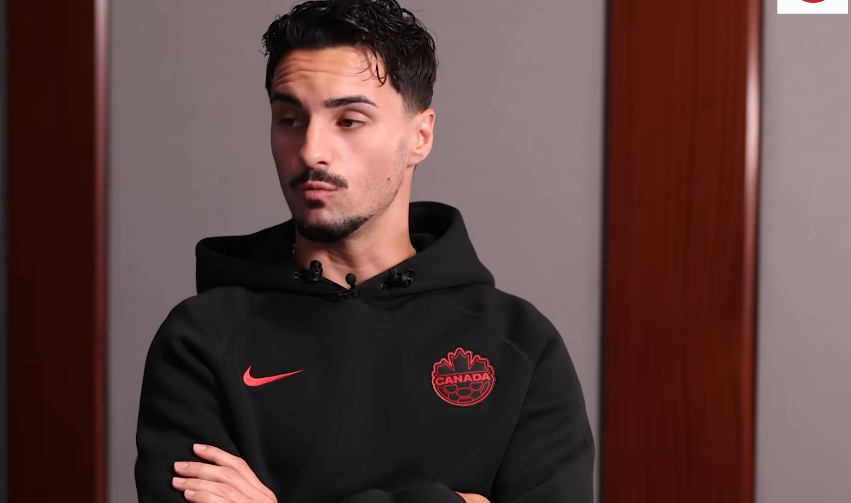
Eustáquio’s background is noteworthy for its purposeful understatement. He did not graduate from a prestigious academy. His upbringing did not fit the description of a Netflix documentary. When he was in high school, he interned at a nearby gym to gain access to the weights because his parents couldn’t afford a gym membership. That particular detail speaks volumes. There’s a resourcefulness that seems more like basic, unglamorous necessity than inspiration-reel material.
Eustáquio is frequently referred to as a “student of the game” by those who follow Canadian football closely, and this description is not uncommon. It relates to a real aspect of his football processing, such as his tactical awareness, spatial perception, and run or press timing. Those attributes don’t just happen. They develop. It’s also important to consider whether his upbringing in two different nations, educational systems, and football cultures provided him with a more comprehensive perspective on the game than someone who was raised in a single, continuous environment.
Before the 2026 World Cup, Eustáquio recorded a video message that the Windsor-Essex Catholic District School Board shared, demonstrating their pride in their alumni connection. He addressed residents of Leamington, Windsor, and Essex County directly in it, pleading for their assistance. It felt warm and unscripted. He specifically mentioned St. Louis Elementary. It was a calm, leisurely message for a professional football player on loan at an MLS team from one of the best teams in Europe—the kind you would send if a location truly meant something to you.
That thread has a subtle intriguing quality. His career was not clearly defined by the school, the town, or his early years in Canada before Portugal took over. However, they are still present and integral to his identity. And on a late June night in Los Angeles, when time was of the essence and a country needed a leader, the offspring of the nomads,
