

This story’s plot—a first-grade class, a muddy field outside of Oslo, and a boy named Henrik who happened to look down at the wrong—or perhaps the right—moment—is almost too tidy. Henrik Refsnes Mørtvedt saw something protruding from the ground while Fredheim School students were on a spring outing in the Gran municipality of Norway, close to Brandbu, in late April. It didn’t appear to be a rock. Nor did it appear to be a root.
It turned out that he had discovered a sword. It was an actual Viking-era blade that had been lying in that ground for about 1,300 years—not a toy or scrap metal. The weapon dates to between 750 and 850 A.D., which puts it at the end of the Merovingian period, just as the Viking Age was starting to take shape throughout Scandinavia, according to officials with Innlandet County’s cultural heritage department.
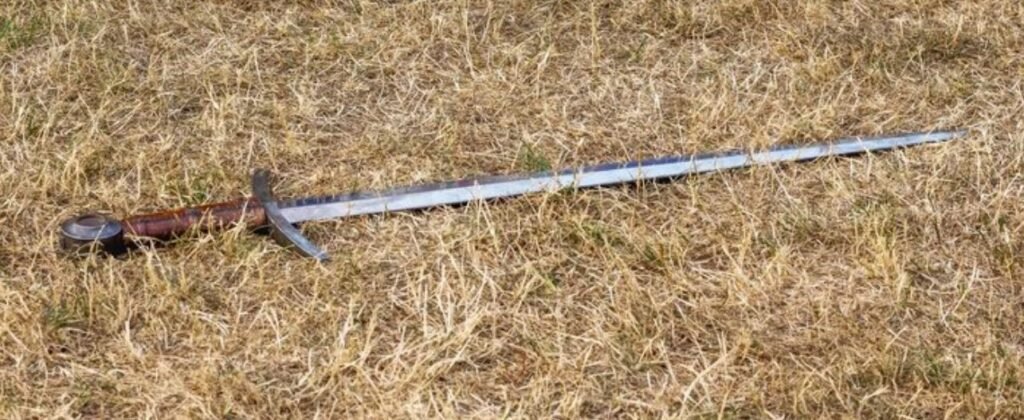
The sword, which originated from long fighting knives known as seaxes, is what archaeologists refer to as single-edged because it is only sharpened on one side. Reporters were informed by Øystein Lia, a senior adviser with the county’s heritage office, that discoveries such as these are truly rare. According to him, about one Viking sword appears in Innlandet every two years. This indicates how uncommon it was for a six-year-old to find one while on a field trip as opposed to a skilled archaeologist finding one during a real excavation.
Here, it’s difficult to ignore the contrast. The majority of Viking artifacts that garner media attention come from formal excavations that are scheduled months in advance or from metal detectorists who have spent years scanning fields. This one was from a child who just so happened to be looking down at the appropriate moment. That has a certain allure, similar to that found in tales of dogs discovering gold coins or beachcombers discovering fossilized teeth. Expertise doesn’t seem to matter much to luck.
The find itself was not nearly as impressive to officials as what transpired next. The kids left the sword where it was and the school immediately contacted archaeologists instead of pulling it free or bringing it back to show their teacher. The class was particularly commended by heritage officials for managing the situation appropriately, which, when you consider it, is a fairly mature response from a group of first-graders. It’s possible that most adults are unaware of the importance of leaving an artifact alone.
Perhaps more than people initially realize, the location is important. Brandbu is located in the Hadeland district, which roughly translates to “Land of the Warrior.” The area has long produced Viking artifacts and Iron Age burial mounds, so it’s not a romantic moniker created for travel advertisements. The sword most likely originated from a grave that has since been disturbed by centuries of plowing, according to archaeologists who found a small cluster of burial mounds about 40 meters from the sword’s surface.
To be honest, that detail begs more questions than it provides answers. Who was interred there? Lia speculated that the owner of the sword was most likely a respectable free landowner, perhaps even a military advisor to a chieftain in the area. However, it is impossible to know for sure—at least not yet, and perhaps never. If there was a body close by, it has long since disappeared into the ground along with anything else that could have provided additional information.
Since then, the sword has been relocated to the Museum of Cultural History in Oslo, where conservators will stabilize and clean it. According to Lia, X-ray imaging might eventually show how the blade was forged, which could provide historians with some insight into the metalworking methods used at the time. But for the time being, the sword remains in a state of conservation limbo, neither buried nor completely understood.
This year, a number of Viking discoveries have been made throughout Norway, including enormous coin hoards and a potential ship burial connected to Ivar the Boneless. It’s unclear if that’s a pattern or just a coincidence. In any case, Henrik’s field trip has earned a spot on that list and will likely make for an interesting tale to share at school for years to come.
