

A scene that would have been unimaginable fifteen years ago is unfolding in reception classrooms all over Britain. On their first day of school, four-year-olds can’t hold a pencil, won’t sit still, and can only speak in short bursts of four words. Many of them cut out the shape of a cell phone when given cardboard and scissors for a creative exercise. They are familiar with that world. Not pretend kitchens, not mud, not blocks. phones.
Lucy Fox, the assistant headteacher at Stoke Primary School in Coventry, has seen this trend solidify year after year. A seasoned receptionist in Hampshire talks about kids who become visibly irritated when a jigsaw puzzle doesn’t react like a touchscreen. The parts don’t move smoothly. The image doesn’t instantly fit. She believes that something in the wiring simply isn’t connecting anymore. Additionally, the data coming in from groups like OMEP and the larger early childhood research community is beginning to validate what these educators have been observing firsthand.
The figures are straightforward. According to a UK government-commissioned study, 98% of two-year-olds spend an average of more than two hours a day in front of screens. Children who used it the most—roughly five hours—had vocabularies that were noticeably smaller and were twice as likely to exhibit behavioral and emotional problems. According to Ofcom research, 37% of kids between the ages of three and five used at least one social media app in 2024, up from 29% just a year earlier. They’re not teenagers. These children still require assistance with brushing their teeth.
Given that attention spans were already getting shorter before smartphones became ubiquitous, it’s possible that some of this would have occurred anyhow. However, Singapore’s GUSTO cohort study, which followed kids for over ten years, presents a more compelling argument. Before the age of two, children who were exposed to a lot of screens exhibited accelerated but premature brain network maturation, a form of forced specialization that later reduced their cognitive flexibility. Those kids took longer to make decisions by the time they were eight and a half years old. They reported feeling more anxious by the age of thirteen. The biological trail is lengthy and unsettling, ranging from screen time in infancy to altered neural development to adolescent mental health.
Kindred Squared CEO Felicity Gillespie puts it simply. Serve-and-return interactions are how language develops; a baby babbles, a parent reacts, and a smile makes another smile. That’s not what screens do. They provide stimulation without expecting anything in return. And that reciprocal exchange is especially important between birth and age two, when the brain develops at its fastest rate. According to research conducted by her organization, 28% of children of reception age were unable to use books properly, tapping and swiping at paper pages as if they were supposed to come to life.
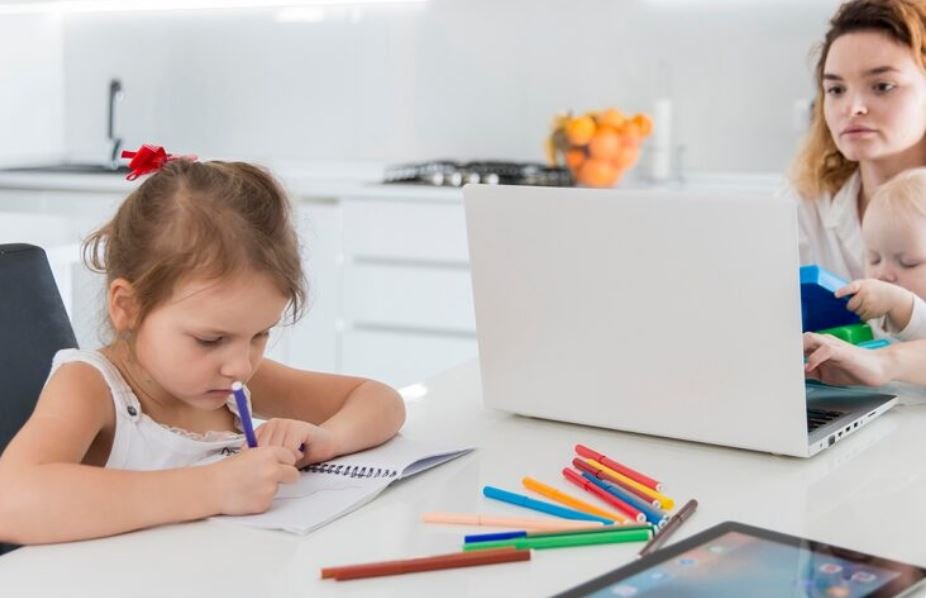
It is worthwhile to resist the temptation to place the blame on parents. Sandy Chappell, a speech therapist whose referrals have increased steadily over the past ten years, remembers the difficult situation that many families found themselves in during lockdowns, working from home with toddlers underfoot and reaching for a tablet out of desperation rather than laziness. Economic disadvantage exacerbates the issue. Families with fewer resources, less flexible work schedules, and smaller living areas rely more on screens—not because they care less, but rather because they have less space to move around.
Pasco Fearon, the director of University College London’s Children of the 2020s study, presents it as a social issue rather than a parental shortcoming. Everyone’s screen time has been increasing, even adults, and it is completely inaccurate to blame parents for a trend influenced by tech companies, financial strains, and pandemic disruption. He doesn’t want a guilt trip; he wants a reset.
It is still challenging to ignore the evidence from the classroom. The ability to share, take turns, carry on a conversation, and sit comfortably without reaching for a glowing rectangle are among the fundamental skills that a generation of kids are starting school without. It is genuinely unclear whether OMEP’s advocacy and the mounting body of research will result in significant policy. Governments have previously pledged to provide guidance. The question is whether guidance by itself can counter an industry that is fundamentally built to draw in and retain viewers, regardless of the age of their eyes.
