

The majority of school systems worldwide approach early childhood education with a certain amount of stubbornness. Small chairs bolted into inflexible rows, worksheets piled on tables, and clocks on every wall serving as a constant reminder that time is being spent, tracked, and optimized are all examples of this. All of this is predicated on the idea that play is something kids do after their real work is done and that structured instruction is serious.
It is becoming more difficult to defend that assumption. Research from organizations like OMEP, which has long promoted child-centered early education worldwide, and institutions like MIT’s Open Learning programs consistently points to the same unsettling conclusion: children typically perform worse over time, not just academically but also socially and emotionally, the more tightly adults control the learning environment. Some research indicates that rigid early learning environments may actually lead to poorer performance in subsequent education. That is a significant discovery. That is a critique of decades of policy.
The origins of the current wave of play-based learning research are what make it truly fascinating. The Lifelong Kindergarten group at the MIT Media Lab has spent years researching the connection between play, creativity, and learning, so MIT’s involvement in early childhood pedagogy is not new. However, the expansion of that discussion into international education policy circles carries a different kind of weight. Promoting imaginative play is one thing for progressive early childhood educators. Another is when organizations involved in engineering precision begin to publish frameworks that claim that when it comes to developing the most important cognitive skills, child-directed exploration consistently performs better than adult-led instruction.
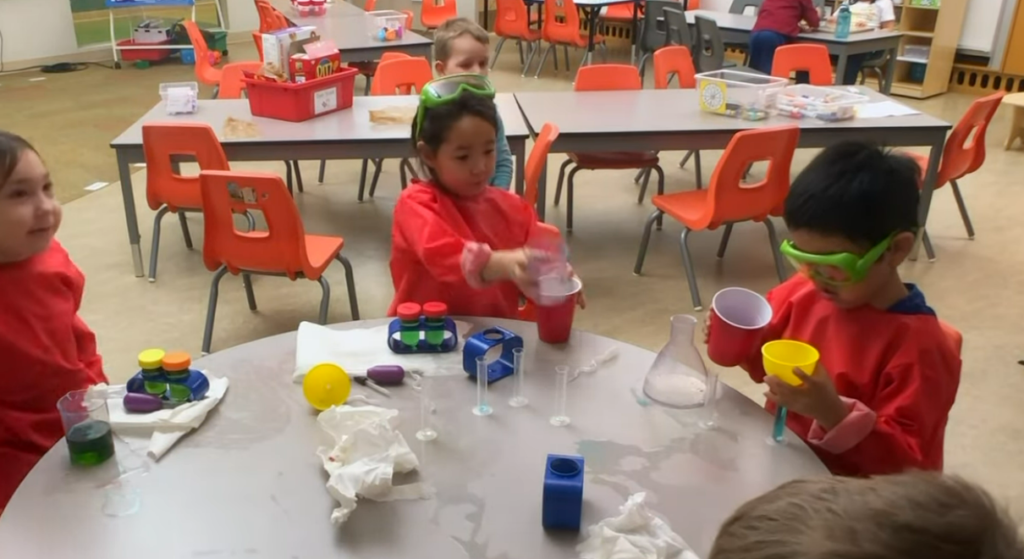
Unexpectedly, some of the most striking evidence came from the pandemic. Four kids who had attended a play-based, Reggio Emilia-inspired early childhood center in northern Colorado were followed in a cross-case study to see how they handled the chaos of the 2020–2021 academic year. The results were remarkably specific: parents and educators described these kids as “willing to adjust,” able to comprehend complex social situations, able to process stress through sophisticated language, and actively welcoming challenge rather than avoiding it. Obviously, four children is not a big sample. However, the researchers did not assert the existence of a universal law. Children who spent their early years navigating the manageable stress of imaginative play appeared to arrive at kindergarten carrying a kind of internal architecture for dealing with the unmanageable, which is something they were documenting that merits further investigation.
That sounds so different from what most school systems are actually producing that it’s difficult to ignore. The qualities that employers claim to value and that standardized tests consistently fall short of measuring are the cognitive flexibility, sophisticated language, and perseverance mentioned in that Colorado study. There is a growing perception that the early education system as a whole has been optimizing for the wrong results for a very long time.
The pedagogical change that scholars consistently suggest is not particularly radical. It doesn’t imply that adults leave the classroom. It does imply that the role of the teacher completely shifts. Rather than imparting knowledge, the teacher takes on the role of an observer, watching a child pretend to operate a grocery store and politely inquiring as to how many apples a family of four might require for a week. Math is a reality. Reasoning takes place. However, it takes place in a setting that the child controls and chooses. The true developmental work appears to take place in that distinction—child agency within a guided environment.
For years, MIT’s Open Learning initiatives have been discreetly constructing infrastructure around these concepts, creating tools and curricula meant to keep joy and discovery ingrained in learning across age groups. However, the wider implication is institutional. There is a growing body of evidence that suggests school systems that have doubled down on early academic pressure over the past 20 years—homework in kindergarten, phonics drills at age four, and standardized tests before kids have lost their first tooth—may be doing more harm than good to children’s development.
Whether that evidence will influence policy on the scale it merits is still up for debate. There are actual pressures that push in the opposite direction, such as parental anxiety, political expectations, and accountability metrics, and research rarely moves systems quickly. However, the discourse is evolving—and not in a subdued, scholarly journal manner. It becomes much more difficult to refute the claim that children learn best through play when reputable organizations like MIT begin to support it.
