

Witnessing one of Silicon Valley’s most influential individuals stand in front of a group of Stanford graduates and lead with a terrible haircut story is subtly disarming. Sundar Pichai began his Stanford commencement speech this spring with a memory of filming a YouTube graduation ceremony in his backyard during COVID lockdowns, sporting a self-administered haircut he obviously still regrets, rather than with quarterly earnings or a prepared vision of the future. The beginning was strangely human. And that seemed to be the whole point.
When Pichai, the CEO of Google and Alphabet, returned to his alma mater to speak to the Class of 2026, his speech sounded more like something an elderly friend would say over coffee than like business acumen. He wasn’t reading maximized talking points from a teleprompter. He was narrating tales. Apparently, they were real ones, one of which his parents were hearing for the first time.
The narrative centers on Pat, a classmate who drives a white Honda Prelude convertible, has an earring in one ear, and is the kind of effortlessly cool guy that every campus seems to produce. During Pichai’s first winter quarter at Stanford, Pat suggested a detour one January morning: skip class and take a drive to Las Vegas. Pichai, who had never taken a road trip or missed a class, agreed. They traveled for nine hours, passed through mountains where it started to snow (Pichai had never seen snow before, so he put his hand out the window to feel it), and reached Vegas just as the nighttime lights were emerging. After winning fifteen dollars at blackjack, he declared himself out. The following day, they took a car back. “For the first time,” Pichai told the graduates, “I realized the world won’t end if I relaxed a little.” No one noticed that they were gone. Depending on who was listening, that line might have landed differently. It probably hurt in a good way for the overachievers in the crowd, and Stanford doesn’t produce many other types.
Pichai was constructing a more comprehensive argument that contradicts the internal perception of elite universities. At institutions like Stanford, the majority of students harbor a silent, enduring fear that every choice they make will be burdensome. The entire structure is altered by the wrong first job, the wrong city, or the wrong lost opportunity. In response, Pichai argues that this pressure is largely fictitious. He proposed that there aren’t many truly significant life decisions, such as selecting a spouse, beginning a family, or making a significant career change. Everything else adds texture rather than direction, such as the biology test, the lecture that was skipped, and the tuba lessons that no one attended.
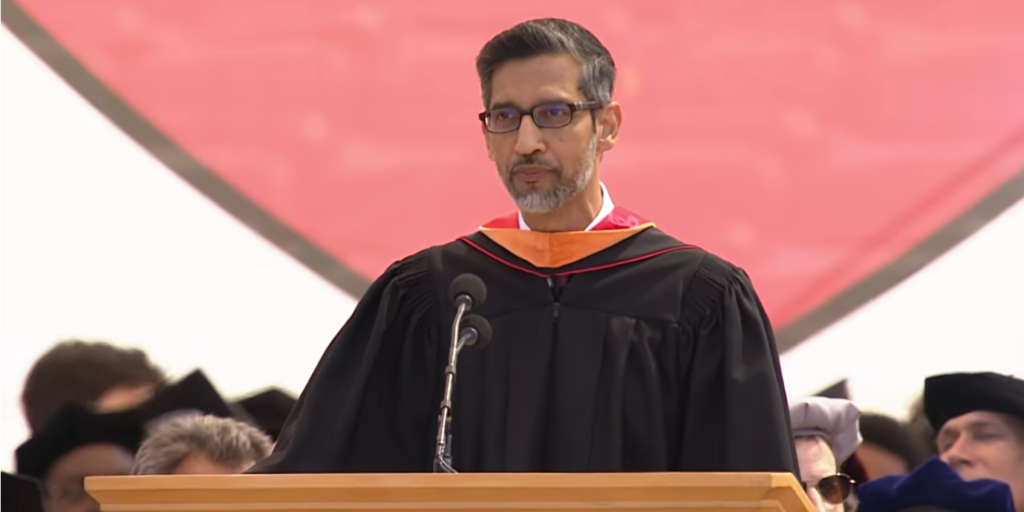
Observing how this speech was received gives the impression that people were eager to hear it. It feels honest in a way that commencement speeches frequently don’t, not because it’s cozy advice.
Additionally, he discussed optimism—not the kind found on bumper stickers, but the kind developed via real constraint. Pichai was raised in Chennai, where his family lived cautiously within boundaries, worried about water trucks during droughts, and waited years for a telephone. The plane ticket that took Pichai to Stanford for the first time cost his father the equivalent of a year’s salary. The California hills were not as lush as promised when he landed; instead, they appeared brown. Mrs. Jane Earl, his host, made the subtle correction that stuck with him for decades: “We prefer to call it golden.” Even though it seems insignificant, that reframe appears to have had a real impact on Pichai’s worldview.
In a time when polished executive speeches and TED-style performance wisdom are commonplace, it’s difficult to ignore how much this speech leaned toward imperfection. He acknowledged being unsure. He acknowledged taking detours. He acknowledged getting a haircut. And that honesty probably mattered more than any polished framework could have in front of a class that was taking on a complex, fast-paced world full of real pressure and real noise.
Naturally, it is still unclear if this generation of Stanford graduates will heed the advice. However, someone told them it was acceptable to stop sweating the tuba, at least for one morning.
