

When students are working in a classroom, there is a certain type of silence. Pencils are moving. the sporadic shuffle of paper. Leaning over a desk to review a student’s work, a teacher walks the rows. This scene has been around for generations, essentially unaltered. However, after spending an afternoon at some schools, something feels different. Screens are glowing. Before students have completed formulating the question, responses are displayed. There is still silence, but it is more difficult to find the thought behind it.
That observation by itself does not prove harm. However, it is the kind of thing that causes you to hesitate.
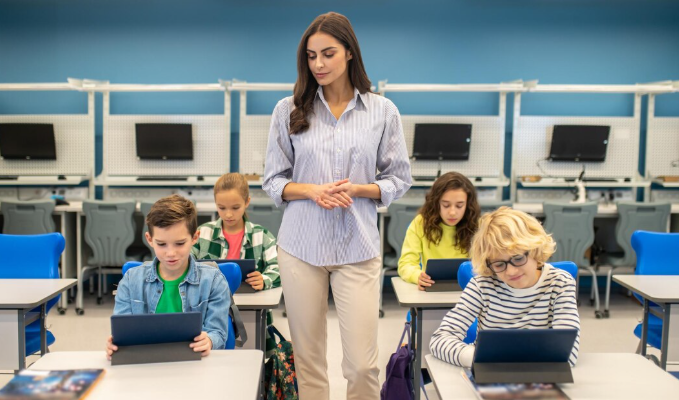
A coalition headed by Fairplay recently demanded a five-year ban on generative AI that interacts with students in PreK–12 classrooms nationwide. The proposal, which has a serious tone and a broad scope, focuses on an issue that seems almost too obvious to mention but somehow continues to go unnoticed: we still don’t know what these tools are doing to the minds of the kids who use them. The current enthusiasm for AI in education is based almost entirely on potential, on what these tools could accomplish rather than what we can prove they do.
Here, an uncomfortable parallel could be drawn. Ten years ago, schools started welcoming social media and smartphones with the same zeal. The advantages appeared to be clear. connectivity. proficiency with technology. involvement. Researchers and courts have since confirmed that what followed was much more concerning: documented harm to young people’s mental health, decreased attention spans, and an increase in anxiety. Now, a number of countries have taken action to limit children under 16’s access to social media. The guardrails didn’t show up until much later, long after the damage had quietly and extensively accumulated.
Observing the current wave of AI adoption in schools gives the impression that the pattern is recurring. Tech firms are expanding rapidly. Instead of being considered partners, schools—which are frequently underfunded and underresourced—are being positioned as eager markets. Before AI tools are used in healthcare, they must pass stringent testing, work closely with experts, and be independently assessed. That step has been mostly omitted from education. Contracts are being signed, products are being introduced, and the kids in those classrooms are essentially the study group.
Respected education policy expert Pedro Noguera brought up this issue recently, pointing out that unresolved issues regarding plagiarism, cognitive development, and the definition of original student work are not insignificant details to be resolved later. They are fundamental to what education is meant to accomplish.
It is difficult to ignore the fact that the schools most vocal about adopting AI are frequently the ones still dealing with the fallout from cell phone bans. That is revealing in some way. It’s worth sitting with, but it’s not exactly damning.
Calling for a ban is not the same as calling for a pause. It is not technophobia disguised in scholarly terminology. In its most rational form, it is a request for the same standard that we apply to nearly every other intervention in a child’s development: present the evidence first. Show that it is beneficial. Show that it doesn’t covertly cost anything that is difficult to quantify or replace.
The schools that proceed cautiously in this area won’t be remembered as the ones that lagged behind. They might go down in history as the ones who prioritized their students over the sales pitch.
