

A man who began his career in a religious boarding school in rural Negeri Sembilan and now oversees one of Malaysia’s biggest educational networks seems appropriate. Born in 1976 in Tumpat, Kelantan, to parents with strong ties to the state, Asyraf Wajdi Dusuki completed his secondary education at Sekolah Menengah Agama Persekutuan in Labu. It was not an ostentatious start. However, it established a tone that appears to have followed him for decades: a comfort level with religious education coexisting with more traditional academic aspirations.
At the International Islamic University Malaysia, where he studied accounting and graduated as the top student in 2000, that blend reappeared. In Malaysian academic circles, being awarded Best Graduate from an institution founded on Islamic ideals is not insignificant, and it probably opened possibilities that a regular accounting degree elsewhere might not have. He didn’t end there. He relocated to Loughborough University in the United Kingdom, where he earned a master’s degree with distinction in Islamic economics, banking, and finance. He continued on to pursue a PhD in Islamic banking and finance, a topic that was still developing in Western academia in the late 1990s and early 2000s.
The peculiarity of that trajectory at the time is difficult to ignore. Pursuing a doctorate in Islamic finance overseas required more than simply career planning because the field was not yet as global as it is today. After returning to Malaysia, he worked as a teacher at IIUM, led research at ISRA, the international Shariah research academy, and subsequently was appointed associate professor at INCEIF, the finance department of the central bank. There, he wrote a paper on poverty and microfinance that won an international award from Emerald’s Literati Network in 2009. This fact, which seldom makes news, indicates how seriously his early academic work was taken.
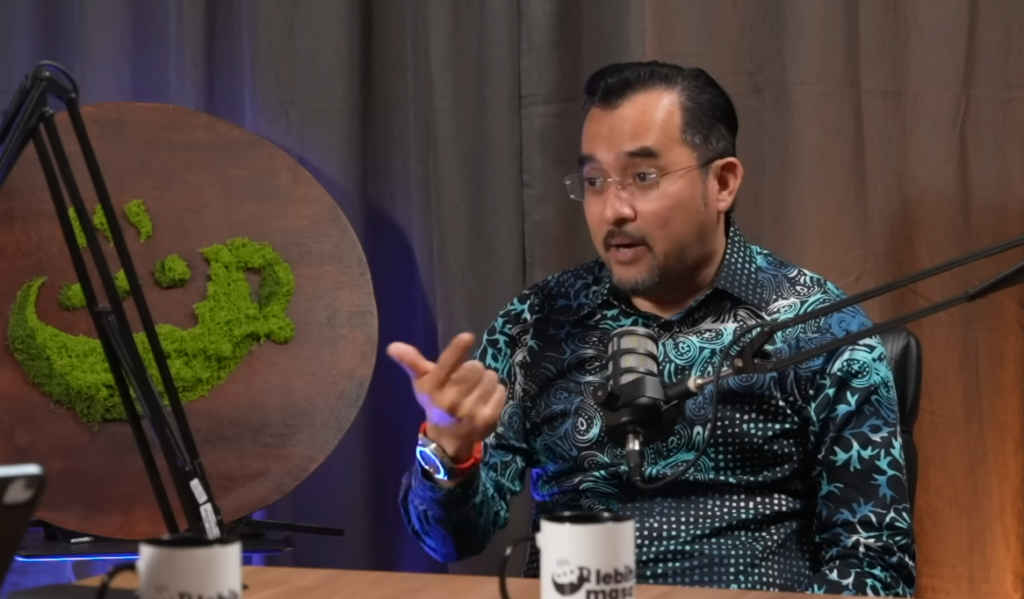
He also authored pieces for Utusan Malaysia, Berita Harian, and Sinar Harian, indicating that long before he had to explain policy to people, he was at ease translating technical finance concepts for a broad audience.
It is more difficult to verify than to presume that his current method of managing MARA is directly explained by that academic background. However, since assuming the position of MARA chairman in March 2023, he has placed a strong emphasis on active engagement with the organization’s educational institutions, including making unexpected visits to MRSM campuses, publicly denouncing bullying, and launching a religious studies program called Mini Ulul Albab at dozens of MARA junior science colleges. There is a pattern there that appears to be related to his own education: religious foundation is just as important as technical and vocational instruction, and he doesn’t seem interested in seeing the two as distinct paths.
How much of this is personal philosophy and how much is just political positioning within UMNO’s larger religious agenda is still up for debate. Most likely a combination of the two. Observing his journey from a small religious secondary school to a doctorate in the UK to chairing one of Malaysia’s most influential education authorities, it is evident that his education had little bearing on his final destination. It served as the blueprint.
