

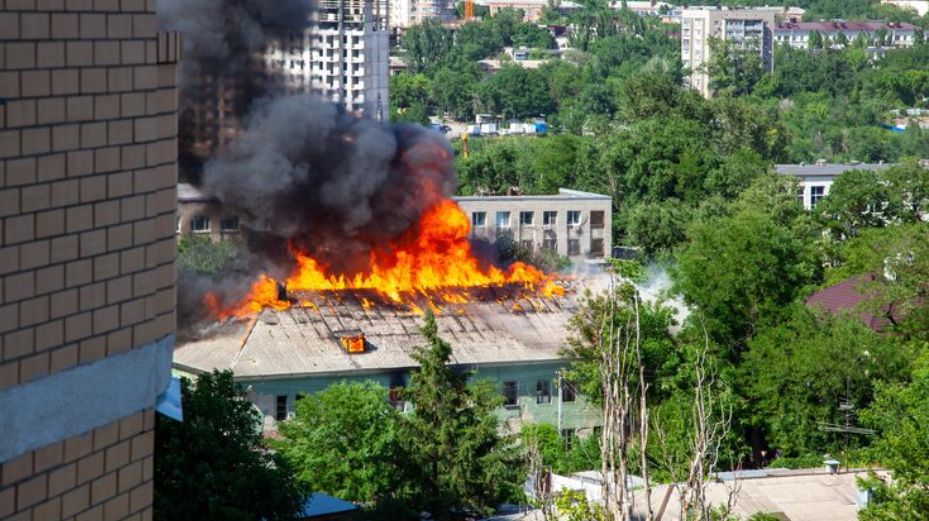
At Erina High School on New South Wales’ Central Coast, a two-story building caught fire late on Monday night. By the time firefighters arrived, smoke was rising into the night sky above The Entrance Road. The first to react was Fire and Rescue NSW. The NSW Rural Fire Service was called in as a backup after the situation was swiftly elevated to a second alarm due to the severity of what they discovered. It’s the kind of call that makes an otherwise calm Monday night in Erina much busier for emergency personnel than anyone could have predicted.
The fire was contained by 6:55 p.m. Reports from the scene indicate that three classrooms suffered the most damage, but the larger building structure seems to have been completely spared. Considering that this was a school campus rather than an occupied residence, the fact that no injuries were reported may not be as shocking as it would otherwise be. However, the distinction between “contained” and “catastrophic” is sometimes less clear than people realize, and a structure fire involving a two-story building can spread quickly.
This kind of fire’s aftermath is frequently less spectacular than the fire itself, but it is still quite disruptive. Erina High School declared that it would be closing for the duration of the cleanup. In the interim, students have been instructed to study from home. This is a common arrangement for Australian schools, which have had to make quick adjustments due to previous disruptions, such as fires, floods, or the pandemic years that are still vivid in the minds of many parents. Twenty years ago, there was no such institutional muscle memory. Today, schools handle this in a way that is almost routine.
Before anyone returns, the school says a thorough site safety assessment must take place. For good reason, that is standard procedure. Not all smoke damage is obvious. Before students can safely return to their desks, three burned classrooms must be cleared, electrical systems must be examined, and structural integrity must be verified. Since Monday night, parents in the area have probably been watching local alerts, scrolling through pages to see what this means for the remainder of the week.
According to current plans, staff and students will return to campus by Wednesday, July 1. That’s a fairly rapid turnaround, which implies that even though the damage was real, it wasn’t severe enough to necessitate a longer shutdown. Although school fire closures in NSW have typically followed similar patterns in recent years—a few days off, a cleanup crew working overtime, and a return to normal once inspectors sign off—the timeline could change if the safety assessment reveals something unexpected.
Public confirmation of the fire’s cause is still pending. The incident was simply described as a structure fire in NSW Rural Fire Service incident records, and Fire and Rescue NSW was identified as the responsible agency. Investigations into school fires usually focus on maintenance problems, electrical malfunctions, or, less frequently, intentional causes, though it’s unclear which applies in this case. It’s the kind of information that usually comes to light days or weeks later, after fire investigators have had a chance to examine what remains of the impacted classrooms.
Even a contained fire has an impact on a school community that goes beyond the actual damage. Once everyone is back on site, there’s the disruption to routine, the rush to rearrange lesson plans for distance learning, and the uneasy feeling of passing a burned-out building. Erina High School is just one of many regrettable Australian schools that have had to deal with a fire and its aftermath in real time. Most people bounce back fast. The true test will be whether Wednesday’s reopening goes as planned or if the evaluation reveals something that extends the timeline.
