

Five-year-old Aurora Nikula is creating a chocolate cake at her nursery in Lahti, Finland, on a typical morning. Leaves, water, mud, and sand. One more handful of mud. With the assurance of someone who has done this numerous times, she tastes the mixture and finds it to be satisfactory. Aki Sinkkonen, a principal scientist at the Natural Resources Institute Finland, is standing close by, observing with sincere scientific curiosity. He’s not here to judge Aurora’s baking. He is here because Aurora is getting her hands deep into a specially prepared patch of forest floor, which contains soil, moss, and microbial life imported from the woods. He thinks it’s important to pay close attention to what Aurora’s body is going through on a biological level.
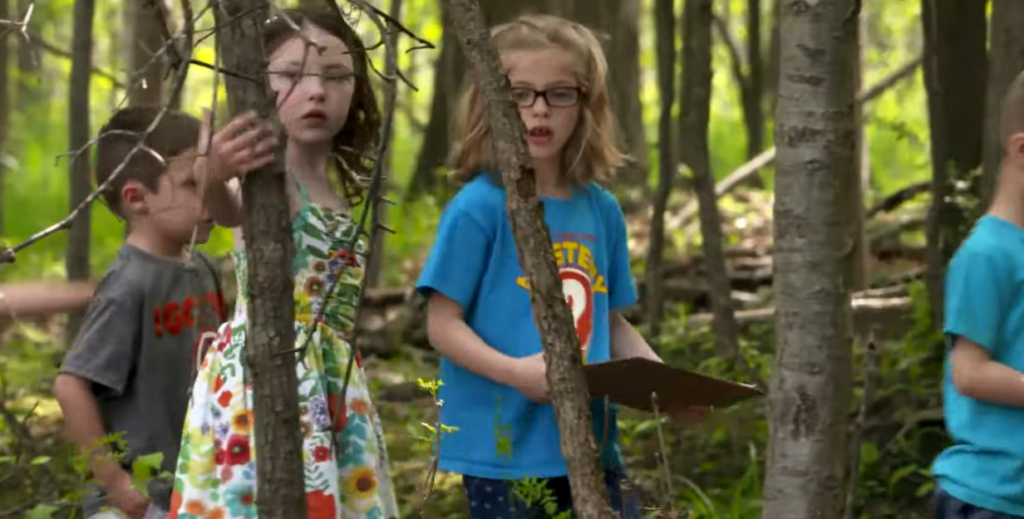
Sinkkonen and his associates have been conducting an experiment in Finland’s urban daycare centers that is simple in design but subtly radical in its implications. Preschool playgrounds were cleared of asphalt, gravel, and sterile sand and replaced with actual forest materials, such as soil, moss, leaf litter, compost beds, berry bushes, dwarf heather, and edible gardens. In this imported understory, children between the ages of three and five spent hours every day playing, planting, digging, and foraging. The biological changes were detectable within 28 days. The children’s skin showed an increase in microbial diversity. The diversity of their gut microbiomes increased. T-regulatory cells, the immune system’s internal moderators that guard against allergies, asthma, and a variety of autoimmune diseases, were more prevalent in their blood work. in less than a month. from soil.
The scientific basis for this is found in what scientists refer to as the “biodiversity hypothesis,” which holds that children’s immune systems are not receiving the necessary training because contemporary urban settings lack the microbial complexity that defined most of human history. The most crucial period for a child’s brain and body development is thought to be the first thousand days of life. During those years, the immune system learns what to defend against, what to tolerate, and what to leave alone in addition to defending the body. Education takes place when a child’s surroundings are rich in microbial diversity. Something disappears when it doesn’t. An increasing amount of research has connected the ecological flattening of contemporary childhood to the allergy epidemic, the rise in autoimmune diseases, and the disproportionate burden of asthma in urban children.
Finland now has more than 40 government-funded rewilding initiatives. With a €30,000 government grant, a daycare center in Helsinki called Poutapilvi-Puimuri is being renovated. At the moment, it is a construction site where excavators are moving dirt to create space for trees, flowers, rocks, planters, sandpits, and a grassy area. Marjo Välimäki-Saari, the center’s director, made it clear to architects: we want nature in it. A commitment to the physical environment of childhood as a public health concern, rather than merely an aesthetic one, is something that is still relatively uncommon in early childhood education. This type of directive is supported by government funding and scientific evidence.
Teachers in America have been observing. In the United States, the forest kindergarten movement has been quietly gaining traction for years among parents and early childhood advocates who feel that children raised in concrete playgrounds and risk-free environments are not safer or healthier, but rather more detached from the real conditions of human development. According to Finnish research, intuition has a biological basis that makes it more difficult to discount. It’s possible that overcoming the institutional and cultural structures that view mud as a liability and soil as a hazard is more important than persuading educators or parents that nature matters, since most people already hold this belief to some degree.
There are actual issues. Land costs, problems with air quality, and the enduring belief among many parents that a good school must be clean are all challenges faced by urban preschools. No one is arguing against basic hygiene, and cultural norms regarding dirt vary greatly. Clean soil sourcing, tetanus shots, and appropriate handwashing practices are all directly addressed by the Finnish model. The researchers contend that when the strategy is carefully considered, the advantages exceed the controlled risks. Helsinki’s former gravel yards and parking lots have been transformed into biodiverse play areas. In densely populated areas, that transformation is theoretically feasible. The will to try is what’s needed.
As you watch Aurora press mud into her cake at the Humpula daycare center in Lahti, you get the impression that something truly significant is taking place, something that defies easy categorization as a wellness fad or curriculum goal. She is playing on a meticulously planned scientific intervention—the forest floor. However, it’s also just a kid in the dirt doing what kids have done for the majority of human history. In certain respects, the experiment is not the rewilding of the playground. Why we ever took that away is the question.
