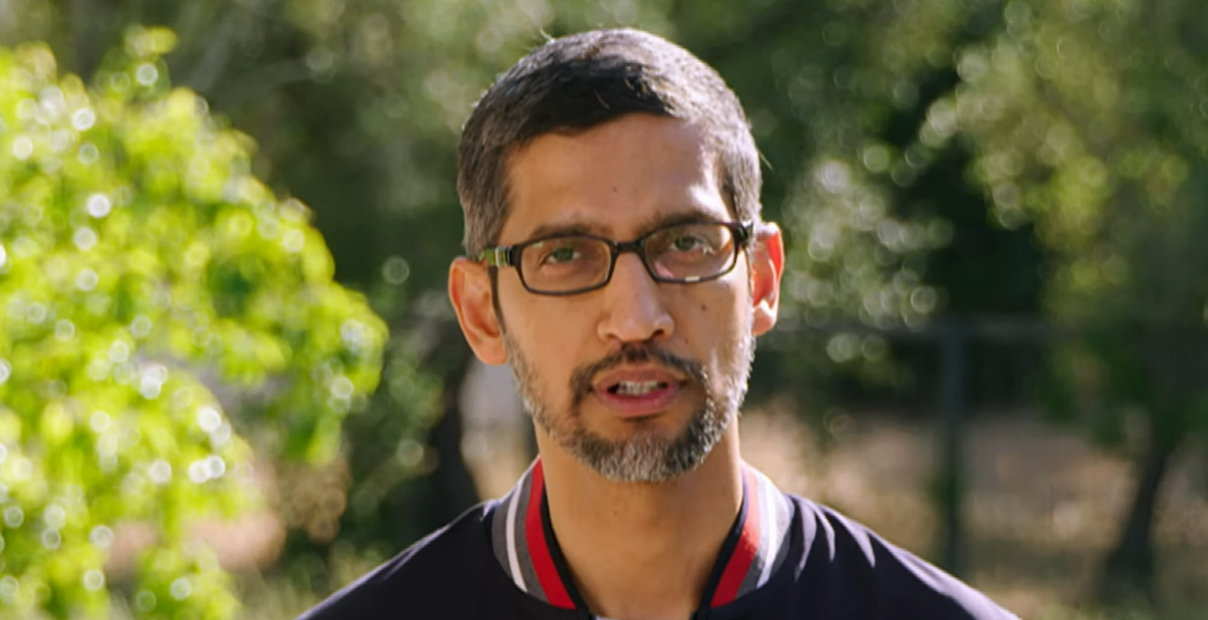
A certain type of story works particularly well: one in which a powerful person acknowledges that they were once utterly, helplessly clueless, but does so with genuine warmth and no justification. One of those tales is that of Google and Alphabet CEO Sundar Pichai. It has to do with a college cafeteria, a Hindi phrase he had no business using, and what he describes as his one day of fame on campus, all while grinning.
Pichai was born and raised in Chennai, Tamil Nadu. At the age of twelve, the family’s first telephone was delivered. He came to IIT Kharagpur, one of the most prestigious engineering schools in India, having studied Hindi in school but never really speaking it outside of the classroom. Anyone who has moved cities or countries as a young person will instantly recognize the difference between knowing a language and actually navigating the informal register of how people actually use it among themselves.
The narrative goes like this: during his early days at the hostel, young Pichai was paying close attention to how the other students spoke to one another. He picked up on the cadence, the casual roughness, and the phrases. Then, one day, he called out using what he believed to be a perfectly normal form of address in order to get someone’s attention at the college mess, the communal canteen that serves as the social hub of any Indian hostel campus. He didn’t use that phrase. The mess staff took offense. For a moment, the mess was closed. Suddenly, the most talked-about person on campus was Sundar Pichai, a recent graduate from Chennai who was still adjusting to one of India’s most challenging universities. In a 2017 interview, he recalled, “So I was very popular for that day,” with a smile that could be heard in the transcript. “It was just for a moment.”
The extent to which this tale has persisted over the years since he first told it is difficult to ignore. It occasionally appears in Indian media, and it recently made the rounds once more, in part due to its humor and in part because it does something that most executive storytelling carefully avoids: it makes Pichai appear genuinely, unguardedly human. The CEO of Google, who currently oversees one of the biggest tech firms in the world, once unintentionally caused a canteen shutdown because he failed to distinguish between student and staff communication. He also gives keynote speeches that are viewed by millions of people and appears in interviews with the New York Times regarding artificial general intelligence.
Spread over a large area of West Bengal, the IIT Kharagpur campus is a world unto itself, a self-contained city of students who live in close quarters, share meals, study through the night, and create the kinds of memories and friendships that tend to solidify into identity. All of that revolves around the mess at the college. The shared table is where students who are living away from home—often for the first time—negotiate a sense of belonging. Additionally, Pichai found that language codes and social hierarchies are enforced there with surprising rigidity.
Beyond the story itself, it’s interesting to consider what it implies about Pichai’s development as a leader. Some executives only showcase the polished version of their beginnings, complete with awards, scholarships, and a straight line to success. Speaking to over 3,500 students at his alma mater in January 2017, Pichai decided to discuss staying up too late, skipping morning classes, and temporarily closing the college mess due to a language barrier. This trait—the ease with acknowledging flawed beginnings—may have contributed to his ability to handle the extraordinary demands of leading Google during what is arguably the most turbulent time in the company’s history. Or perhaps it’s easier than that. Perhaps it’s just a long-forgotten, genuinely amusing tale that he shares because it still brings him joy.