

Imagine the scene at the conclusion of the Round 8 match on April 30: the crowd is still on their feet as Dylan Moore, one of the competition’s more dependable set shots, lines up after the siren with the scores locked. He puts it in the slot. There is a draw for the Hawks. Supporters of Collingwood sigh and make their way to the exits. It feels like one of those annoying near-misses that football season frequently presents. The sequence leading up to Moore’s kick might never have been permitted to occur at all, something that no one in that stadium fully realized and would not come to light for almost four weeks.
The rotation count, which sounds almost administrative, is at the heart of the AFL Hawthorn Collingwood interchange error. Teams are only allowed 75 interchange rotations per game under the competition’s regulations. In the final seconds, Hawthorn made their 76th rotation, according to Champion Data, the league’s official data provider. James Sicily took Jack Gunston’s place on the field as Moore was getting ready to take his shot. The rules would have been obvious if an umpire had been informed of that violation in real time. Collingwood would have been awarded both a 50-meter penalty and a free kick. The objective would never have been accomplished. By six points, the Pies prevail.
When Xander McGuire of Channel Seven revealed the story on The Agenda Setters, there was an instant response. It was infuriating, according to Caroline Wilson, who is not one for understatement. Even more bluntly, Kane Cornes stated that Collingwood ought to object and that the evidence amply supported overturning the outcome. These two points are not abstract given the ladder context, where Hawthorn is ranked fourth and Collingwood is ranked tenth. They make the difference between a wildcard scramble and a finals spot.
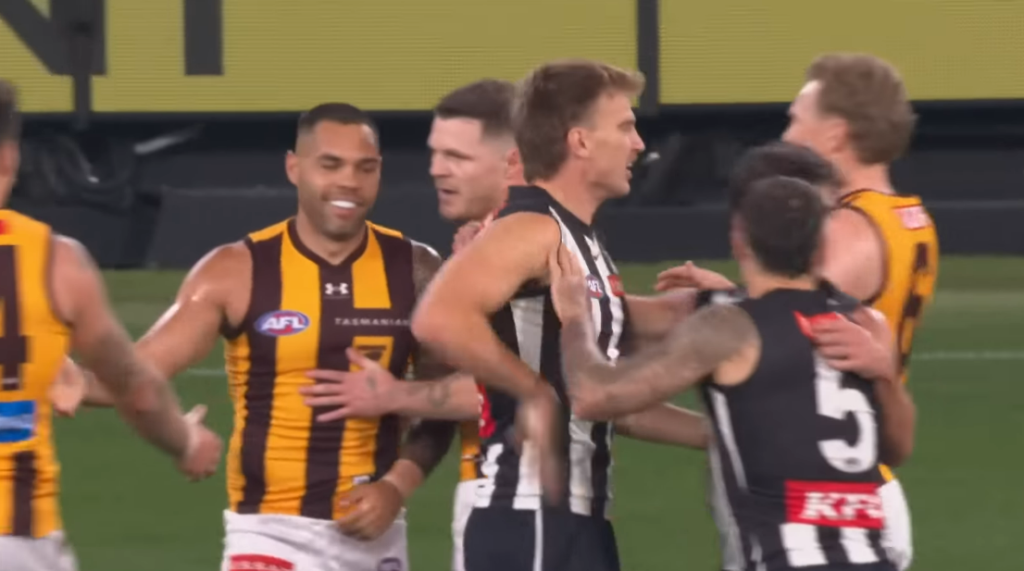
The AFL’s response was measured and, depending on your point of view, either extremely convenient or comforting. Greg Swann, the league’s executive general manager of football performance, clarified that when Gunston entered the game, the interchange official had Hawthorn listed at just 74 rotations, making it the 75th, not the 76th. Hawthorn made four rotations during the first quarter, but the official only recorded three, which is where the disparity originated. Every count for the remainder of the game was one behind after that. Additionally, Swann cited vision that demonstrated Gunston didn’t truly arrive at the field prior to the siren sounding, which the AFL claims renders the entire issue irrelevant.
Because of the split-second timing involved, it’s still unclear if the video evidence completely resolves the dispute; reasonable people continue to disagree. The case has been closed by the AFL. No additional action, no adjustment of points, and no official recognition that a first-quarter recording error might have determined the result of a match between two teams whose seasons depend on precisely this kind of margin.
The way the AFL’s own regulations create this specific bind is unsettling. Clubs must use the interchange official’s count rather than Champion Data’s. This is supposedly in place to avoid confusion during games. In actuality, this means that, regardless of what the technology indicates, an official’s uncorrected error from the first quarter becomes the final record for the entire game. It’s a bit like asking someone to navigate using a map that was wrong from the first intersection.
Watching this unfold, it’s hard to escape the feeling that Collingwood’s quiet response — declining to publicly comment — tells its own story. Whether that’s pragmatism, resignation, or something else entirely, the club seems to have calculated that pushing back won’t change the outcome. The AFL has spoken. The draw is in place. Moore’s goal remains on the highlight reel. Additionally, a three appears where a four ought to in a late April first-quarter log.
