

A school building that punishes its occupants has a very unsettling quality. Not in the dramatic sense of broken windows or crumbling ceilings, but rather through a more subdued and draining form of failure. The kind that appears every May, every January, and yet manages to surprise everyone and nobody at the same time.
That is currently the Cardozo Education Campus in Ward 1 of Washington, D.C. Midway through May, classrooms are 95 degrees. In a heat that would cause most office workers to call in sick, students are attempting to focus during finals and Advanced Placement exams. While attempting to explain algebra, teachers are wiping perspiration from their brows. It’s a scene that seems nearly impossible to defend, but here it is once more.
Paul Abdou, a math teacher, put it simply. Several classrooms had already reached the 80s by Tuesday morning. The day before, the temperature in his own room reached 95. “You can imagine what that’s like for students who are trying to learn and do their best,” he replied. The tone of someone who has previously made the same observation, filed the same complaint, and seen the same non-solution roll in is one of measured exhaustion. Over the course of his five years at Cardozo, the air conditioning system has failed in the spring and the heating system has failed in the winter. The same breakdown appears in a different form each season.
In 2013, Cardozo underwent a complete building renovation. This is noteworthy because it indicates that there was never any investment made in the building. They spent money. At least once, attention was paid. However, a renovation that is more than ten years old obviously failed to address the structural or mechanical dysfunction that keeps reappearing, and it’s difficult to avoid wondering if the correct issues were ever resolved or if the renovation was more aesthetically pleasing than anyone acknowledged at the time.
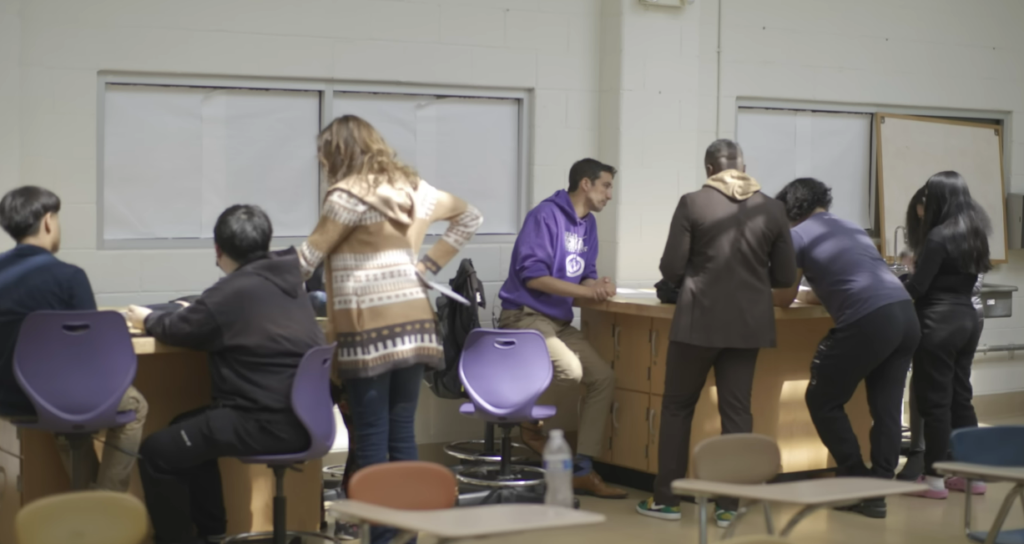
Abdou took care not to place the blame on the administrators of the school. Instead, he gestured to the Department of General Services, the city organization in charge of maintaining the public buildings in Washington, D.C. That distinction is important. This is about a city maintenance system that appears to treat school buildings as a low-grade chronic problem rather than an emergency, not about school administrators making poor decisions on a hot afternoon. In a statement, the DGS promised window units and spot coolers, promised that workers were working nonstop, and stated that long-term fixes, such as fixing cooling towers and pumps, were being evaluated for the summer. It reads exactly like all the statements that preceded it.
The school closed on Wednesday for the second day in a row after conducting a “heat evacuation” on Tuesday morning. Ballou High School in Ward 8 also had to deal with malfunctioning cooling equipment. The same mechanical failure occurs simultaneously in two different neighborhoods and schools. This could be a result of both unusual May temperatures and aging infrastructure. It’s also possible that this is just what occurs when a heat wave and neglected maintenance finally collide.
Abdou made reference to the film “Groundhog Day,” which depicts the same day that never ends and offers no way out. It’s a fitting and somewhat depressing analogy. Because the pupils who are seated in those hot classrooms aren’t forced to stay there. They arrived at school, got ready for exams that would affect their futures, and discovered a setting that made serious academic work truly challenging. That’s a big deal. That’s the kind of information that appears in results but not in budget spreadsheets.
It’s still unclear if the promised repairs will be made or if there will be more failed heating systems and hurried apologies in the upcoming winter. It is evident that Cardozo’s teachers and students have been experiencing this instability for a long time. “We’re working on it” must eventually give way to something that truly works.
