

You can see the inconsistencies of St. John’s University before you even park when you drive up Queens’ Utopia Parkway on a weekday morning. A few hundred yards away, chemistry majors are preparing for the possibility that their entire department may not exist for the next incoming class, while students in scrubs head toward the new health sciences building, which recently received LEED Gold certification. It’s an odd time for a school that is either quietly collapsing or flourishing, depending on which headline you read this month.
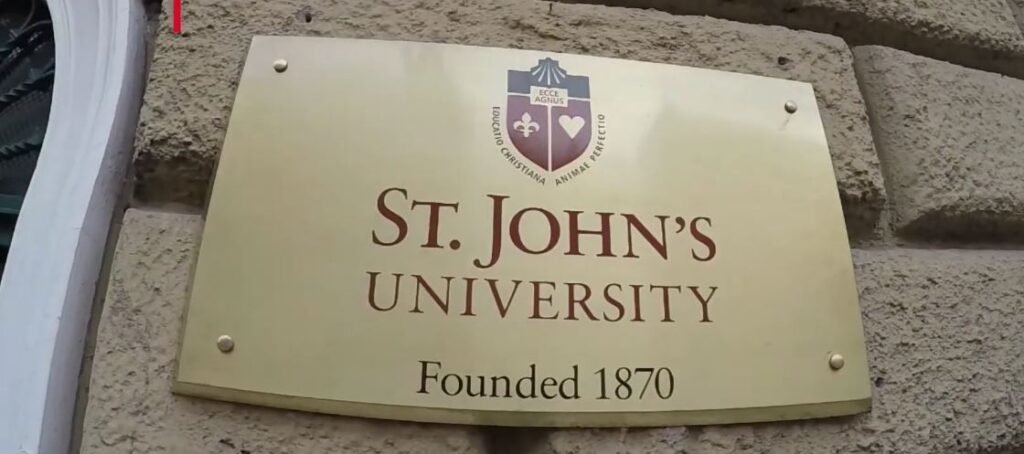
With more than 20,000 students and a presence from Rome to Staten Island, St. John’s, which was founded in 1870 by the Congregation of the Mission, has spent more than a century establishing itself as one of the nation’s larger Catholic universities. One of the things that makes the present so fascinating is that scale. A single difficult decision is not being made by a small liberal arts college. This expansive institution is attempting to be a dozen different things at once, including a research university, a basketball powerhouse, a nursing school, and a business incubator, and not all of those goals are maturing at the same pace.
That tension is aptly captured in the chemistry scenario. The number of students enrolled in the major decreased from 82 in 2020 to 32 in 2025. The administration’s consultants attributed this decrease in part to students switching to biochemistry, a more recent major designed with premed students in mind. The comparison, according to faculty, is unfair because biochemistry effectively siphoned off students from its parent department. It’s the kind of internal math that sounds tidy in a faculty meeting but messy in a slide show. How much weight enrollment spreadsheets have against institutional identity will be revealed if the appeal is successful this autumn.
In the meantime, it is evident that some areas of the university are moving more toward reinvention than retreat. In a ceremony that, by all accounts, felt more like true history than ceremony for ceremony’s sake, the nursing program recently graduated its first cohort in more than 60 years, pinning new nurses. Marketing instructors at Tobin College of Business are reorganizing their courses to focus on AI-driven ad targeting, viewing tools like Meta’s automated optimization as the new standard of literacy for a marketing career rather than a threat. The way that’s being taught is honest; it’s less “AI will save you,” and more “you need to know when to turn it off.”
Then there is the aspect of campus life that is completely absent from enrollment reports. For a school this size, St. John’s basketball has carried an excessive amount of cultural weight, and this year’s Big East run gave the community something to unite around while more difficult discussions took place in academic departments. A small, very Queens moment that shows how this school maintains its Catholic identity loosely enough to allow it to be humorous went viral when a student was seen shouting about the Knicks and receiving a thumbs-up from Pope Leo XIV.
The pattern that lies beneath all of this is difficult to ignore. St. John’s is neither collapsing nor coasting. It’s a university that attempts to feel like the same place that graduates remember while making obvious, occasionally uncomfortable trade-offs about what gets resources and what doesn’t. A generation of students who came in expecting AI fluency and biochemistry labs, not 1990s textbooks, will likely find the school’s ability to maintain its older traditions—the Masses, the mascot, and the sense of place on Utopia Parkway—more credible than any one program.
