

The fact that one of the most influential technologists alive, Larry Page, grew up in a home that, in his own words, resembled a controlled explosion at a university library is subtly telling. There are computers everywhere. Stacks of science magazines on surfaces. A mother who taught programming, and a father with a PhD in computer science. The actual education may have started long before any enrollment paperwork was completed.
Page was born in 1973 in Lansing, Michigan, and from a young age, his surroundings were more of a low-key laboratory than a childhood home. His father brought home an Exidy Sorcerer, a boxy early personal computer that most children would not have known how to use, when he was six years old. Page quickly figured it out. Additionally, he reportedly became the first student at his elementary school to turn in a word processor-printed homework assignment. A minor detail that reveals something about the way his mind was already functioning.
In addition to attending East Lansing High School, he studied music composition and played the saxophone during his summers at Interlochen Arts Camp in Michigan. This aspect of his past is often disregarded. Page has stated unequivocally that his training in music influenced his perspective on computing speed—the notion that timing is crucial in music and that milliseconds count. Although it’s a strange connection, it doesn’t seem forced to come from him.
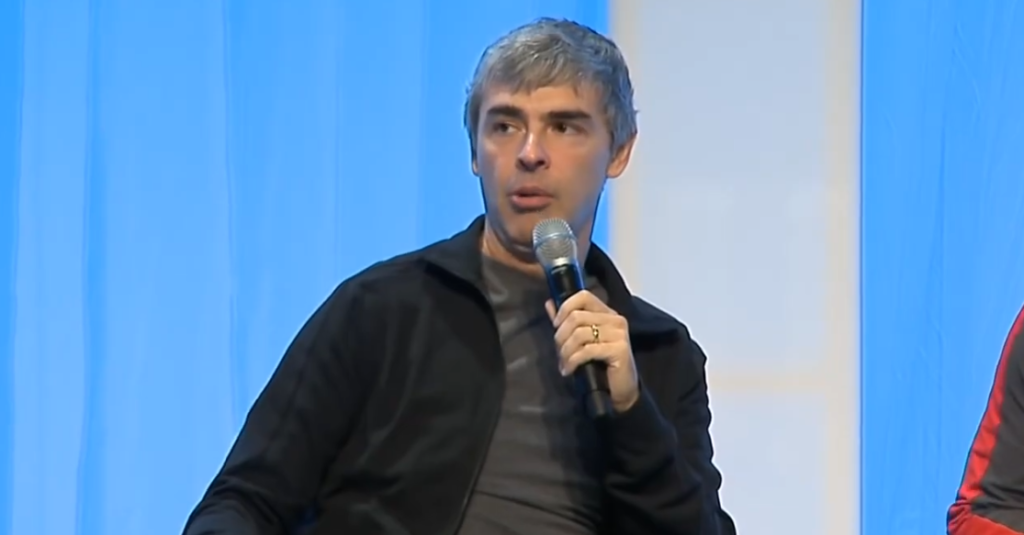
Larry Page’s formal education began at the University of Michigan, where he graduated with honors in 1995 with a Bachelor of Science in Engineering with a concentration in computer engineering. Contrary to what the credential implies, he was more restless and creative during that time. Using Lego bricks, he constructed a functional inkjet printer as a true experiment in low-cost, large-format printing rather than as a novelty. He suggested a personal rapid transit network—basically, a driverless monorail—to replace the university’s bus system. He presided over an honor society for engineers. These weren’t the actions of someone who was just enrolled to earn a degree.
He relocated from Michigan to Stanford University, where he enrolled in a PhD program in computer science in 1995. At this point, the narrative changes from that of a promising student to something more significant. When Page arrived in need of a dissertation topic, he started considering the World Wide Web’s structure, particularly how pages connected to one another and the meaning behind those connections. Terry Winograd, his advisor, urged him to follow through on the concept. Later on, Page would describe it as the best advice he had ever gotten.
The BackRub research project, which attempted to map and rank the web’s link structure, came next. Sergey Brin, a fellow Stanford PhD candidate, was sufficiently impressed by the work to participate. Together, they created the PageRank algorithm, which determines a webpage’s relevance based on the quantity and quality of other pages that point to it rather than keyword repetition. The realization now seems almost apparent. It was truly novel at the time.
In order to focus on developing the search engine full-time, the two eventually took a leave of absence from their PhD programs. The degree was never completed. That is somewhat ironic because, in theory, the education that gave rise to Google was insufficient. However, the result is difficult to dispute.
Compared to most tech origin stories, Larry Page’s educational journey actually reflects something less dramatic. It wasn’t a flash of brilliance or a flash of lightning. It was a long accumulation: a technologically advanced home, a Montessori school that fostered curiosity, an unconventional university education, and a graduate program that guided him toward the perfect issue at the perfect time. He was not limited by the classroom. It seems to have truly set something free for once.
