

Somewhere in the Jenks Public Schools Math and Science Center, there’s a poster that says “Bell to Bell, No Cell.” It’s been there long enough to seem unremarkable; it’s just a piece of furniture, one of those details in a school hallway that you only notice if you look for it. However, that poster and the underlying policy have evolved beyond a local ordinance. Oklahoma’s previously temporary school cell phone ban became permanent on May 7, 2026, when Governor Kevin Stitt signed House Bill 1276 into law. All Oklahoma public school students will not be allowed to use their personal phones, smartwatches, or non-school-issued tablets from the first bell to the last starting on July 1.
The path to permanence took less time than most anticipated. The bell-to-bell ban was first introduced in Oklahoma as a one-year experiment for the 2025–2026 school year, with the understanding that districts would no longer be required to implement the policy going forward if it proved ineffective, parents rebelled, or teachers spent the entire day confiscating devices. That was not the case. Lawmakers chose to completely forego the optional phase and establish the ban as the state standard because the responses they received from educators were so consistent. There are still exceptions for students who require medical condition monitoring devices and for real emergencies. The rest remains in the locker or backpack.
Moore Public Schools superintendent Robert Romines provided perhaps the most candid explanation of how he anticipated this to proceed. It was going to be a mess, he thought. He imagined teachers playing phone police during class, irate parents phoning the office, and general opposition from students who’ve had electronics in their pockets since middle school. He had changed his mind a few weeks into the academic year. In class, students were more attentive. There were fewer disciplinary incidents. Additionally, Romines noted with some surprise that children were playing board games and passing footballs during breaks—activities that you just wouldn’t have seen the previous year. “That’s big,” he remarked. “I mean, that’s huge.”
| Field | Details |
|---|---|
| Law | House Bill 1276 |
| Signed By | Governor Kevin Stitt |
| Date Signed | May 7, 2026 (Wednesday) |
| Effective Date | July 1, 2026 |
| Policy Name | “Bell-to-Bell” Ban |
| Devices Covered | Cell phones, smartwatches, personal tablets, non-school-issued electronic devices |
| Exceptions | Medical emergencies, health monitoring devices |
| Students Affected | ~700,000 Oklahoma public school students |
| Prior Policy | Temporary ban for 2025–26 school year (would have become optional without new law) |
| District Authority | Each school board must establish its own policy, including disciplinary measures |
| Key Supporter Quote | Robert Romines, Moore Public Schools Superintendent |
| Teacher Quote | Heather Davis, 7th grade teacher — “My kids are way more engaged” |
| Observed Outcomes | Improved student engagement, reduced behavioral incidents, increased peer social interaction |
| Original Bill Author | Sen. Ally Seifried (co-author of SB 139) |
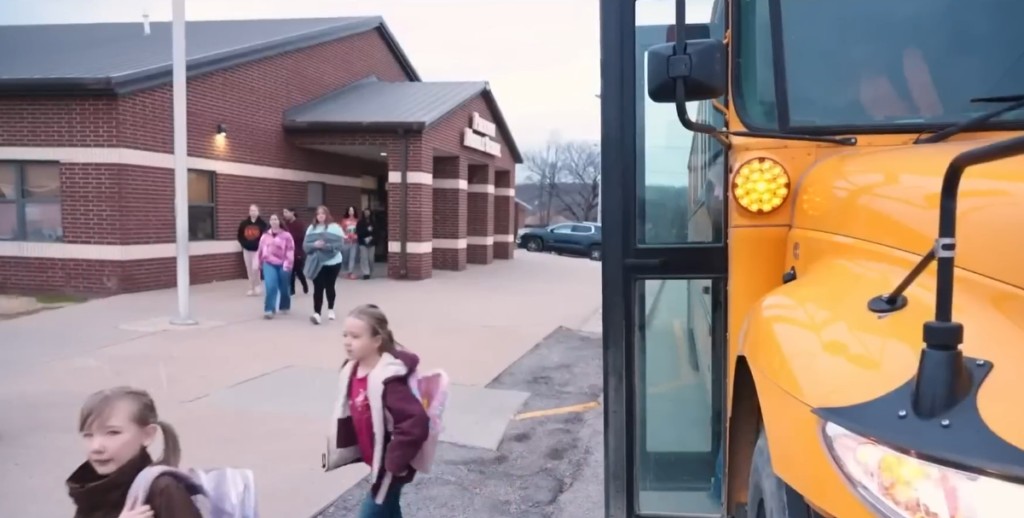
Heather Davis, a seventh-grade teacher, stated it more succinctly. Her pupils were more attentive. There were more of them going by. She made the connection between both changes and the lack of phones in a way that didn’t need much explanation: take away the distraction, and you’ll see what happens. That’s a simple observation that is consistent with an increasing amount of research indicating that smartphone bans in schools enhance social behavior and academic focus, especially among younger teenagers who haven’t fully formed the habit of self-regulation around attention-grabbing devices.
Observing this develop, it seems like Oklahoma stumbled into something that many other states have been considering without making a commitment. It is noteworthy that there was enough political will to move from a temporary ban to a permanent law in a single legislative session, indicating that the trial year’s feedback was not only favorable but convincingly so. Legislators don’t act this swiftly unless there is compelling evidence or a sizable political support for the change, both of which seem to be present in this instance. Parents were in favor of it. Teachers were in favor of it. Superintendents were in favor of it. It was signed by the governor.
Since the new law requires each school board to create its own disciplinary policy, it is still unclear how specific districts will manage enforcement. There will almost certainly be edge cases that push the limits of the policy, and this flexibility may result in some uneven outcomes—stricter in some districts, more lenient in others. When a student’s phone buzzes with an unexpected family emergency, what happens? How do schools deal with new students who don’t know the rules during the first few weeks of September? Rather than in the governor’s office, these are the kinds of questions that arise at the building level, in discussions between assistant principals and mildly irate seventh graders.
However, the experiment seems to have addressed the fundamental question it was intended to address. Without phones, students can still learn. It turns out that some of them were merely waiting for someone to decide for them.
