

One day, when you enter a well-run preschool as an observer rather than for a tour, something subtly unexpected occurs. A four-year-old bargains with a classmate for a turn. Without being asked, another person stacks blocks, knocks them down, and attempts an alternative strategy. Instead of correcting, a teacher crouches down to eye level and listens. From the outside, it doesn’t appear to be much. However, what is actually taking place in that room is some of the most neurologically complex learning that a person will ever experience.
For many years, early childhood education—roughly from birth to age eight—has been viewed as a soft concern, a cozy waiting area before “real school” starts. Though slowly and unevenly, that perception is evolving. The years prior to kindergarten aren’t preparation for learning, according to brain research. The adult brain just cannot keep up with the speed at which they are learning.
A child’s brain reaches about 90% of its full development by the time they are five years old. Neural connections are being formed at a rate that will never be seen again during those formative years. Touch, dialogue, play, repetition, and even conflict all cause synapses to fire continuously. Researchers can track the effects of a child’s early experiences and the people who shape them well into adulthood. It’s worth taking a moment to consider that fact.
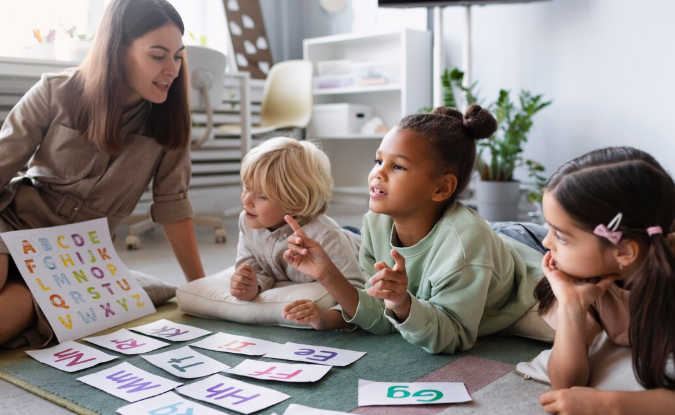
Early childhood education’s theoretical underpinnings are not new. For many years, Jean Piaget maintained that children acquire knowledge through experience rather than passive reception. Lev Vygotsky, who worked in the Soviet Union in the 1930s, postulated that learning is essentially social and that a child progresses through a “zone of proximal development” under the supervision of an adult who possesses slightly more knowledge than they do. After observing children in Roman classrooms, Maria Montessori—a physician by training—developed a whole philosophy centered on children’s innate curiosity and independence. According to Friedrich Froebel, play is a mechanism for development rather than a diversion from it.
These concepts went beyond academia. They influenced actual classrooms, actual curricula, and actual discussions about the needs of young children. It’s remarkable that early childhood education continues to face challenges in terms of funding, public respect, and political attention despite decades of research.
The situation is so uneven on a global scale that it should probably worry more people than it does. Only roughly 40% of children between the ages of three and four receive any kind of early childhood education worldwide. That percentage falls to about one in four in sub-Saharan Africa. Access is available in wealthier nations, but quality is a different story. Children whose families have the fewest resources are typically most affected by the large discrepancy between what the research suggests and what most classrooms actually provide.
Economists have been making the economic case for funding early childhood education for years, and it is hard to refute. Stronger academic performance later in life, fewer special needs classifications, and lower rates of grade repetition are all linked to high-quality early childhood education programs. The initial costs are typically greatly outweighed by the long-term benefits to society. However, the median amount spent on pre-primary education worldwide is only about 0.4 percent of GDP. Given the evidence, that number is, to be honest, difficult to explain.
The way this work is viewed could be part of the issue. It is a common misconception that ECE teachers are just sophisticated babysitters. It is a frustrating and consequential misunderstanding. It is a technically challenging task for a preschool teacher to calibrate a lesson to meet a child exactly where they are cognitively, socially, and emotionally—adjusting in real time, documenting development, and working across five developmental domains simultaneously. It is a sign of skill, not simplicity, that it frequently appears effortless.
There is a perception that public discourse on education tends to concentrate on the years that are simpler to quantify, such as test scores, college admissions, and graduation rates. Such metrics are difficult to generate in early childhood. However, it creates conditions that make all those later metrics possible, which may be more significant. One of the more significant educational issues of the upcoming ten years may be whether or not communities, parents, and legislators start treating it appropriately.
