

Kids who are left to their own devices outside can cause a certain kind of chaos. A log is pulled across a yard. Someone gets their shirt caught in a tree. As a child kneels down next to a puddle and draws with a stick in the mud. There are no guards around. No one is stepping in. The World Organization for Early Childhood Education (OMEP Spain) says that where it looks like chaos is where something important is being built.
The position of OMEP Spain is so interesting that it’s been noticed by people outside of academia. Without much hesitation, they say that their point is that kids who don’t have meaningful outdoor play as kids can’t fully develop into good citizens. Not citizens who are struggling. Not ones that are weak. ones that don’t work. It sounds like a big claim until you look at what scientists are actually finding about what happens to a child’s brain when they play outside without any rules.
An investigation done in 2018 found that American kids play outside about 35% less often than their parents did. Just seeing that number should make you think. But it’s not the number that stands out; it’s what’s going on in kids’ minds during those hours they’re not awake. For many years, Ellen Beate Hansen Sandseter, a professor at Queen Maud University College of Early Childhood Education, has looked into what she calls “risky play.” She comes to a clear conclusion: letting kids take physical risks outside makes them more independent, better at figuring out what’s dangerous, and stronger emotionally. Not because someone taught them. Because they lived them.
Bridget Walsh, a professor of Human Development and Family Science at the University of Nevada, Reno, says that playing outside is like working out your brain. Running, jumping, and swinging aren’t just physical things to do. They use parts of the brain that help control emotions. They make pathways stronger in the prefrontal cortex, which is the part of the brain that makes plans and choices. The hippocampus, which helps us remember things and find our way around, also gets a workout. What looks like kids having fun is actually the brain doing important exercises.
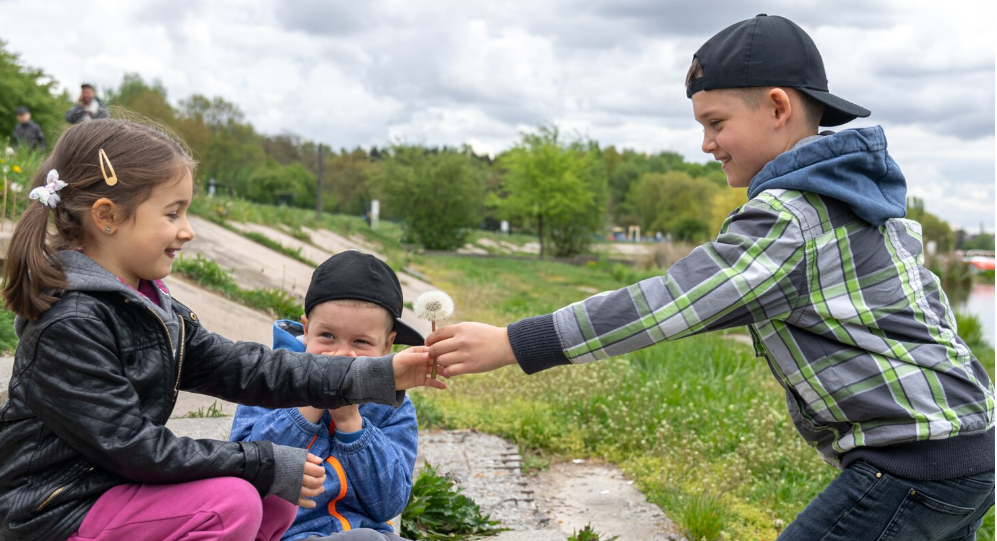
Also, there’s something that’s harder to measure but simple to see. Professor emerita Louise Chawla of the University of Colorado Boulder says that nature is “full of can-I-do-it activities.” Would you like to help me lift this rock? Could I climb that tree? These questions aren’t small. They are early tests to figure out how dangerous something is, boost confidence, and find out what the body can do. And most importantly, nature doesn’t change how hard it is to fit the child’s level of comfort. Real trees don’t cut back their branches. The depth of a real puddle is hidden from you. There is a point to that resistance.
It’s hard to see in real time what kids lose when they are cooped up inside, have too many activities, and are constantly watched. Benjamin Powers, a senior scientist at Haskins Laboratories, says that teens and young adults can have trouble when life doesn’t go as planned if they haven’t practiced handling conflict or new situations on their own. That’s not a little thing. In real life, things don’t always go as planned.
You should be aware of the real problems that make it hard to play outside. UNICEF has found that many kids don’t have access to safe green spaces, even in places that are thought to be child-friendly. There are still laws in some U.S. states that make it illegal for kids to explore on their own. It takes a lot of time, money, and worries about safety. When people really can’t get to a lot of natural materials, researchers like Chawla suggest small-scale solutions like bins of them, plants inside, and loose things like feathers and leaves. Getting outside is better than not getting outside at all.
Even so, OMEP Spain’s case gets through the caveats. Outside play is nice, but that doesn’t mean nature is good for your mood. People say that those unstructured outdoor hours are the best place to learn how to negotiate, tolerate risk, self-regulate, and solve problems without a referee, all of which are important for civic life. A review of school-based green space programs done in 2024 found that kids’ moods, social connections, and activity levels all got better over time. A European longitudinal study found that being close to green spaces as a child was linked to a 55% lower risk of psychiatric disorders later in life.
When I read those numbers, I can’t help but think about what we’ve given up in the name of safety and structure. They’re not just joking when they argue over where to put the log that’s halfway up the tree. They’re changing into people.
