

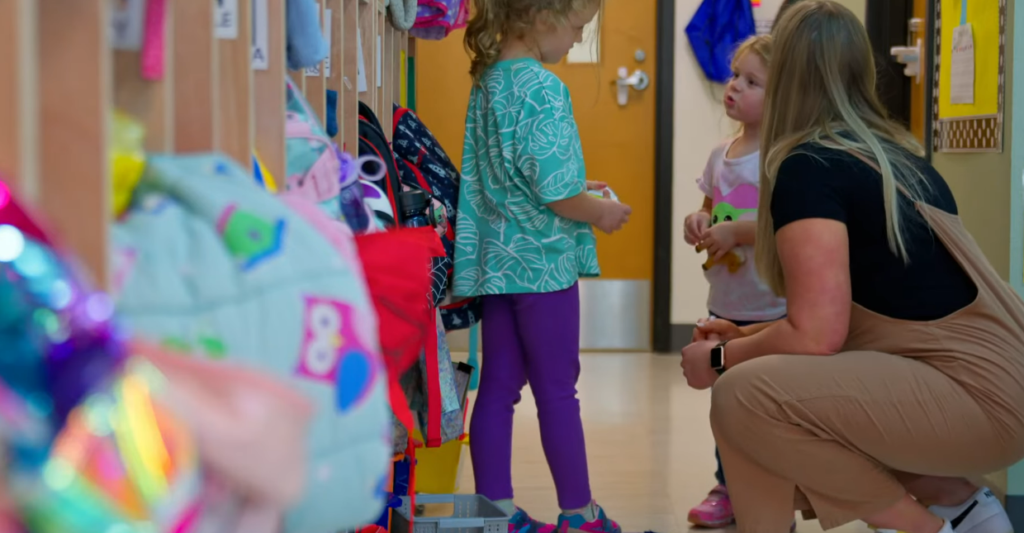
If you walk into any good preschool on a Tuesday morning, you’ll see something that is often overlooked. The space is noisy, a little disorganized, and yet somehow well-organized. While kneeling beside a child solving a puzzle, a teacher speaks in a calm, precise tone that is neither hurried nor patronizing. The teacher observes another child watching something outside by the window without becoming distracted. All of this is not an accident. The person in charge of that room most likely has a degree in early childhood education, and most people outside the field are unaware of how difficult the training required to earn that degree is.
As a formal field of study, early childhood education encompasses children from birth to about age eight, during which time their physical and cognitive development advances more quickly than at nearly any other stage of life. A child is doing a great deal of developmental work when they learn to walk, form words, count objects, control their frustration, and share space with strangers. The individuals in charge of assisting with that work require more than just perseverance and good judgment. They require a methodical grasp of early literacy, classroom management, child development theory, and what constitutes appropriate learning at each stage. That is the core of what is taught in an early childhood education program.
The degree itself is available in multiple formats. A two-year associate’s degree can be used as a springboard for a bachelor’s degree and opens doors to entry-level jobs at childcare facilities. The majority of public and private schools require classroom teachers to complete a bachelor’s degree, which typically takes four years and 120 credit hours. In order to prepare students for a full teaching internship in their senior year, universities such as the University of Missouri offer a Bachelor of Science in Education in Early Childhood program that places students in clinical settings beginning in their sophomore year. You can’t replicate that kind of early, repeated exposure to real classrooms with lectures alone. A four-year B.Ed. in Early Childhood Care and Education is offered by Virtual University in Pakistan, which reflects the growing institutional recognition that the field requires serious, committed training rather than merely a module included in a general education degree.
Graduate courses go beyond that. With a master’s degree, classroom teachers can advance their careers, take on leadership positions, or focus on areas such as bilingual education or working with kids who have developmental disabilities. Those who wish to train the next generation of educators or conduct research in the field usually pursue a doctorate. Although it’s a long path, the field is now more accessible than it was in the past thanks to the variety of options, which range from associate degrees to PhDs and from fully online to in-person programs.
The way these programs have grown over the last ten years gives the impression that society is gradually realizing what scholars have long recognized: the early years of education carry a disproportionate amount of weight. A child’s academic trajectory is often shaped by what they learn—or don’t learn—between birth and age eight. Giving someone that responsibility without adequate preparation is not a small task.
Whether the industry will resolve the long-standing conflict between the value of the work and the typical pay is still up in the air. There is a persistent discrepancy between the value of the credential and the compensation associated with it because teachers with degrees in early childhood education frequently make less than their counterparts in higher grades. To be honest, that’s a problem worth naming. However, the degree itself and the career it opens up continue to be among the most significant decisions one can make—quietly creating something in those tiny spaces that reverberates for decades.
