

That feeling of being lost that comes up when Nick Fuentes thinks about his school years. The picture that comes out of Lyons Township High School in La Grange Park, Illinois, doesn’t immediately show the path that was taken afterward. He was president of the student council. He took part in Model UN and speech contests. He had his own talk show on the school TV channel and hosted a political talk show on the school radio station. According to a former classmate, he was a “talented public speaker with seemingly mainstream conservative views.” That doesn’t sound like what most people would expect to hear.
Take a moment to think about that. Nick Fuentes’s education story isn’t about someone who was always on the edge. At least, that’s not how the people who knew him back then saw it.
Fuentes was one of only four students chosen to greet Illinois Governor Bruce Rauner during an official school visit in May 2016. He was also the one who led the politician into the building. That’s not the kind of distinction given to someone who causes trouble. Bill Allan, who oversaw the school’s TV services and worked directly with Fuentes, later said that the young man stood out. He also thought that Fuentes might have been interested in controversy in part to build his social media presence. It’s hard to say if that was strategy, conviction, or both.
That was until graduation in 2016, when things changed. In the Chicago Tribune, reporter John Keilman made it clear: Fuentes “embraced the extreme right” after high school. That year, he went to Boston University to study politics and international relations. This seemed like a natural choice for someone who had spent his teens arguing about policy on school radio. He might have been drawn even more into the online world at BU because of the way it was set up. It’s also possible that he was already changed when he got there.
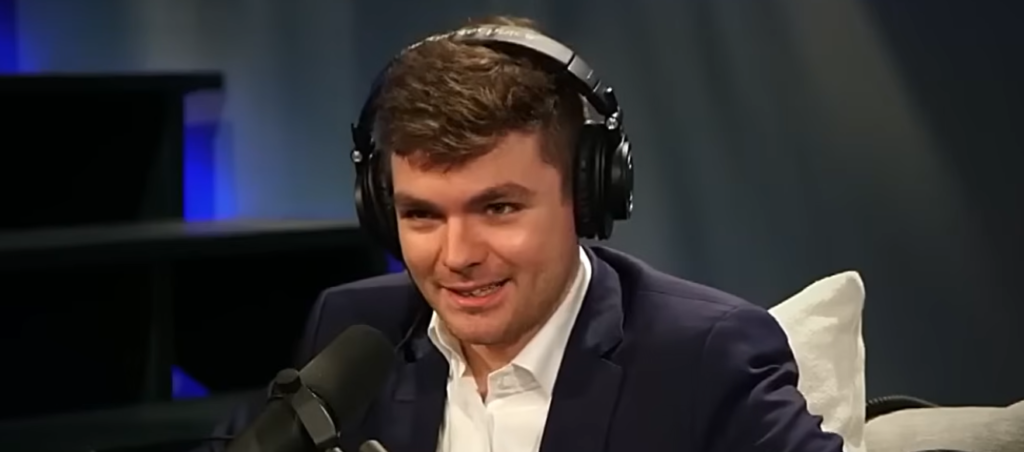
Fuentes’ time at Boston University came to an end when he went to the Unite the Right rally in Charlottesville, Virginia, in August 2017. He later said that he went to “protest immigration and multiculturalism” and that he was not a racist or white nationalist. On the other hand, his Facebook posts from that time said something different. They talked about a “tidal wave of white identity.” He said that after the rally, he got about fifteen death threats. He left the university because he didn’t think he could stay safe there anymore. He was no longer officially learning about Nick Fuentes in the usual sense.
After that, he talked things over with his parents. In a documentary with British journalist Louis Theroux, Fuentes talked about asking his family to give him a year to work in the media. That’s what I’ll do if it works out. “I’ll give up if it doesn’t work out,” he remembered telling them. They agreed. From what he said, it worked out. He finally got an associate degree from the College of DuPage in 2019. It was a less flashy degree that was easy to miss in the midst of all the other things going on in those years.
Looking back at it all, Fuentes’ schools seemed to have served more as launching pads than as deep academically forming experiences. He learned how to speak in public, keep an audience interested, and use irony and humor to say mean things in a way that was easy to defend. He learned these skills in a high school TV studio and a live stream chat room, not in a lecture hall. It probably depends on who you ask what that says about him or about the media ecosystem that saw those skills pay off so quickly.
