

The idea of extracting drinking water from desert air seems almost counterintuitive. Every instinct tells you that there is no water when you stand in the Atacama in northern Chile, one of the world’s driest landscapes. Bone-pale is the ground. To an uncomfortable extent, the sky is clear. However, water is present. dissolved subtly into the atmosphere, in quantities that far exceed most people’s perceptions of what is truly present in a desert. The existence of the water has never been a question. The question has always been whether anyone could create something useful enough to be released.
Researchers at MIT and Stanford University may have made the most compelling move toward a solution to date. A hydrogel, a sponge-like composite of lithium chloride and polyacrylamide, the same polymer used in diapers, is described in a study published in Nature Communications in May 2026. It absorbs water vapor from ambient air overnight and releases it as drinkable liquid when heated by sunlight during the day. There are no moving parts, no grid connection, and no electricity needed for the process. Currently, the panel can generate up to two liters of water per day, which is about what a person needs to survive in an emergency. The panel is spread across a surface about the size of a bath towel. Although that is a small amount, the researchers hope to achieve five liters.
This particular paper is worth reading because of its durability story. Previous iterations of this hydrogel performed well in laboratory settings and even in field experiments, but they deteriorated after about thirty cycles of water absorption and release. 30 cycles. That figure was practically disqualifying for a technology designed to supply communities in arid regions over years or decades, both financially and in terms of safety, as the water’s drinkability would be jeopardized by salt and degraded polymer seeping into the condenser. The Stanford and MIT team spent four years trying to figure out why the material was failing. They discovered that the metal surface used to capture solar heat was releasing ions, which created radicals inside the gel and attacked the polymer chains from the inside.
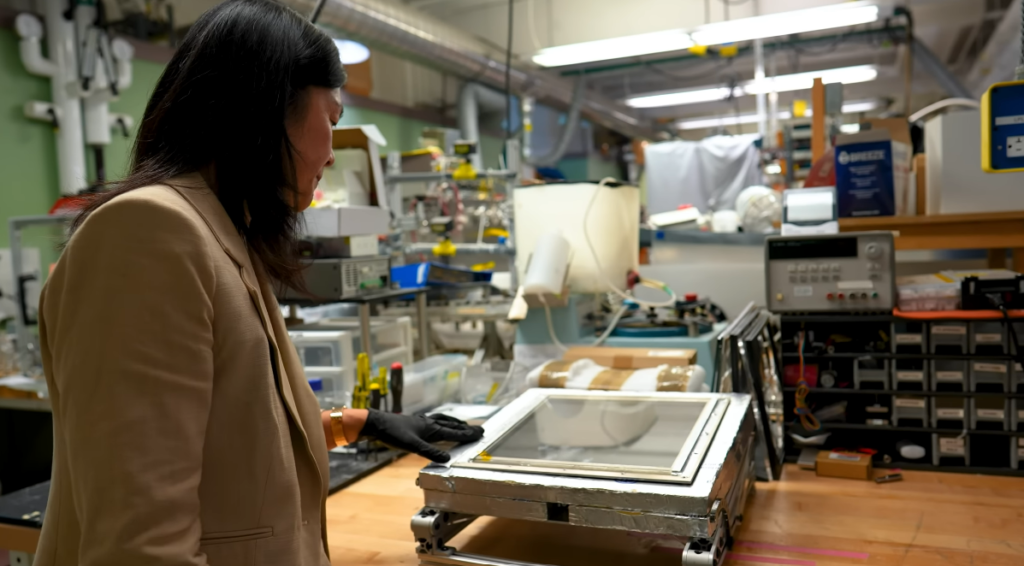
Once found, the solution was quite simple: the metal backing was coated to prevent corrosion. After applying that coating, the hydrogel held up under stress testing at 167 degrees Fahrenheit for more than eight months and remained stable for more than 190 harvesting cycles over 96 days. It’s difficult to ignore how much of the challenge in this case came from the materials science underlying the concept rather than the concept itself. The water harvesting system had been working for many years. The container was gradually consuming its contents, which was the issue.
The research’s co-leader, Carlos Diaz-Marin, an assistant professor at Stanford, has estimated the economic potential of this at about one cent per liter. According to some calculations, that would be comparable to what American households pay for tap water and about 1% less expensive than bottled water. The implications for rural communities in inland arid regions, where desalination is not feasible due to geography and water transportation is costly and unreliable, change significantly at that price point. This is not a luxury country convenience item. The global context here is that, despite decades of infrastructure investment in wealthier countries, one in four people still do not have access to safely managed drinking water.
It would be incorrect to suggest otherwise because the technology is not yet prepared for community-scale deployment. Scaling from a bath towel to a household water supply presents engineering challenges that field conditions will stress-test in ways no laboratory fully anticipates, the output is still modest, and the panels require additional efficiency improvements. However, it seems that the fundamental issue—a gel that is effective but short-lived—has been resolved. It feels different now than it did even two years ago to watch the gap close between proof-of-concept and practical deployment. The researchers believe that the next milestone is not whether or not this works, but rather how quickly they can make it work well enough and affordably enough for those who need it most.
