

In institutions that don’t have to yell, a certain kind of pride develops gradually over decades. Located in the center of New Brunswick, New Jersey, Rutgers Robert Wood Johnson Medical School exudes a calm confidence. When you walk through its hallways or speak with the families who have sent generation after generation through its doors, it becomes evident that this place has significance, even though it doesn’t always make national headlines like some Ivy-adjacent programs do.
The school began as a two-year medical science program at Rutgers University in 1962. Its eventual development into one of the most comprehensive medical schools on the East Coast was unimaginable at the time. It was fully accredited as a four-year MD program by 1972, and the first graduating class crossed the stage in 1974. modest but significant beginnings. Slow, earned growth like that usually sticks.
Approximately 757 medical students are currently enrolled at Rutgers Robert Wood Johnson Medical School, which employs over 4,900 faculty members and staff. It works with 34 hospital affiliates and a network of ambulatory care facilities throughout New Jersey, operating across campuses in both Piscataway and New Brunswick. Although the numbers are important, they don’t fully convey the place’s character. What matters is how students discuss it and, more importantly, how they return to it.
A story that seems almost too perfectly symbolic to be true is currently making the rounds, but it is. Christian Simon, a 25-year-old who recently graduated from RWJMS in May 2026 with a medical degree, is the fifth person in his immediate family to do so. His dad works as an internist. His mom is a pediatrician who has retired. The two older brothers, one in anesthesiology and the other in orthopedic surgery, are alumni of RWJMS. Additionally, a younger sister is applying to be number six. “I had some friends in medical school whose parents were doctors,” Simon replied, “but I think our family is unique with everyone graduating from the same medical school.” It’s difficult not to find that subtly remarkable.
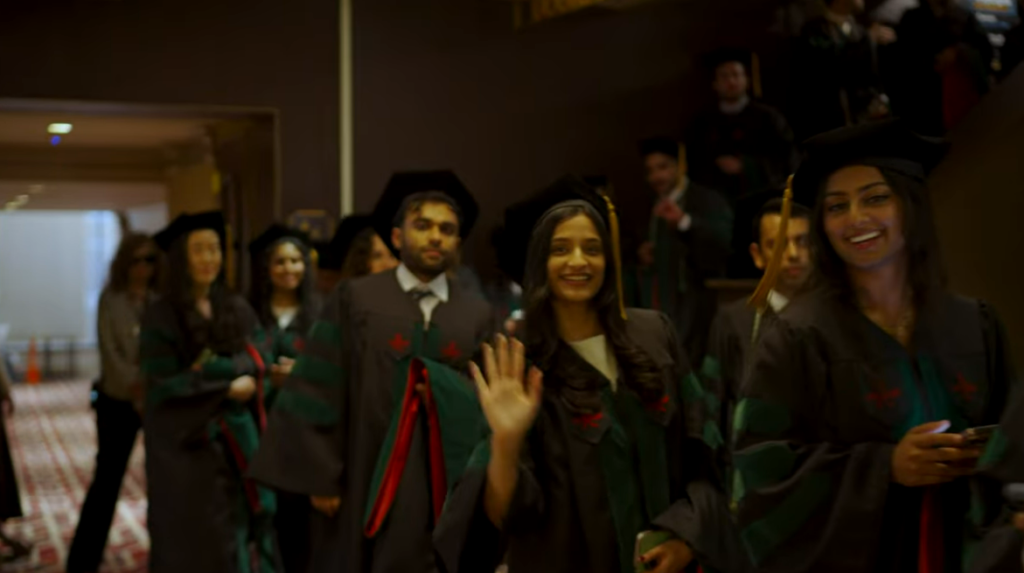
Families like the Simons are drawn back by more than just tradition. A certain emphasis on patient relationships, community service, and the type of medicine that calls for more than just technical proficiency is ingrained in the school’s culture. Growing up, Simon saw his father visit nursing homes and the church to assist neighbors in need. RWJMS appears to foster or at least draw that type of medication. He intends to pursue a fellowship in cardiology after starting his internal medicine residency at Johns Hopkins Hospital this summer. He described internal medicine as “like being a detective,” “constantly piecing together clues to find the diagnosis.” Someone who merely wants to get paid doesn’t speak like that.
The school’s clinical reputation and research goals are closely related. In fiscal year 2012 alone, RWJMS was awarded $89 million in research grants, of which about $50 million came directly from the National Institutes of Health. Particular strengths include cell biology, neuroscience, child health, and cancer research. The school’s affiliations with the Child Health Institute, the Center for Advanced Biotechnology and Medicine, and the Rutgers Cancer Institute of New Jersey provide faculty and students with access to resources that go far beyond the school’s public profile. The institution may simply have been misrepresented to the general public for many years.
The school anticipates a significant structural change in the future. The new Rutgers School of Medicine, which will combine RWJMS and New Jersey Medical School into one cohesive institution, is anticipated to become one of the biggest medical schools in the nation upon its anticipated accreditation in 2027. That’s a significant development. It’s still unclear if this scale turns out to be advantageous or if it leads to the kind of institutional sprawl that dilutes what makes the school function. In the medical field, larger doesn’t always equate to better, and RWJMS has established its reputation based on something more personal than size.
The school appears to have a better understanding of the fact that medicine is ultimately a human profession than many of its peers. Long shifts, conversations at the dinner table, and the silent observation of a father who always knew what to do when someone needed help are all ways that it is passed down. “Seeing him graduate is a reminder of the continuity of the medical profession — knowledge passed forward, values preserved, and compassion renewed with each generation,” stated David Seiden, an adjunct professor of neuroscience and cell biology who has now instructed several members of the Simon family. You don’t create that with a marketing budget. Over the course of more than 60 years of labor, it builds up gradually and purposefully.
