

Two girls, Nasra and Muslimo, sit at their desks at Kabasa Primary School in Dollow, a dusty town in southwest Somalia. They are eighth graders. Children from both the host community and displaced families attend the school, and most days the atmosphere in the classroom is more intense than the actual lessons. The land outside provides all the information you need to understand why so many of their classmates are absent. The drought has appeared, disappeared, and then returned. Additionally, fewer kids show up each time it comes back.
A UNICEF report published in April that quantifies this gradual degradation has a subtly devastating quality. Climate-related weather events have interrupted the education of 130 million children in Eastern and Southern Africa. Schools were damaged. Schools were closed. Schools that are only partially operational due to leaky roofs or that run shorter hours because there isn’t enough food, electricity, or water for the students to survive a full day. The estimated cost of all of this is $140 billion in lost lifetime income for those kids and approximately $1.3 billion in infrastructure damage. If nothing changes, the number rises to 520 million children and $380 billion in losses by 2050.
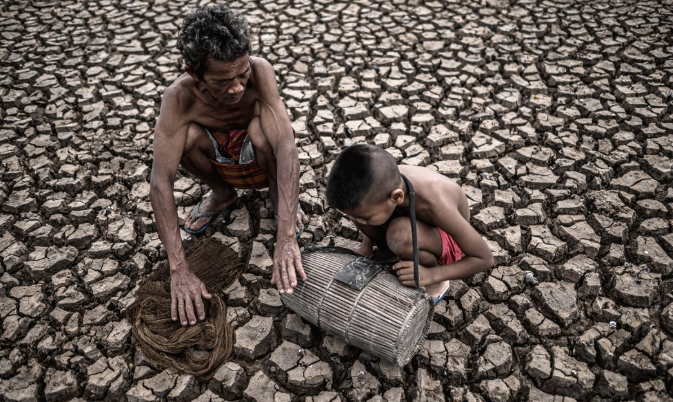
Until you sit with these numbers, they remain abstract. When a child’s classroom’s tin roof is torn off by a cyclone, she misses more than just three weeks of school. She slows down. Sometimes she completely loses her position, particularly if her family decides she should assist with fetching water instead or get married early because there will be one fewer mouth to feed at home. The report almost casually mentions that rural children and girls are disproportionately affected. The rapidity with which a climate statistic transforms into a gender statistic or a poverty statistic is difficult to ignore.
A tiny window into the pattern is provided by Zambia. Approximately five million students’ education was interrupted by floods and droughts between 2005 and 2024, resulting in $60 million in immediate damage and up to $5 billion in lost revenue. Nearly ten million people across the border were left without consistent access to food, water, or electricity during the El Niño drought of 2023–2024. Schools made do. At lunchtime, some sent kids home. Some just ceased to open their doors. It is infamously hard to raise attendance figures once they start to decline.
However, education receives less than 1.5 percent of global climate finance. That number merits a moment on the page. 1.5 percent or less. UNICEF’s regional director for Eastern and Southern Africa, Etleva Kadilli, put it bluntly: children are bearing the brunt of a crisis that they did not cause, and financing decisions largely ignore the impact on them. Reading her words gives me the impression that those closest to this problem are worn out from repeating themselves in rooms that don’t really pay attention.
Strangely, for governments that have not yet taken action, the economic argument might be the strongest. According to UNICEF, every dollar spent on climate-resilient schools can yield up to thirteen dollars in benefits down the road. That’s not the math of philanthropy. Banks typically use glowing slide decks to highlight this type of return development. However, the urgency seems to vanish when the recipients are eight-year-olds in Mozambique or Ethiopia instead of named infrastructure projects.
This month, the relatively new UN organization called the Fund for Responding to Loss and Damage convened in Livingstone, Zambia, to assist vulnerable nations in coping. It was urged by UNICEF to acknowledge children’s rights in climate finance. It’s still unclear if that recognition results in real money that is disbursed fast enough to be significant. Observing this from a distance gives you the unsettling impression that, while the actual losses in actual classrooms continue to compound, the discussion about loss and damage has become comfortable, almost ritualized. Nasra is still studying somewhere in Dollow. How many of her classmates will be there the following term is the question.
