

When the threat is invisible, a certain kind of dread descends upon a neighborhood. There isn’t a fire in sight. There was no distinct smell in the air. Just a map with a circle drawn around your house, an announcement, and officials telling you to leave and take what you need for a few days. Beginning on the evening of May 21, 2026, when a cooling system failure at the GKN Aerospace facility caused one of the most terrifying industrial emergencies, that was the reality for almost 50,000 residents in Garden Grove, Anaheim, Stanton, Westminster, Buena Park, and Cypress. Southern California has seen in years.
Methyl methacrylate, a volatile and extremely flammable liquid used to make plastics and resins for aircraft, was the chemical at the heart of it all. About 6,500 gallons of the material were kept in a 34,000-gallon storage tank at the Garden Grove facility. When the cooling system meant to keep it at about 50 degrees failed, the temperature inside the tank rose toward 100 degrees and continued to rise. Officials from the Orange County Fire Authority promptly recognized two potential outcomes, neither of which was favorable. The tank would either burst and release thousands of gallons of hazardous chemical into the nearby parking lot, or it would go into thermal runaway and explode in a Boiling Liquid Expanding Vapor Explosion (BLEVE), which could cause secondary explosions from adjacent tanks containing fuel and other chemicals. When officials described it, they weren’t being cautious. They claimed that both situations were real.
Tens of thousands of people slept in shelters, parking lots, or at relatives’ homes throughout the county during the five days of overnight missions that followed, millions of gallons of water continuously sprayed onto a failing tank, and firefighters working only after dark because daytime heat made the situation more volatile. Families at the Orange County Fairgrounds in their RVs, school districts transitioning to remote learning in the middle of the week, and a Red Cross network overburdened are all images that are difficult to ignore. On Saturday night, there was a crack in the tank, which the crews cautiously interpreted as a natural pressure release rather than a catastrophic failure. That distinction was very important. The worst-case explosion was ruled out by officials by Monday.
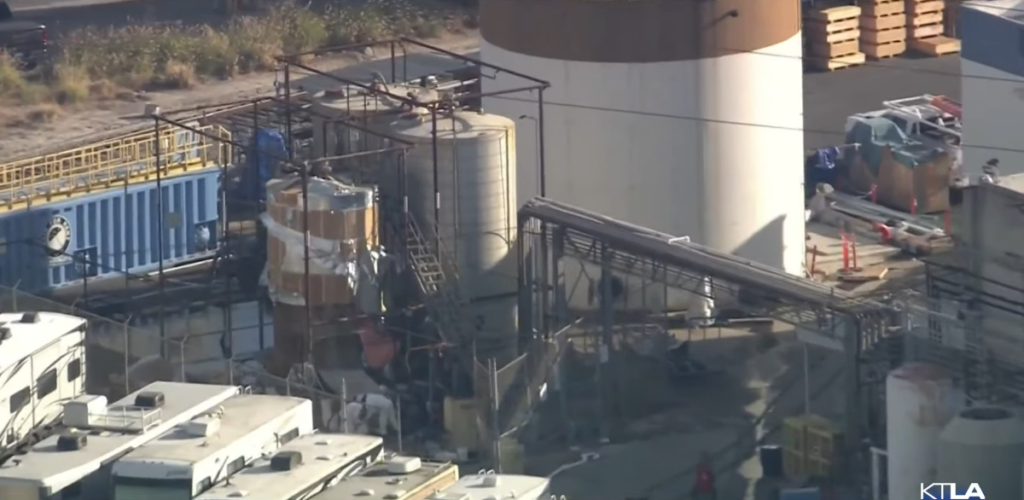
It wasn’t over, though. In those press conferences, the word “stabilize” was used frequently and with caution, which told its own tale. There was still a chance for smaller explosions. Tuesday was spent by firefighters gradually lowering the water flow on the tank, monitoring the temperature, and determining whether the chemical inside had sufficiently cured and solidified. OCFA declared that there was no risk left by Tuesday night. At 7:30 p.m., the evacuation orders were lifted. There were no reported injuries. Considering what had been discussed a few days prior, that result was not insignificant.
What surfaced in the background while the tank was being doused is more difficult to ignore. In 2024, GKN Aerospace, the UK-based aerospace manufacturer running the facility, paid slightly less than $910,000 to settle a lawsuit with California’s South Coast Air Quality Management District for violations that included emitting volatile organic compounds—the same class of chemical as methyl methacrylate—without the required permits. A criminal investigation was launched by the Orange County District Attorney, who also urged whistleblowers to come forward. Almost immediately after, displaced residents filed class-action lawsuits alleging carelessness and inadequate upkeep. The larger question seems more urgent: why was a facility handling thousands of gallons of highly flammable chemical situated in the middle of a densely populated residential and commercial corridor in the first place? Some of those legal issues might take years to resolve.
When evacuation orders were eventually lowered, one Stanton resident put it bluntly while standing outside his house. “They were probably here first,” he remarked regarding the establishment. “But now we’re populated.” Over the course of five days, the majority of the official statements made at those podiums have less weight than that quiet observation. While the surrounding neighborhoods have become closer and denser, the industrial geography of mid-century Southern California remains unaltered. That tension wasn’t brought on by this incident. It simply made it impossible to ignore.
