

With folders on the table, courteous handshakes, and photographers moving around to get the ideal angle, the signing ceremony in Tashkent this April carried the quiet weight that sometimes accompanies government events. However, there was something less ordinary going on behind the formality.
Uzbekistan recently joined the Global Platform for Access to Childhood Cancer Medicines, a collaboration between WHO and St. Jude Children’s Research Hospital, as one of just six pilot nations. The agreement is more than just a paper milestone for the 3,500 children in the nation who receive cancer diagnoses every year. It’s a line of supply.
| Field | Details |
|---|---|
| Country in focus | Uzbekistan |
| Key initiative | Global Platform for Access to Childhood Cancer Medicines |
| Co-founders of platform | St. Jude Children’s Research Hospital and WHO |
| Acting Minister of Health | Mr Asilbek Khudayarov |
| WHO Representative to Uzbekistan | Dr Asheena Khalakdina |
| Total investment commitment | US $200 million over 6 years |
| Procurement agents | UNICEF and PAHO Strategic Fund |
| Children diagnosed annually in Uzbekistan | 3,500 |
| Hospital schools project | “We Teach/They Learn”, led by Prof. Sergey Sharikov |
| Uzbek hospital school | Mehrli Maktab School, Tashkent |
| Schools established in Uzbekistan | 7 |
| Subjects taught | Electronics, IT, music, math, art |
| Survival rate gap | Over 80% in high-income countries vs under 30% in many low- and middle-income ones |
Asilbek Khudayarov, the acting minister of health, presented the choice as an acknowledgment of the nation’s emphasis on childhood cancer, and this framing isn’t just diplomatic theater. Since September 2019, Uzbekistan has been a focus nation for the WHO Global Initiative for Childhood Cancer, and policy reform has advanced in tandem with medical efforts. Someone in the system seems to have decided that this couldn’t continue to be deprioritized. The more difficult question is whether that momentum continues after the cameras have left.
The platform’s numbers are impressive. Over the course of six years, St. Jude has committed US$200 million; procurement is handled by UNICEF and the PAHO Strategic Fund. It takes years to measure these things, but the model is supposed to be transformative, and the language surrounding it occasionally suggests that more confidently than the data does yet. However, the gap they are attempting to bridge is harsh and well-established. Over 80% of children with cancer survive in high-income nations. Less than 30% do in many low- and middle-income nations. Often, medications make a difference.
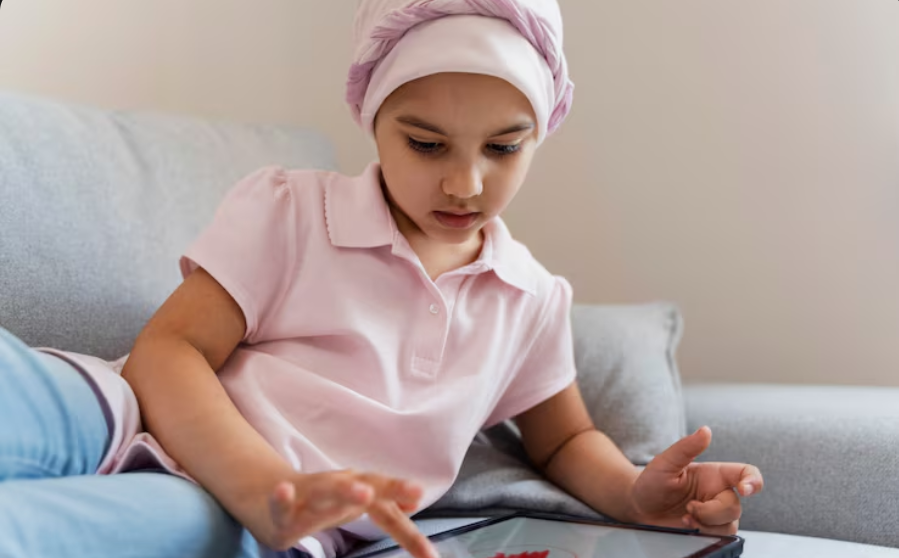
The medicine pipeline is not the only thing that makes the Uzbek story unique. The Mehrli Maktab School, a hospital school for kids ages 2 to 18 that teaches everything from electronics to music, is located in the south wing of the Scientific and Practical Medical Center for Pediatric Oncology, Hematology, and Immunology in Tashkent. It is a part of the global “We Teach/They Learn” initiative, which began in 2011 at the Moscow Rogachev Center and has since expanded to Kyrgyzstan and Uzbekistan. Andijan, Fergana, and Nukus have opened branches; Namangan, Samarkand, and Bukhara will follow.
The project’s director, Professor Sergey Sharikov, discusses cancer in a straightforward manner that most administrators shy away from. He experienced cancer as an adult, and he consistently returns to the same conclusion: when discussing this illness, there must be some light. He cites Russian pediatrician Stepan Khotovitsky from the 19th century, saying that children are not miniature versions of adults. Treatment is not interfered with by the hospital lessons. They serve as a link to friends, everyday life, and the future that a sick child still has hope for.
It’s difficult to ignore how that philosophy has subtly produced outcomes that go beyond the readily apparent medical metrics. At the UNESCO International Youth Festival in Kazakhstan last year, eleven Mehrli Maktab students were named winners or finalists, with Samira Idrisova winning first place. The last exhibition made its way to the Paris headquarters of UNESCO. Children in the middle of treatment, painting their way into a structure that most artists never see.
The logistics of distribution, the persistence of political will, and whether the survival gap truly closes are all still unknowns. However, the architecture being constructed in Uzbekistan treats sick children as future scientists and artists rather than as statistics by fusing medicine and education. Investing in their education is an investment in our collective future, according to Sharikov. At least that portion doesn’t sound like a press release.
