

A minor, nearly unimportant aspect of Dua Lipa’s life story is often overlooked in favor of the Grammy Awards and chart records: she was once told she couldn’t sing by a primary school music teacher. She was having trouble hitting the high notes during her choir audition at Fitzjohn’s Primary in West Hampstead, and the answer was no. It’s the kind of moment where many things could have come to an end. Rather, it led her to Sylvia Young Theatre School, where she began weekend classes at age nine and, apparently for the first time, was told the opposite.
That difference reveals something about the real nature of her education. From talented kid to international pop star, it wasn’t a straight line. It was patched together across two nations, uneven, interrupted, and sometimes depressing. When she was in elementary school, she studied cello, carried the instrument on her back to class, and eventually gave it up because, in her words, it kept hitting her in the head. tiny, nearly humorous detail. However, it also serves as a reminder that her early training wasn’t planned for celebrity. Like most childhoods, it was typical.
When Kosovo gained independence in 2008 and her family returned to Pristina, everything changed. While still a teenager in a nation rebuilding its identity, she enrolled in Mileniumi i Tretë School, improved her Albanian, and, according to her own account, began seriously considering a career in music. An English-raised child relearning her parents’ language in a city emerging from conflict and taking in a local hip-hop scene that wasn’t present in her London upbringing is something to sit with. It’s not the standard origin story of a pop star, and it probably shouldn’t be reduced to one.
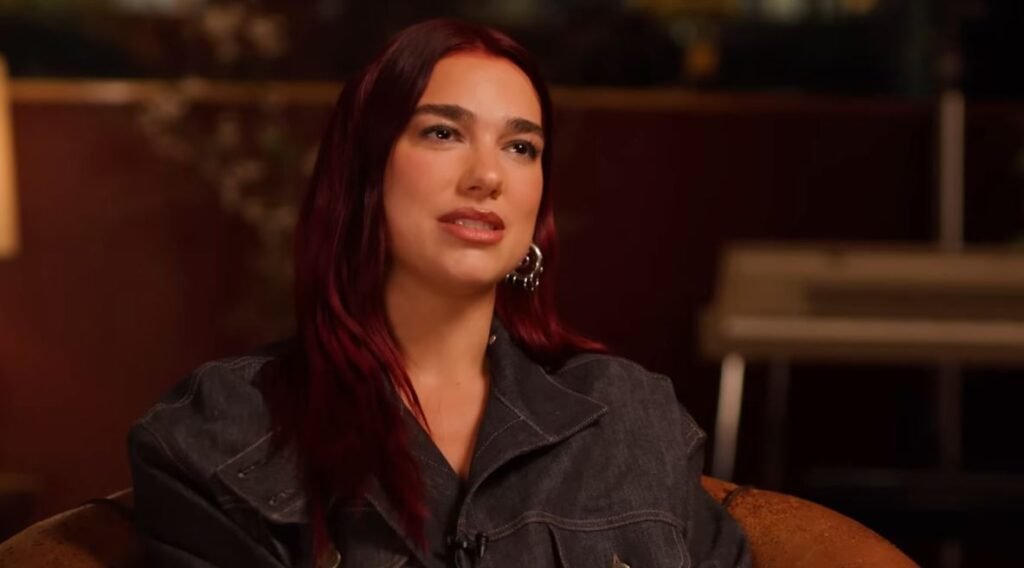
Her decision to move back to London alone, live with a family friend, and attend Parliament Hill School for her A-Levels at the age of fifteen is what most accounts of her life revolve around. It’s worth stopping to consider how strange that is. That kind of flexibility is not typically granted to teenagers. Despite everyone’s apparent awareness that the true objective was music, her parents reportedly approved of it because it was presented as a way for her to further her education. She returned to Sylvia Young part-time in addition to her studies, dividing her time between tests and YouTube renditions of Christina Aguilera and Alicia Keys.
It’s simple to overlook the fact that her formal education continued after her music career took off. Decades after becoming well-known, Lipa obtained a GCSE in Spanish in October 2025. This academic degree was apparently pursued for its own sake and had no clear connection to a career. The typical celebrity narrative, which portrays school as something you avoid rather than return to, is complicated by this small data point. There’s a feeling that education was never merely a way out for her.
It doesn’t read like a neat success formula when you look at the entire arc, which includes the cello, the rejected choir audition, the back-and-forth from Tirana to London, the part-time stage school, and the adult GCSE. Perhaps the most telling detail of all is that it reads more like someone who, despite having obviously “made it,” kept going back to school.
