

When powerful people share a room but lack a common vision, a certain kind of institutional stubbornness takes hold. Commissioners, athletic directors, and media executives have spent days discussing the main issue that no one seems to be able to clearly answer at the Big Ten’s spring meetings in Rancho Palos Verdes, a quietly pricey stretch of California coastline that seems strangely appropriate for a discussion about money: if the College Football Playoff expands to 24 teams, who is actually funding this thing?
The College Football Playoff expansion dispute can be summed up as follows: the Big Ten wants 24 teams, the SEC wants 16, and the ACC and Big 12 have sided with the larger number. Tony Petitti, the commissioner of the Big Ten, has made it very clear that there will either be 24 teams or the format will remain at 12. No compromise, no 16-team option. The CFP confirmed it will stay at 12 teams through at least the 2026 season in response to that ultimatum and the lack of an agreement, which speaks volumes about how successful these talks have been thus far.
Speaking at the Alabama Sports Hall of Fame in Birmingham, SEC commissioner Greg Sankey sounded more like someone who was genuinely perplexed that the opposition hadn’t produced more compelling statistics than someone who was delving deeply. “We’re open to the conversation,” he stated, “but there are a lot of ideas out there that have to be supported with analysis and information, not speculation.” It’s difficult not to interpret that as a scathing indictment of the Big Ten’s public campaign strategy, which involves making promises before the necessary funding is in place.
Furthermore, those foundations are actually unstable. The CFP currently has a six-season, roughly $7.8 billion contract with ESPN that expires in 2031–2032. ESPN has stated its stance: either stay at 12 or push to 16 at most. ESPN paid that amount exclusively and has no interest in sharing the postseason stage. Fox, which does not currently own any CFP rights, is loudly excited about 24 teams, which may speak more to Fox’s programming gaps than to the best interests of the sport. Last season, Fox only broadcast three games with at least 10 million viewers. Ten were broadcast by ESPN. Fox’s enthusiasm is based on simple math.
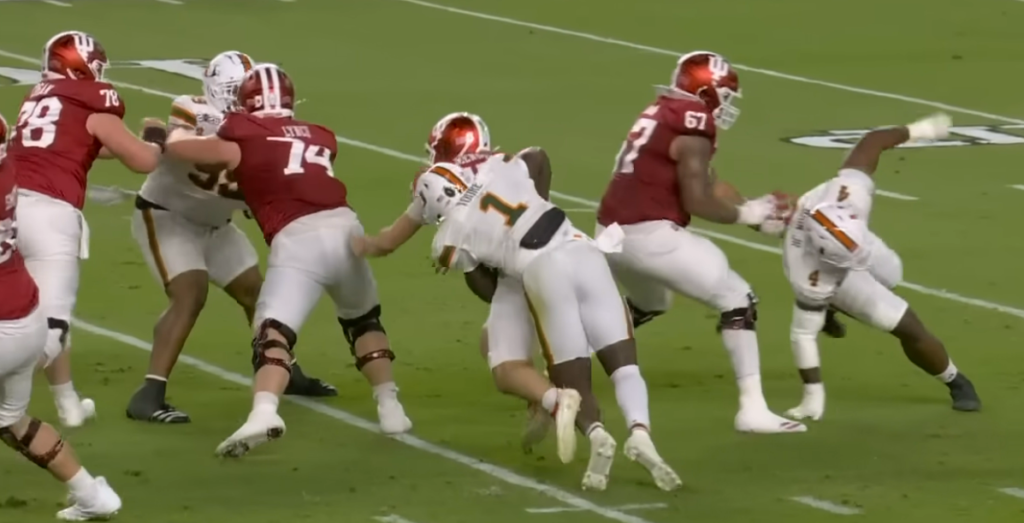
As you watch this unfold, you get the impression that the football itself is practically irrelevant. A jump to 24 teams was described by Texas coach Steve Sarkisian as a “knee-jerk reaction,” and he is not the only coach who believes the regular season would be hollowed out by the expanded field. A 24-team bracket makes mid-November games between ranked opponents feel like exhibitions, which is the SEC’s clear and persistent fear. It’s reasonable to be concerned when almost 25% of the best teams in the sport are already assured a postseason berth. In college football’s playoff expansion history, schools have typically scheduled weaker opponents rather than stronger ones as the field expands. The claim that 24 teams would result in better nonconference games in September is, at best, speculative.
There is also a problem with the money math. Conference championship games, which together bring in about $200 million a year for the Power 4 conferences, would probably be eliminated if the number were increased to 24. According to Petitti, first-round games held on campus could recover about $80 million of that. The value of the SEC’s own championship game alone is $100 million; importantly, the SEC retains this money instead of sharing it through the CFP. Although Sankey hasn’t stated it explicitly in those terms, anyone who is paying attention can see the math.
Maybe this doesn’t end as dramatically as the noise right now indicates. The idea of expanding March Madness to 96 teams seemed inevitable when the NCAA debated it in 2010. However, the larger number quietly died when CBS and Turner jointly bid for a 68-team format. It’s not impossible for ESPN and TNT to reach a 16-team agreement that eliminates Fox and limits the damage. It’s still unclear if the conferences have the self-control to wait for something that genuinely benefits the sport or if the prospect of immediate financial gain will prevail as it usually does.
From a distance, it seems like college football is bargaining with itself. The scarcity that gives every late-October game a sense of importance makes the regular season one of the most captivating aspects of American sports. Drama is diluted rather than added when the playoff field is doubled. The conferences are aware of this. The coaches are aware of this. It’s a different matter entirely whether the commissioners act on it or not.
