

After a team’s season concludes, a certain silence descends upon Charles Schwab Field, and on Wednesday night, it belonged to Georgia. 24,446 spectators watched the Bulldogs leave the field for the final time this season as the scoreboard showed 11-4 in Oklahoma’s favor. Unlike some elimination games, it wasn’t a blowout. Five home runs over the course of nine innings, each eroding Georgia’s remaining hope into the final frames, was something slower and more methodical.
Two of them were struck by Jason Walk. Dasan Harris also felt that the game had changed from “still possible” to “essentially over” when he hit a two-run blast in the eighth inning. Another was added by Trey Gambill. As the game progressed, it became apparent that Oklahoma simply had more swing reserves than Georgia had outs to offer. The Sooners finished with a total of fifteen hits. After the game, coach Wes Johnson stated unequivocally that Oklahoma was hot, making pitches all night long, and not missing anything. When the lineup card tells the same story twice in three days, it’s difficult to argue otherwise.
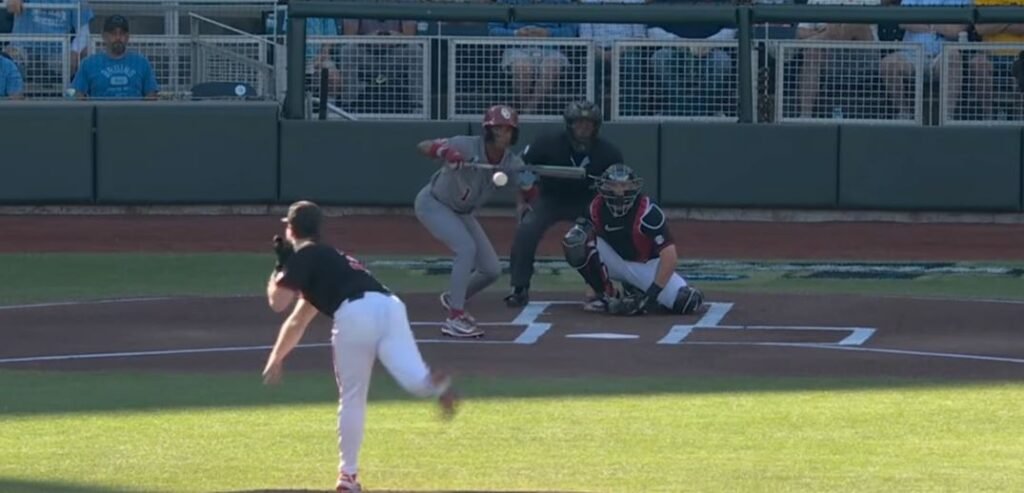
Because these two had previously met in Omaha. Earlier in the tournament, Oklahoma had already defeated Georgia 4-3 in a closer, more tense match. This one was more detached and less tense. After leading the Bulldogs through a period in which they gave up just five runs in three College World Series games, Georgia’s bullpen eventually gave way due to repeated contact. After giving up four runs on six hits in just 3.1 innings, Paul Farley handed the ball to Matt Scott, who gave up five more. Even from a distance, you can tell that the staff was simply running out of answers on this kind of outing.
Georgia engaged in combat. With two bases-loaded walks, they overcame a 5-1 deficit to 5-3—the kind of modest, unglamorous offense that keeps a dugout believing. However, Oklahoma responded right away in the lower half, and this pattern—Georgia chipping, Oklahoma responding—repeated until the gap grew too big to close. In his final collegiate at-bat, Georgia’s senior shortstop Kolby Branch—possibly the most reliable batter of the spring—hit a home run. Fifty-six for his career, twenty for the season. A career-defining swing that ended in defeat seems almost too fitting, as though the moment wanted to give him something even though it cost him the season.
Observing this Georgia team’s overall trajectory, one thing that sticks out is how far they’ve come to be in Omaha. A program that hadn’t made it to the College World Series since 2008 won the SEC regular season, won its first conference tournament, and set a school record by finishing 53-14. The fact that one elimination game went awry does not make those numbers vanish. If anything, they raise a different question: was this defeat just Oklahoma’s superior performance on a given night, or did it indicate that Georgia’s thin pitching depth by August standards would always be put to the test by a lineup centered around power?
Which explanation is more plausible is still up for debate. Perhaps they both do. With momentum that appears to be almost unstoppable right now, Oklahoma advances to play North Carolina for the national championship. Fans may be less inclined to focus on the eighth inning in Omaha, but they will still remember the SEC title as Georgia returns home with a stellar season and an uncomfortable final box score.
Observing programs build toward such moments gives me the impression that a few unexpected swings can make the difference between championships and deep postseason runs. The season belonged to Georgia. Oklahoma had the bats on this specific night. Although Branch’s home run won’t alter the outcome, it’s likely the picture that Georgia supporters will remember the most—proof that there was still something worthwhile to watch even in an ending.
