

On a Tuesday morning, you will observe things in a special education classroom that are not included in any policy report. The teacher’s desk was piled high with binders. The sticky notes that indicate incomplete IEP documents. With his headphones on, the student in the back corner appears to be focused solely on a screen. These seemingly insignificant details reveal a system that has consistently been underfunded and asked to accomplish too much with insufficient resources.
But something is beginning to change. Artificial intelligence is slowly but surely finding its way into special education classrooms, and when it does, the results are truly remarkable.
Personalized learning is undergoing the most rapid change. AI-powered systems can now monitor a student’s progress in real time, modifying pace and difficulty without waiting for a teacher to realize something isn’t working. A teacher overseeing twenty-two students simply cannot manually replicate that kind of dynamic responsiveness for a student with dyslexia who reads three grade levels behind her peers or a child with ADHD who loses the thread of a lesson after four minutes. It’s possible that this is one of those infrequent instances where technology solves the right issue rather than the practical one.
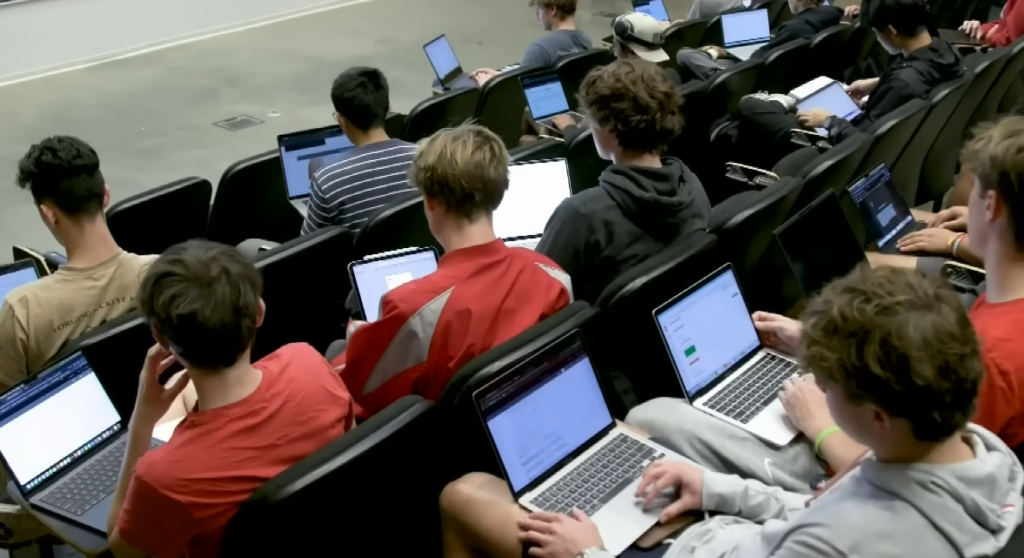
Then there are assistive technologies, which might be where AI’s effects are felt the quickest. Although speech-to-text software has been around for a while, more recent AI-powered models are significantly more accurate, responsive, and capable of managing the erratic speech patterns typical of students with autism or cerebral palsy. Schools are testing smart glasses that give students with low vision real-time audio descriptions of their surroundings. Sitting in therapy rooms in states like Texas and California, robots created to assist kids with autism spectrum disorder in practicing social interactions are providing some students with a stress-free environment to practice abilities that the human world finds frightening. Observing some of these tools in use gives the impression that the gap between what is theoretically feasible and what is actually accessible to actual children is finally, albeit tentatively, beginning to close.
Most people outside the field are unaware of the administrative burden that special education teachers have to bear. The time that teachers truly want to spend with students is taken away by tasks like creating and maintaining Individualized Education Programs, monitoring behavioral data, and creating materials that are different for students with wildly different needs. AI tools that can create differentiated worksheets, synthesize progress notes, or draft IEP language aren’t flashy innovations, but they are crucial for a teacher who gets to school at seven, leaves at six, and still brings work home. In order to free up more time to sit next to a struggling reader or work through a social story with a child who is having a difficult week, a number of educators have described using AI to handle the clerical portion of their jobs.
Whether all of this scales is still up for debate. Teachers who were already considerate, well-resourced, and supported by administrators who took training seriously are typically found in classrooms where AI tools are functioning effectively. The schools most in need of these resources are frequently the least prepared to use them. That gap won’t go away on its own.
The truth is that special education has not been improved by AI. It hasn’t. However, there are currently students in classrooms who are able to communicate in ways that were previously unattainable, whose teachers have a few more hours to actually teach, and who are exposed to materials that are specifically tailored to their mental processes. That is not insignificant. It may even be a beginning in a field that has long demanded more than it has gotten.
