

The typical indicators of tech ambition can be seen when you stroll through some San Francisco neighborhoods: sleek storefronts, coffee shops supported by venture capital, and sidewalks crowded with people gazing into phones with the quiet intensity of someone reading their own stock ticker. This city has turned disruption into a religion. Maybe it was just a matter of time until someone decided that the kindergarten classroom also needed to be disrupted.
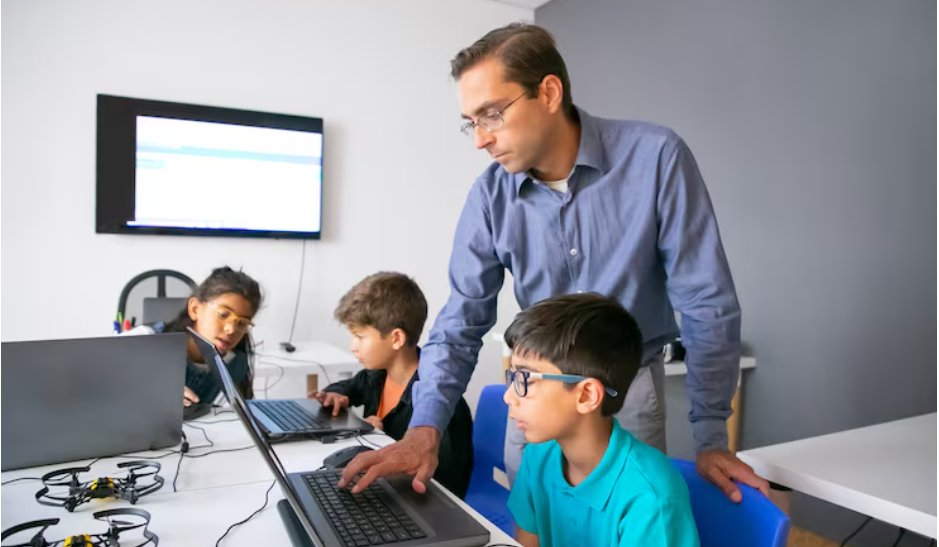
Alpha School, which positions itself as an AI-powered substitute for conventional K–8 education, opened its San Francisco campus this autumn. The pitch is aggressive in its simplicity: instead of teachers, students are guided by AI-powered apps for just two hours each day in core academics. Life skills, passion projects, and startup pitches take up the remainder of the day. There are “guides” in place of teachers—adults who provide motivation and emotional support while letting the software handle the actual teaching.
On the day a camera crew visited, 14-year-old Ethan Wong was allegedly using AI to create a molecular gastronomy app. He acquired the skill of making investor pitches. His father acknowledges that it had been a long time since he had witnessed such a smile as he left school. Alpha’s marketing team could not have scripted a better image.
And yet. Another version of this tale feels more like a costly gamble with other people’s kids than it does like innovation. Alpha isn’t exactly democratizing education at $75,000 a year, which is more than most Ivy League tuition. It serves a very small portion of San Francisco that hardly qualifies as a demographic. By definition, the 15 pupils in the first class come from families that move in affluent circles. Claims that students score in the top one to two percent nationally begin to raise unsettling questions about what’s really being measured when a school’s own admissions process filters for extraordinary privilege.
Scholars from Berkeley, Stanford, and Harvard have examined Alpha’s model with about equal parts curiosity and skepticism. In academic parlance, Emma Pierson of Berkeley’s AI Research Lab characterizes herself as a cautious optimist, which is about as reserved as it gets. It’s not that AI has no place in education. It’s because deployment is happening far more quickly than any thorough analysis of the effects. She pointed out that “educational experiments that do not work well for kids” have a long history and that tech-driven enthusiasm tends to completely ignore that history.
The question of who this model truly serves is another. Self-directed, app-based environments tend to favor children who are already self-assured and intrinsically motivated, according to Ying Xu of Harvard, whose own research explores AI’s role in student learning. This approach may be subtly alienating to children who struggle—those who require peer interaction, collaborative whiteboard moments, and a teacher who recognizes when something is wrong. “Just like Montessori schools, the format doesn’t work for all students,” she replied. Even though there isn’t much space for such nuance in Alpha’s marketing materials, that is an important and honest admission.
The fact that Alpha’s real use of AI might not be as radical as its branding implies is genuinely intriguing and somewhat ironic. Its pedagogy does not involve chatbots. It makes use of numerous apps that have long been used in both public and private schools. The AI primarily serves as a pacing tool, assisting teachers in identifying areas in which a student is having difficulty and modifying the content accordingly. Chris Agnew of Stanford put it simply: “They’re leading with AI because they’re riding the wave.” It’s not a criticism. However, it is important to bear this in mind when analyzing the school’s broader assertions.
The president of United Educators of San Francisco, Cassondra Curiel, has been forthright about her concerns, urging stricter regulations and cautioning that untested AI in educational settings poses serious risks. In a city whose whole economy depends on moving quickly, it’s still unclear if those cautions will have much of an impact. Next autumn, Alpha intends to grow from fifteen to seventy-five students, and some scholarships will be offered. Whether or not the research has caught up, the experiment is expanding.
Here, it’s difficult to avoid feeling the pull of both sides. It’s not insignificant to witness a teen pitch a startup with sincere enthusiasm. However, it is odd to look for the future of education at a school that costs more than a year at Harvard, serving children whose futures were arguably already assured.
