

The fact that one of the more genuinely brilliant engineering concepts of recent years began with a garage and a rejection letter is almost poetic. William Freeman, an electrical engineer at Polaroid at the time and a professor at MIT today, saw an advertisement in Scientific American back in 1985. Up to $10,000 was available for creative textile and apparel concepts through the Innovative Design Fund. Freeman provided a zipper with three sides. The kind that could turn a chair or tent from soft to solid like flipping a switch, but not the kind that closes a jacket. The plan was rejected. Despite this, Freeman patented the concept, put it away, and presumably hoped that the world would catch up.
That didn’t happen for about forty years.
The Y-zipper is the result of researchers at MIT’s Computer Science and Artificial Intelligence Laboratory, or CSAIL as it is more widely known, revisiting Freeman’s triangular zipper concept. The name is appropriate and direct. When a slider is drawn across three flexible plastic strips, they interlock along three sides to form a rigid, triangular tube. The resultant structure has a 160-fold increase in bending stiffness. That is a substantial amount. That’s what separates something more like a tent pole from a strand of cooked spaghetti.
Based on the idea, the lead researcher, MIT postdoc Jiaji Li, and his team developed a software design tool that allows users to specify the desired geometry, such as straight, bent, coiled, or twisted, and the system automatically creates the zipper geometry before sending it to a 3D printer. In a single pass, the printer manages the slider housing, the teeth, and the flexible bridges connecting them. The term “elegant” may be overused in engineering coverage, but it’s difficult to avoid in this context. The entire device snaps together and prints in one piece.
The Y-zipper resembles a squid with three loose tentacles extending in various directions when it is unzipped. These tentacles lock together to form a taut, rod-like column when the slider is pulled up. Video demonstrations have garnered genuine attention due to the unusual visual, which isn’t always the case for fabrication research. Online viewers initially seem unsure of what they’re seeing, which is typically an indication that the concept is genuinely novel.
The CSAIL team’s prototyped applications are sufficiently diverse to imply the concept’s actual breadth. It typically takes one person six minutes to set up a tent. That is reduced to about a minute and twenty seconds when Y-zipper ribs are fastened to the frame. In order to provide adjustable rigidity in a medical setting without the need for electronics or pumps, the researchers also wrapped the device around a wrist cast, enabling a patient to zip the brace firm at night and loosen it during the day. The zipper as a therapeutic mechanism that responds to a patient’s daily rhythm has a subtle significance.
The robots come next. In order to automate the zipping action and create a robotic quadruped with movable leg length, the team connected a motor to the Y-zipper. shorter legs for confined spaces and taller legs for rough terrain. Although the direction is intriguing, it’s still unclear if this will translate smoothly into real-world deployment—field conditions tend to complicate lab demonstrations. Additionally, the team conducted durability tests that appear promising: the device withstood about 18,000 open-close cycles before breaking, and 3D simulations indicated that this resilience was due to its elastic structure.
Here, the materials are important. The group used two plastics that are frequently used in 3D printing: thermoplastic polyurethane, which is more flexible, and polylactic acid, which can support larger loads. Although the current printing platform places restrictions on how big the zippers can actually get, Li has suggested that future metal versions could be much stronger and that scaling up for larger structures is a logical next step.
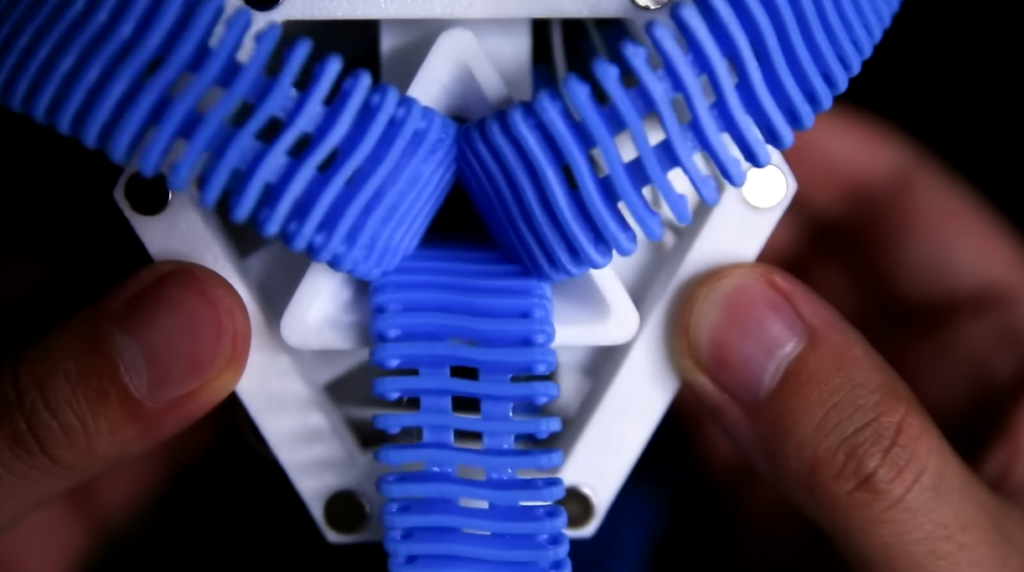
The way this fits into the expanding field of HCI and fabrication research around “tunable stiffness”—the notion that an object shouldn’t have to be one thing all the time—is what makes the larger context intriguing. Previous methods included origami-inspired mechanisms, jamming-based systems, and inflatable structures, many of which needed external pumps, were difficult to reverse, or required manual reassembly. Most of those restrictions are circumvented by the Y-zipper. It can be made rigid with a single motion and reversed with the same motion. No additional hardware, no heat, and no pumps are needed.
Li and his team have mentioned applications that go far beyond the current prototypes, such as spacecraft appendages designed to collect rock samples from adjacent surfaces and emergency shelters quickly deployed during disaster relief. For the time being, these are speculative, and research coverage has a tendency to let speculative applications handle too much of the work. However, as this develops, the underlying idea seems resilient enough that some version of those futures is worth considering. At the very least, an idea appears to have good staying power if it was able to endure forty years in a garage and emerge stronger.
