

The scene outside Harvard-Westlake’s Upper School campus in Studio City is predictably chaotic if you drive north on Coldwater Canyon Avenue on any weekday morning. Cars are parked along the narrow street, and students are moving between buildings on 22 acres nestled into the hillside. It’s the kind of controlled bustle that suggests a place that takes itself seriously without having to make an announcement. At first, the campus served as a country club. In some way, that detail seems appropriate.
Despite what the name suggests, Harvard-Westlake School is not connected to Harvard University. The Harvard School for Boys, established in 1900 by a Boston-born teacher named Grenville C., is where the “Harvard” part originates. Emery requested permission to use the name from Charles W. Eliot, the president of Harvard University at the time, and was granted it. The school began on a barley field in Los Angeles, evolved into a military academy supported by the Episcopal Church, and, in 1937, moved to its present site in Studio City thanks to a $25,000 loan from aviation pioneer Donald Douglas. The Westlake piece came later, from a 1904-founded girls’ school that remained an all-female institution for decades until a contentious merger in 1991 made Harvard-Westlake fully coeducational. It seems that those who were present at the time can still recall the controversy.
Currently, the school has about 1,600 students enrolled in two campuses for grades seven through twelve. Anyone familiar with Los Angeles geography will know that the Middle School is located on North Faring Road in Holmby Hills. The cost of tuition for the 2024–2025 school year is $49,700; additional expenses for books, meals, extracurricular activities, and a bus service raise average annual costs to over $55,000. In 2023, the school gave out $14 million in financial aid, with roughly 20% of students receiving an average of $33,500. Although the majority of families still arrive at the school in cars with German names on the hood, that is a significant number.
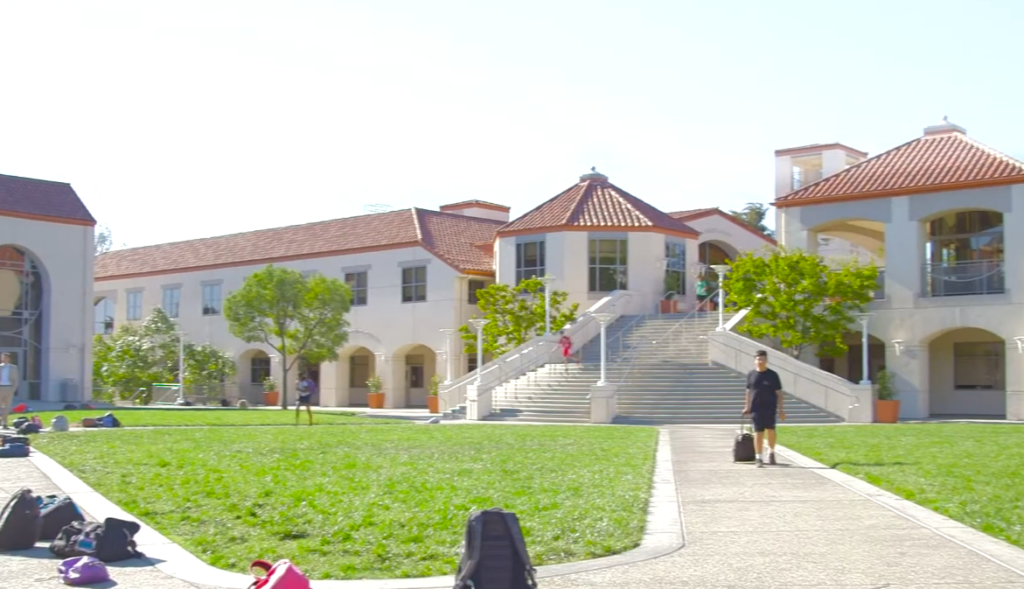
The most noticeable aspect is the academic profile. Recent graduating classes have averaged 716 verbal and 745 math on the SAT. Out of 292 seniors, 27 made it to the National Merit Semifinals in the 2019 class alone. Harvard-Westlake has continuously been ranked by Niche as one of the top ten private high schools in the country; in one recent ranking cycle, it was ranked second in California and sixth nationally. It is ranked in the top 150 schools worldwide by the Schools Index. Although these rankings are accompanied by the customary asterisks, there is a pattern that is difficult to ignore.
The baseball program is possibly less anticipated. One Studio City school has produced so many professional pitchers that it is difficult to ignore. Max Fried is currently a pitcher for the New York Yankees. The Detroit Tigers’ Jack Flaherty is a pitcher. The San Diego Padres signed Lucas Giolito. The Chicago Cubs’ center field player is Pete Crow-Armstrong. These are not big-league, marginal careers.
Fried agreed to a $218 million contract. About 60% of students participate in interscholastic sports at the school, which fields 22 varsity teams overall. This participation rate would surprise anyone who thought a school with these academic numbers would treat athletics as an afterthought.
Weddington Golf & Tennis, a 16-acre club less than a mile from the Upper School, was purchased by Harvard-Westlake in 2017 for more than $40 million with plans to build a new athletics center.
epending on how you interpret it, this type of action conveys institutional ambition or confidence. With two campuses, a $148 million endowment, and an alumni list that consistently appears in box scores and on professional rosters, the school seems to have spent more than a century creating something that has substantial momentum of its own. For any institution, the question of whether that trajectory will continue unabated is always open, but there is currently no indication that Harvard-Westlake is slowing down.
