

A version of Donovan Mitchell’s story exists in which he plays baseball. At Canterbury School in New Milford, Connecticut, Mitchell is chasing down a pop-up in the infield when he collides with the catcher, breaking his jaw. Mitchell leaves with a broken wrist and, unbeknownst to him, an entirely different future. His baseball career as a sophomore is over. His planned AAU run has been canceled. His route to the NBA was unintentionally opened.
The career stat lines and highlight reels tend to overlook this kind of information, but it is important. There are many of these subtle turning points in sports careers that don’t become apparent until years later.
Mitchell began his high school career at Canterbury School as a multi-sport athlete, playing baseball and basketball, which is how many children in Connecticut divide their time between different seasons. He was competent. As early as December 2012, college coaches were starting to take notice of his name. However, “ready for national exposure” and “good” at the prep level are two different things, and his injury made his family reevaluate the entire strategy.
For his junior and senior years, his mother moved him to Brewster Academy in Wolfeboro, New Hampshire. On paper, the decision seems straightforward, but anyone familiar with prep basketball knows what it really means: Brewster wasn’t just a school with a strong team. NBA-caliber players came specifically to be seen, tested, and developed at one of the nation’s most well-known programs. There was a declaration of intent to move there.
Mitchell’s tenure at Brewster is intriguing because it wasn’t just transactional. He didn’t simply show up, put in a lot of practice, and remain focused. At the end of his junior year, he ran for senior prefect, and it seems that he won, which speaks volumes about how quickly he made friends. He participated in the school musical. As a member of the Gold Key Club, he gave tours to visiting students. There’s a certain ease and social confidence there, which likely carried over into team cultures and locker rooms in ways that aren’t evident in box scores.
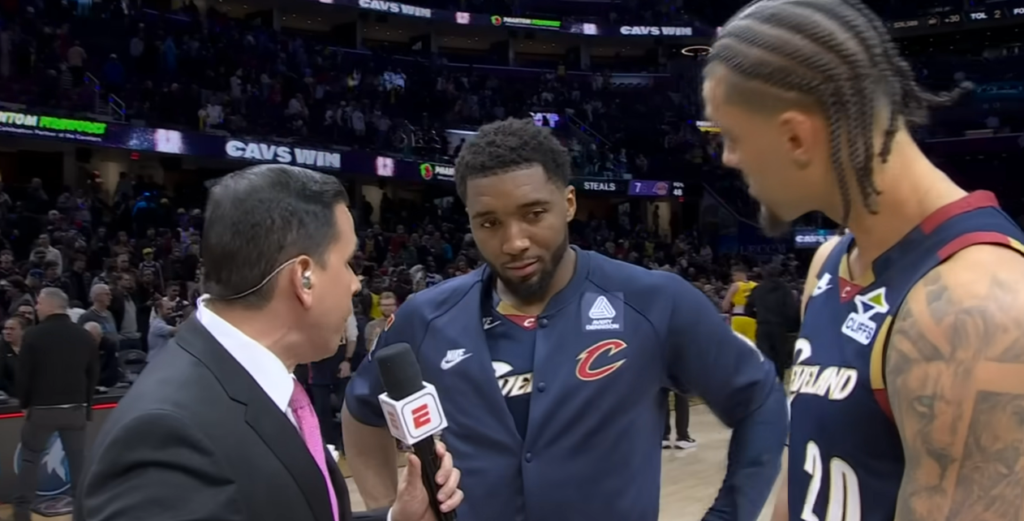
The outcomes on the court happened quickly. With Brewster’s squad, he won two prep school national titles. He participated in the Jordan Brand Classic regional game. He was ranked 27th in the 2015 class by one recruiting service and 43rd by another. In any case, the phone was ringing. The list of universities that called was extensive and included Auburn, Florida, Indiana, UConn, and Marquette. Before declaring for the draft, he committed to Louisville, where he would go on to average 15.6 points per game as a sophomore and be named to the first team of the ACC.
However, one summertime detail is often forgotten. Mitchell played streetball in New York City during the summers at Rucker Park, the renowned Harlem courts where basketball players make or break their reputations in front of irate spectators. He made a dunk that appeared on SportsCenter during an Under Armour event on a basketball court in Brooklyn. Before any official recognition came, he was constructing something, piece by piece.
It’s difficult to ignore how crucial the Brewster years were to everything that came after. The 39-point second half against the Pistons in May 2026 that tied an NBA playoff record, the seven consecutive All-Star selections, the 71-point game against the Bulls in Cleveland—none of it would have happened the same way without that transfer, without that injury, and without his mother’s decision, which at the time probably seemed huge and clear in retrospect. Perhaps the most significant event in Donovan Mitchell’s life was the broken wrist that ended his baseball career. He was simply unaware of it at the time.
