

MIT tends to produce a certain type of person. Not only are they technically proficient, but they are also constitutionally skeptical—trained to challenge presumptions, reject consensus for its own sake, and reach conclusions via a method rather than an emotion. Whether or not Thomas Massie is flattered by that description, it helps to explain him.
Growing up in an Appalachian community in Vanceburg, Kentucky, where his father operated a beer distributorship, Massie’s aspirations weren’t necessarily focused on Cambridge, Massachusetts. However, he was able to attend MIT, where he graduated with a Master of Science in mechanical engineering in 1996 and a Bachelor of Science in electrical engineering in 1993. A study of haptic interfaces and virtual touch through point interaction was the title of his master’s thesis, which most politicians couldn’t even pronounce correctly. He created a technology that allowed users to physically feel digital objects on a screen while still a graduate student. This idea was genuinely innovative at the time and later proved to be beneficial.
He didn’t simply publish the study and go on. In order to commercialize the technology, Massie and his wife Rhonda, who also studied mechanical engineering at MIT, co-founded SensAble Devices Inc. in 1993, the year he completed his bachelor’s degree. In the end, the business secured twenty-four patents, employed seventy people, and raised over thirty-two million dollars in venture capital. In the end, the hardware they created was utilized to create shoes, jewelry, cars, dental prosthetics, and reconstructive implants for injured soldiers. In 2003, he sold the business and went back to Kentucky. Only a man. a farm. Additionally, there seems to be a wide range of views regarding the federal government.
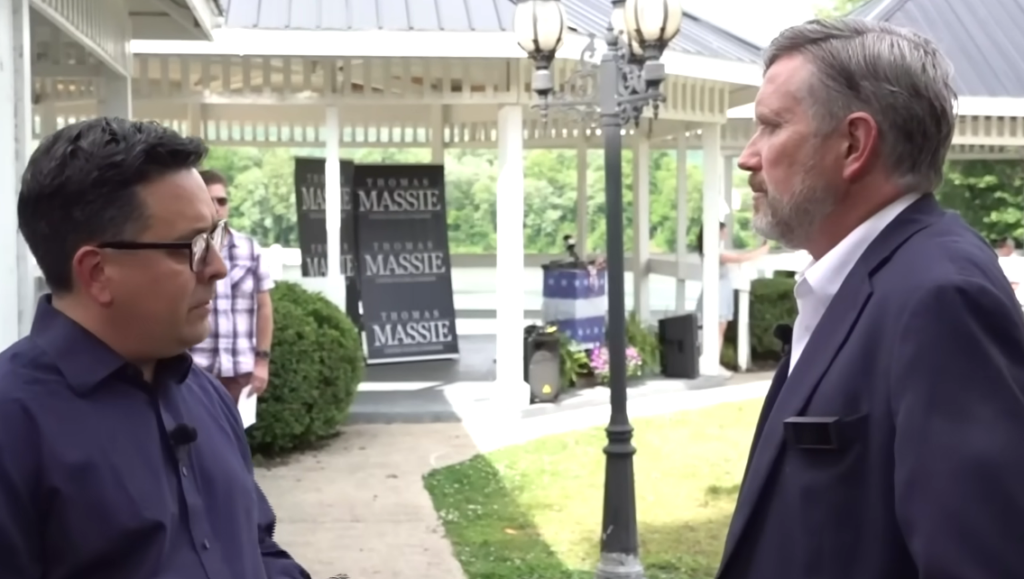
When you consider that background, it’s difficult to ignore the fact that his time in Congress makes more sense. A person who was brought up through law school and local party committees will have a different relationship with Washington than someone who was trained to stress-test systems, built a business from the ground up, and watched it succeed or fail based on real-world outcomes rather than political goodwill. Massie earned the moniker “Mr. No” during his years in the House by repeatedly voting against the Speaker of his own party, opposing measures that passed 412 to 1, and voting present on the Iran nuclear deal when all other Republicans opposed it. That isn’t obstruction in and of itself, or at least it doesn’t feel that way when you look back to someone whose whole intellectual development revolved around the question: does this really work?
He constructed his own home as well. disconnected. utilizing wood and stone that he collected from the property, solar panels, and a repurposed Tesla battery that he modified himself on a cattle farm in Garrison, Kentucky. The man kept submitting patent applications to Congress. Coverage that highlights his most controversial votes often obscures this detail, but it is important. After commencement, the education continued.
It was neither a scandal nor a policy failure that ended his congressional career, at least for the time being. It was a primary. Massie lost to Ed Gallrein, a former Navy SEAL supported by Trump, on May 19, 2026, following the most costly U.S. House primary in American history, with over $32 million spent on advertisements. The race carried the full weight of a sitting president’s political apparatus and drew millions from pro-Israel interest groups. Massie claimed to have “stirred up something” and hinted at a 2028 run during his concession speech.
What Washington does without him is still unknown. Regardless of one’s opinion of his votes, he was genuinely unique—a working engineer in a building full of lawyers, asking questions that were sometimes accurate and sometimes inconvenient. It is difficult to replace that combination, which was developed at MIT and honed on a farm in Kentucky.
