

Suburban neighborhoods now have a certain silence that did not exist twenty years ago. On a Saturday afternoon, you might hear lawnmowers, a dog, and the occasional car as you pass a row of homes. Children are something you don’t hear very often.
Bicycles left sideways on driveways, abandoned lots, and partially constructed tree forts have all diminished. It’s possible that parents have just stopped talking about their children’s whereabouts. However, the data contradicts this. In every nation, children are spending less time outside than any previous generation.
| Information | Detail |
|---|---|
| Topic Focus | Access to nature and outdoor play in early childhood |
| Recommended Daily Outdoor Time (Ages 1–4) | At least 3 hours of physical activity |
| Recommended Daily Activity (Ages 5–17) | Minimum 60 minutes of moderate-to-vigorous movement |
| Key Framework Cited | Australia’s Early Years Learning Framework (EYLF), Outcome 2 |
| Documented Benefit | Children spending 2+ hours outside daily showed 27% more physical activity |
| Notable Risk Factor | Girls, urban children, and minority groups have measurably less outdoor access |
| Linked Mental Health Outcome | Lower stress, fewer ADHD symptoms, better emotional resilience |
| Common Barriers | Screen time, structured schedules, urban density, safety concerns |
This drift has been monitored by researchers for some time, and the results are not encouraging. Compared to boys, girls play outside less. Compared to kids in greener suburbs, kids in crowded urban neighborhoods receive less of it. According to study after study, children from minority backgrounds are underrepresented in green spaces. Additionally, as children get older, outdoor play becomes less and less a part of their everyday lives, primarily replaced by screens and schedules. Teachers feel that something subtly significant is disappearing, and there is disagreement over how to restore it.
This is peculiar because science has gone in the other direction. There is growing evidence that children shouldn’t spend so much time indoors. Unstructured outdoor play has been associated with reduced rates of ADHD symptoms in preschoolers, improved cardiovascular health, a stronger immune system, and improved focus in the classroom. The more time young children spent outside, the less attention problems they displayed, according to a Norwegian study. That is a significant discovery. It’s worth stopping to look at that pattern.
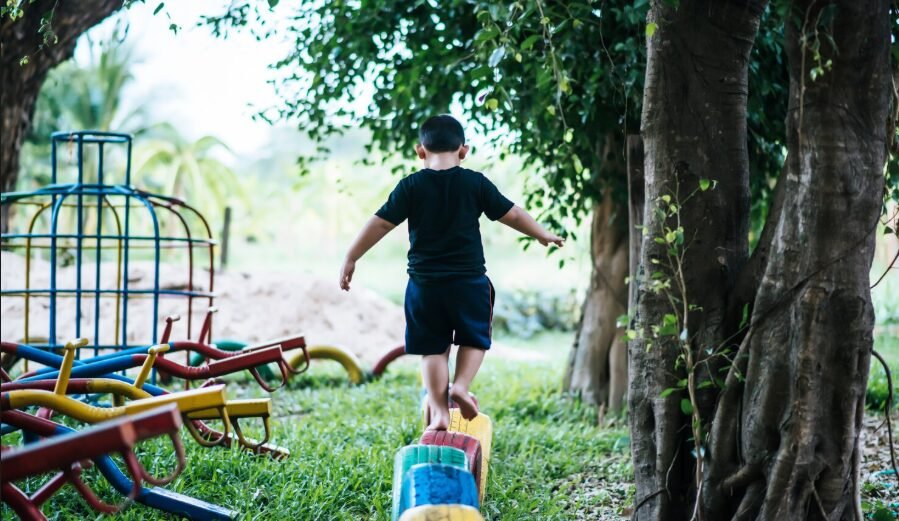
The most straightforward argument for outdoor play is the physical one. Jumping, climbing, and balancing on uneven terrain are not decorative abilities. They develop the gross motor coordination that indoor spaces, no matter how well-designed, are unable to truly duplicate. No plastic toy can match the fine motor control, sensory awareness, and connection to biodiversity that a child who picks up sticks, digs in dirt, and makes mud pies is developing. Children actively sought out interactions with insects, plants, and uneven terrain when given access to wilder outdoor spaces, according to research conducted on nearly 500 families in the United States. There is a desire. Often, the setting is lacking.
Inequality bites at that point. A community garden, a wooded playground, and a backyard aren’t all equally distributed. Some kids see grass primarily through a classroom window, while others grow up climbing trees on a daily basis. Community planners have begun to take this seriously, arguing that it is necessary to incorporate less accessible forms of natural space into the more accessible ones. parks in your pocket. Schoolyards with wild edges. Another question is whether municipalities follow through.
It’s difficult to ignore what’s lost when those moments don’t occur when you watch a four-year-old see a ladybug for the first time—really spot it, crouch over it, and tell anyone nearby about its existence. There is a perception that early childhood education has become very adept at structured learning but far less adept at letting kids spend enough time outside on their own to make their own discoveries. After all, the trees continue to impart knowledge. Whether we continue to send kids to that classroom is the question.
