

Tom Holland‘s journey to this point is truly unique. Not only to Spider-Man and Hollywood, but also to the type of actor who enters a New York City high school full of future Nobel laureates and takes a seat like any other student. His educational journey is not a clear-cut narrative. Along the way, it doubles back on itself, bends, and goes through a few unexpected rooms.
Holland began his early education at Donhead Preparatory School, an all-male Catholic prep school in Wimbledon, after being born in Kingston upon Thames in 1996. He received a dyslexia diagnosis when he was seven years old. Unwilling to let that define him, his parents enrolled him in a private school where he could get the one-on-one attention he required. By most accounts, this was a financial burden for the family. It’s the kind of choice that, while frightening at the time, seems obvious in retrospect.
He eventually enrolled at the BRIT School for Performing Arts and Technology in Croydon after attending Wimbledon College, a Jesuit comprehensive school. Adele, Amy Winehouse, and Jessie J all went through the same hallways at the BRIT School, which has produced an almost ridiculous concentration of British talent. For Holland, it was the point at which his education finally aligned with his true self—a performer, a hands-on learner, and someone who is more alive when moving than when seated at a desk.
However, the education that the majority of people are unaware of originated earlier and in a totally different way. He started taking a hip-hop dance class at Nifty Feet Dance School in Wimbledon when he was nine years old. After seeing a flyer at the school he was visiting, his mother had almost casually signed him up. Everything was altered by that choice—that one tiny, easily overlooked flyer. At a local dance festival, a choreographer saw him. This led to an audition for Billy Elliot the Musical, two years of rigorous training in ballet, tap, and acrobatics, and, at the age of twelve, a leading role on the West End stage.
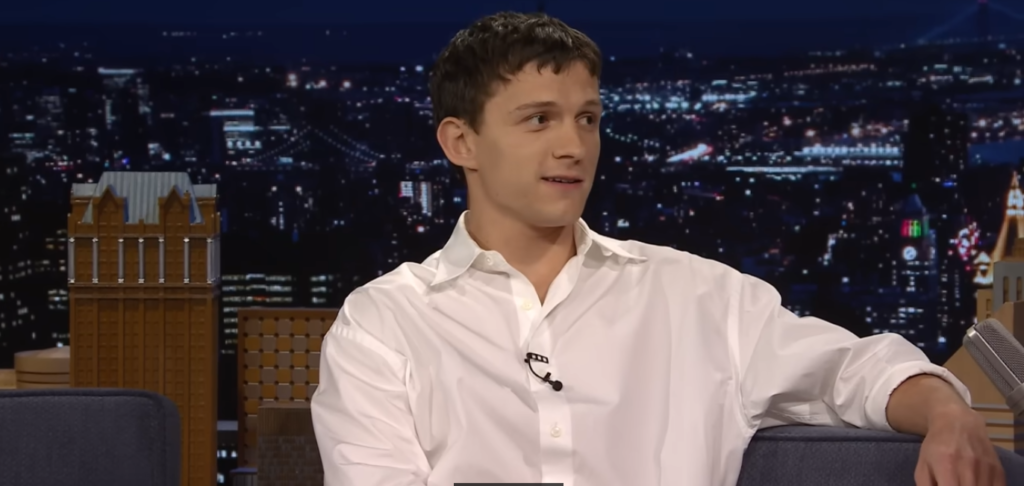
Holland also briefly attended a carpentry school in Cardiff, Wales, when he was a teenager. He had thought about teaching in elementary schools. These qualifications don’t usually appear on superhero casting calls, but they reveal something authentic about a person who was sincerely attempting to find his place in the world.
In order to prepare him for the role of Peter Parker in Spider-Man: Homecoming, Marvel Studios sent him to spend a few days at The Bronx High School of Science in New York, which may have been the most bizarre part of his educational journey. This is not your average school. Neil deGrasse Tyson, an astrophysicist, and eight Nobel Prize winners are among its alumni. Admission requires a high score on a competitive citywide exam. According to reports, most students didn’t think Holland was going to be Spider-Man when he sat in class and wandered the hallways. He later claimed that the experience felt appropriate because no one in the movie thinks Parker is Spider-Man either.
It’s worth stopping to consider that particular detail. This young person, who used to struggle to get through a school day due to bullying and dyslexia, is now sitting in one of America’s most academically demanding high schools, researching a role that would eventually bring in over $1 billion. There is more to the gap between those two points than just professional achievement. It’s a specific type of arc that is not accidental.
He acknowledges that while he was playing Billy Elliot, his GCSE scores declined. It was difficult for him to return to school after maturing more quickly than his peers in a professional setting. There’s a feeling that formal education and Holland were constantly at odds with one another. However, the stage, the dance studios, the BRIT School, and the short carpentry detour all contributed to the development of the physical intelligence, emotional range, and unique instincts that directors continued to notice.
His background in dancing and gymnastics, rather than his grades, was a factor in the Russo brothers’ decision to cast him. Stan Lee claimed that Holland was precisely the right height and age when he had envisioned Peter Parker. It was more of a body of lived experience than a transcript that led him to that position. It was a combination of structured training and actual stumbling, the kind that formal education seldom gives credit for but that life eventually rewards.
