

A certain type of story travels the world and, for some reason, misplaces its passport at the border with the United States. One such tale is the OMEP World Assembly resolution on the education of refugee children. Adopted at the 68th World Assembly and bearing the burden of a real humanitarian crisis—more than half of the world’s school-age refugee children are not attending school, with millions of them under the age of eight—it received significant coverage in forty countries and hardly made an appearance in domestic U.S. media. Not because it wasn’t a true story. Because there were other things on the minds of American news cycles.
Since 1948, OMEP, the World Organization for Early Childhood Education, has operated in this field. Its assembly resolution called for something surprisingly simple: regardless of national boundaries or legal status, every child from birth to age eight should have access to high-quality play and education as a fundamental right. It requested that governments establish safe areas for displaced children to play and learn, train teachers specifically to work with traumatized children, and treat early childhood care as an integral part of a global commitment to human dignity rather than as an optional social service. These concepts are not radical. They have the support of organizations like UNESCO and UNHCR, as well as decades of research. However, the discussion hardly got underway in the United States.
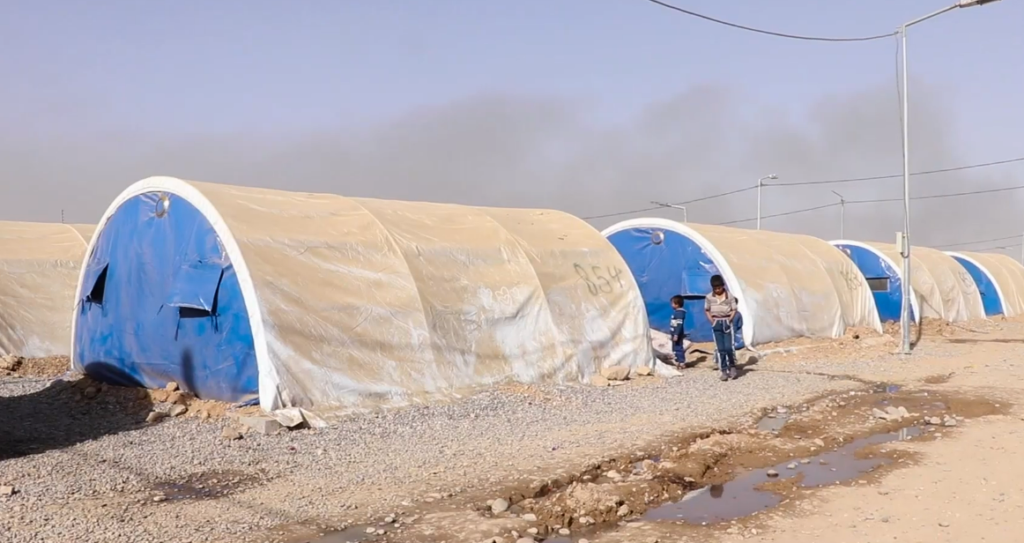
Here, some context is important. The resolution came about at the same time that UNHCR was publishing its own scathing reports on refugee education, which revealed that only 63 percent of refugee children attend primary school, compared to 91 percent worldwide, and that the difference widens to 84 percent globally versus 24 percent for refugees at the secondary level. When children get to college age, the disparity is nearly too disheartening to mention: 3 percent for refugees and 37 percent worldwide. These are not insignificant variations. Alongside the formal educational system that the rest of the world takes for granted, they describe a parallel one that is characterized by exclusion. Over half of all out-of-school refugee children and adolescents were concentrated in just seven countries: Chad, the Democratic Republic of the Congo, Ethiopia, Kenya, Lebanon, Pakistan, and Turkey. Many of them were living in camps that had become their permanent homes.
The resolution’s strength lay in its refusal to view this as someone else’s issue. It presented early childhood education for displaced children as a social justice issue, something that is owed rather than given, rather than as charity. The American media, which was preoccupied with domestic border disputes at the time, found it difficult to accept this framing. The discussion of migration was almost exclusively focused on politics and policy, with remarkably little attention paid to what happens to a five-year-old who misses three years of school and is unable to catch up. OMEP was attempting to discuss that child. The majority of American media outlets were not paying attention.
It’s difficult to ignore the way that silence has gotten worse over time. OMEP has continued this work through subsequent assemblies, such as the 76th in 2024, which advocated for a full UN Decade for Early Childhood Care and Education, and the 77th in Bologna, which adopted a declaration that explicitly identified humanitarian crises and child displacement as ongoing crises requiring innovative and cultural solutions. The fundamental claim that the youngest displaced children are the most vulnerable, the most invisible, and the most important to invest in was present in each of those instances. The international community has attempted to react, albeit inadequately and imperfectly. Funding has been reduced. The advancement has stopped. The figures have deteriorated. Nearly half of the estimated 19 million refugee children worldwide were not enrolled in school at the end of 2024.
Looking at this collection of work, one gets the impression that the authors of these resolutions and declarations are aware that they are fighting against something more significant than apathy: wealthy countries’ structural propensity to attribute refugee crises to other locations, systems, or budgets. This tendency was identified and resisted by the OMEP resolution. As of right now, it’s genuinely unclear if that pushback ever reaches the audiences who need to hear it.
